







Question: Please help!!!! Rogers provided a framework to compare a large number of innovations using a common vocabulary and set of metrics. He defined diffusion as
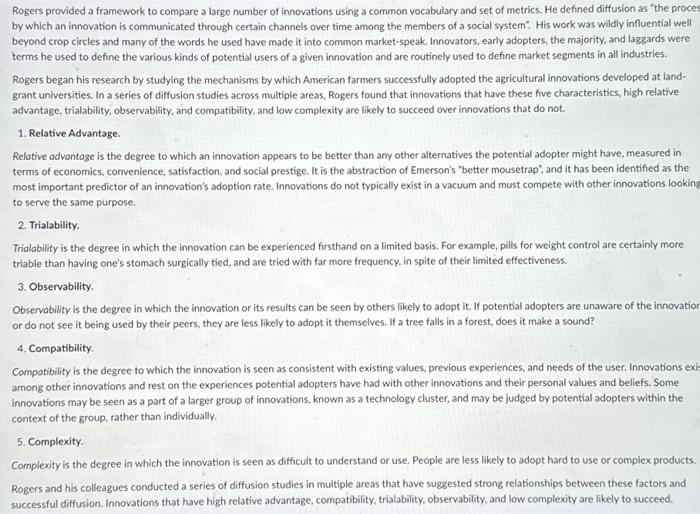
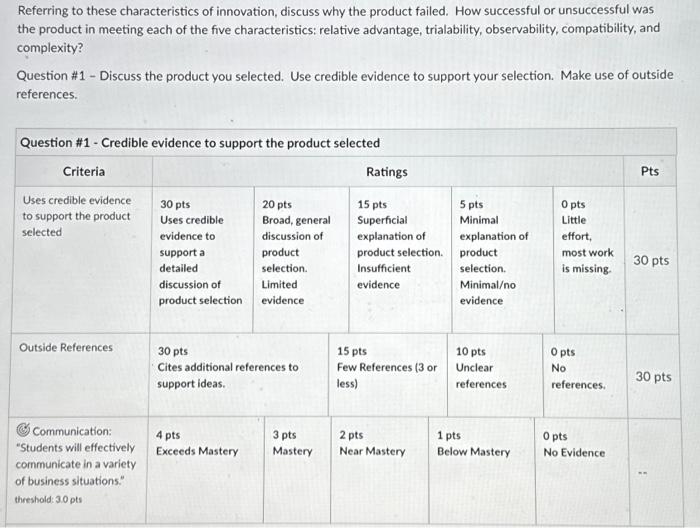
Rogers provided a framework to compare a large number of innovations using a common vocabulary and set of metrics. He defined diffusion as "the proces by which an innovation is communicated through certain channels over time among the members of a social system". His work was wildly influential well beyond crop circles and many of the words he used have made it into common market-speak. Innovators, early adopters, the majority, and laggards were terms he used to define the various kinds of potential users of a given innovation and are routinely used to define market segments in all industries. Rogers began his research by studying the mechanisms by which American farmers successfully adopted the agricultural innovations developed at landgrant universities. In a series of diffusion studies across multiple areas, Rogers found that innovations that have these five characteristics, high relative advantage, trialability, observability, and compatibility, and low complexity are likely to succeed over innovations that do not. 1. Relative Advantage. Relative advantage is the degree to which an innovation appears to be better than any other alternatives the potential adopter might have, measured in terms of economics, convenience, satisfaction, and social prestige. It is the abstraction of Emerson's "better mousetrap", and it has been identified as the most important predictor of an innovation's adoption rate. Innovations do not typically exist in a vacuum and must compete with other innovations looking to serve the same purpose. 2. Trialability. Trialability is the degree in which the innovation can be experienced firsthand on a limited basis. For example, pills for weight control are certainly more triable than having one's stomach surgically tied, and are tried with far more frequency, in spite of their limited effectiveness. 3. Observability. Observability is the degree in which the innovation or its results can be seen by others likely to adopt it. If potential adopters are unaware of the innovation or do not see it being used by their peers, they are less likely to adopt it themselves. If a tree falls in a forest, does it make a sound? 4. Compatibility. Compatibility is the degree to which the innovation is seen as consistent with existing values, previous experiences, and needs of the user. Innovations exi among other innovations and rest on the experiences potential adopters have had with other innovations and their personal values and beliefs. Some innovations may be seen as a part of a larger group of innovations, known as a technology cluster, and may be judged by potential adopters within the context of the group, rather than individually. 5. Complexity. Complexity is the degree in which the innovation is seen as difficult to understand or use. People are less likely to adopt hard to use or complex products. Rogers and his colleagues conducted a series of diffusion studies in multiple areas that have suggested strong relationships between these factors and successful diffusion. Innovations that have high relative advantage, compatibility, trialability, observability, and low complexity are likely to succeed. Referring to these characteristics of innovation, discuss why the product failed. How successful or unsuccessful was the product in meeting each of the five characteristics: relative advantage, trialability, observability, compatibility, and complexity? Question \#1 - Discuss the product you selected. Use credible evidence to support your selection. Make use of outside references
Step by Step Solution
There are 3 Steps involved in it

Get step-by-step solutions from verified subject matter experts
 Study Help