







Question: Please help showing and explaining work Problem set 3: use the following information to answer questions 10-12 (30 points total): 10. Calculate the Y-intercept, a,
Please help showing and explaining work
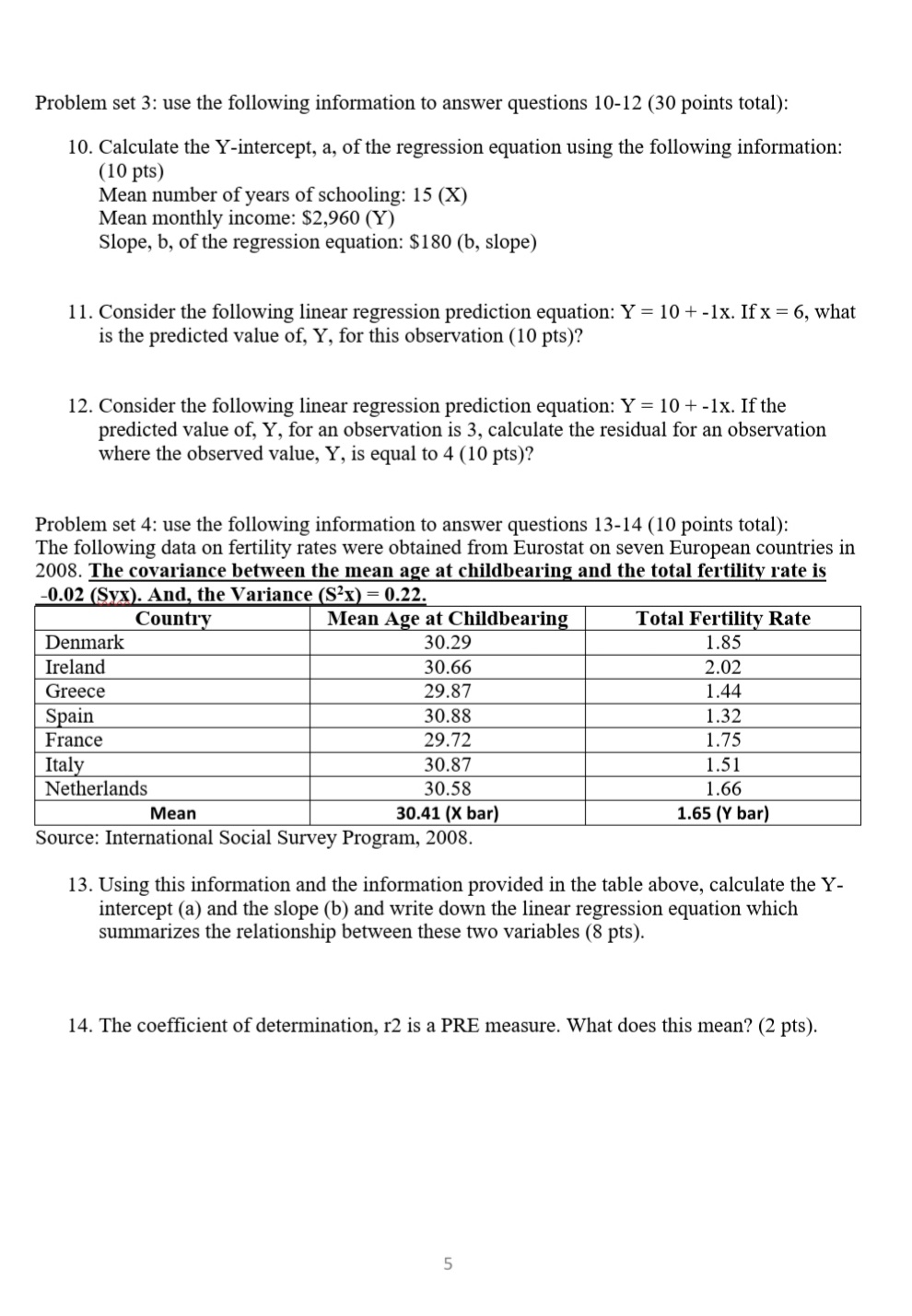
Problem set 3: use the following information to answer questions 10-12 (30 points total): 10. Calculate the Y-intercept, a, of the regression equation using the following information: (10 pts} Mean number of years of schooling: 15 (X) Mean monthly income: $2,960 (Y) Slope, b, of the regression equation: $180 (b, slope) 11. Consider the following linear regression prediction equation: Y = 10 + - In. If X = 6, what is the predicted value of, Y, for this observation (10 pts)? 12. Consider the following linear regression prediction equation: Y = 10 + -1x. If the predicted value of, Y, for an observation is 3, calculate the residual for an observation where the observed value, Y, is equal to 4 (10 pts)? Problem set 4: use the following information to answer questions 13-14 (10 points total): The following data on fertility rates were obtained from Eurostat on seven European countries in 2008. The covariance between the mean age at childbearing and the total fertility rate is 41.02 ,, a. . And the Variance $1: = 0.22. Conn Mean A 1 e at Childbearin Total Fertlll Rate Denmark 30.29 1.85 Ireland 30.66 2.02 Greece 29.87 1 .44 S ain 30.88 1.32 France 29.72 1.75 Ital 30.87 1.51 Netherlands 30.5 8 1 .66 Mean 30.41 or bar) 1.65 (Y bar] Source: International Social Survey Program, 2008. 13. Using this information and the information provided in the table above, calculate the Y- intercept (a) and the slope (b) and write down the linear regression equation which summarizes the relationship between these two variables (8 pts). 14. The coefficient of determination, r2 is a PRE measure. What does this mean? (2 pts). \f
Step by Step Solution
There are 3 Steps involved in it

Get step-by-step solutions from verified subject matter experts
 Study Help