







Question: Please help solve this Computer Science (cryptography) problem. Thanks! Exercise 1. Pseudorandom Functions [30 points] Let F 10, 1) -> [0,1j be a pseu- dorandom
Please help solve this Computer Science (cryptography) problem. Thanks!
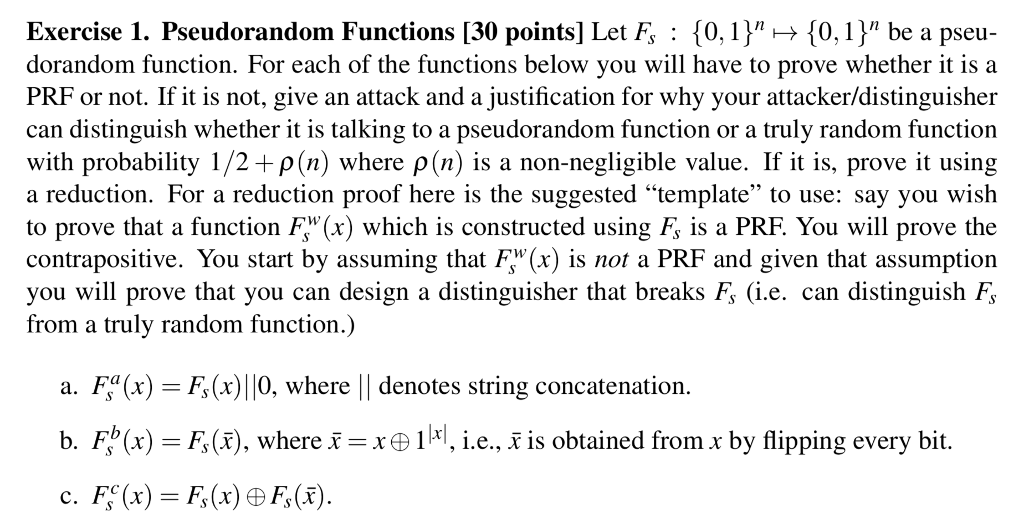
Exercise 1. Pseudorandom Functions [30 points] Let F 10, 1)" -> [0,1j" be a pseu- dorandom function. For each of the functions below vou will have to prove whether it is a PRF or not. If it is not, give an attack and a justification for why your attacker/distinguisher can distinguish whether it is talking to a pseudorandom function or a truly random function with probability 1/2+(n) where (n) is a non-negligible value. If it is, prove it using a reduction. For a reduction proof here is the suggested "template" to use: say you wish to prove that a function F"(x) which is constructed using F is a PRF. You will prove the contrapositive. You start by assuming that F"(x) is not a PRF and given that assumption you will prove that you can design a distinguisher that breaks Fs (i.e. can distinguish Fs from a truly random function.) a. F, (x) = F, (x)110, where I denotes string concatenation b. F,,, (x) F,() , where x-x91lxl, i.e., x is obtained from x by flipping every bit Exercise 1. Pseudorandom Functions [30 points] Let F 10, 1)" -> [0,1j" be a pseu- dorandom function. For each of the functions below vou will have to prove whether it is a PRF or not. If it is not, give an attack and a justification for why your attacker/distinguisher can distinguish whether it is talking to a pseudorandom function or a truly random function with probability 1/2+(n) where (n) is a non-negligible value. If it is, prove it using a reduction. For a reduction proof here is the suggested "template" to use: say you wish to prove that a function F"(x) which is constructed using F is a PRF. You will prove the contrapositive. You start by assuming that F"(x) is not a PRF and given that assumption you will prove that you can design a distinguisher that breaks Fs (i.e. can distinguish Fs from a truly random function.) a. F, (x) = F, (x)110, where I denotes string concatenation b. F,,, (x) F,() , where x-x91lxl, i.e., x is obtained from x by flipping every bit
Step by Step Solution
There are 3 Steps involved in it

Get step-by-step solutions from verified subject matter experts
 Study Help