







Question: Please help solve this statistics problem, please provide detailed working out for the parts, thanks! Let U1, U2, , U be independent and identically distributed
Please help solve this statistics problem, please provide detailed working out for the parts, thanks!
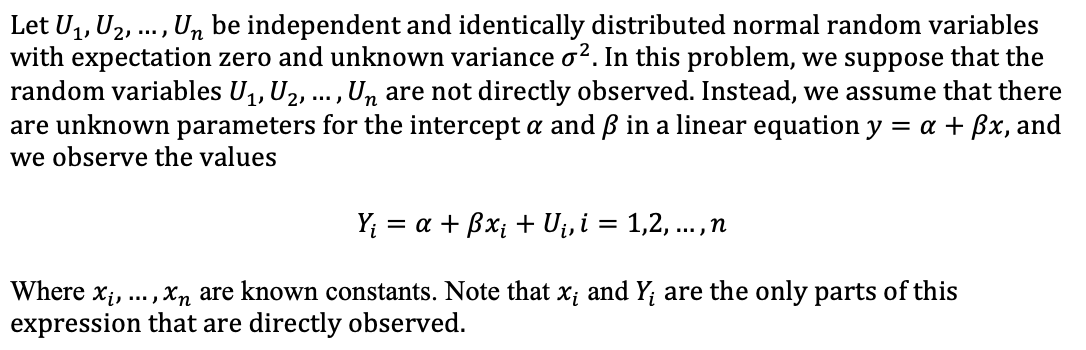
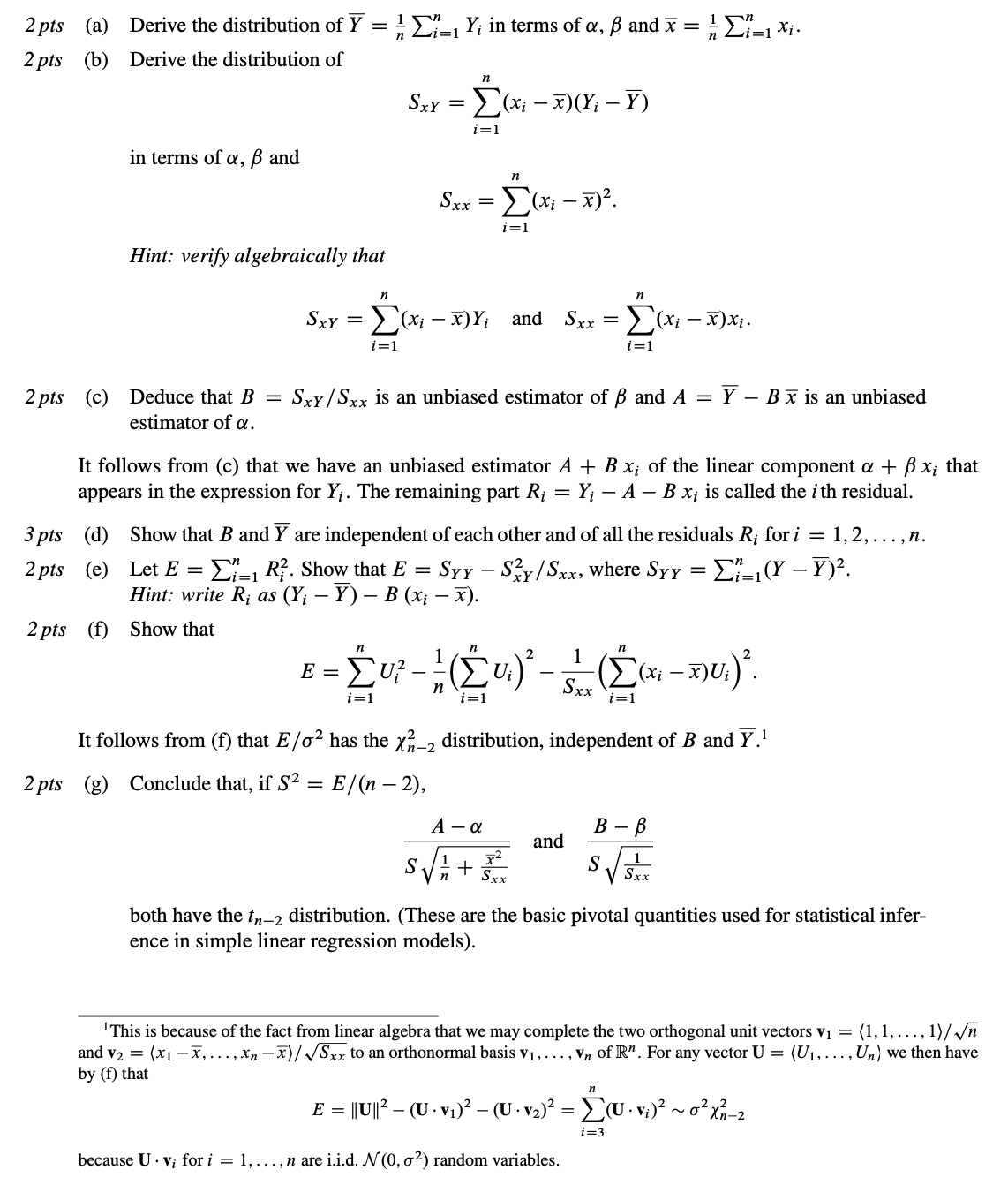
Let U1, U2, , U\" be independent and identically distributed normal random variables with expectation zero and unknown variance 0'2. In this problem, we suppose that the random variables U1, U2, , U" are not directly observed. Instead, we assume that there are unknown parameters for the intercept a: and [3 in a linear equation y = a: + x, and we observe the values Yi = a+xi + Ubi = 1,2,...,n Where xi, , xn are known constants. Note that xi and Y} are the only parts of this expression that are directly observed. 2 pts (a) Derive the distribution of Y = _ _ _, Y; in terms of a, B and x = , Zi=1 Xi. 2pts (b) Derive the distribution of SxY = _ ( x - x ) ( Y, - Y) i= 1 in terms of a, B and Sxx = (xi - x)2. 1=1 Hint: verify algebraically that SXY _(xi - x) Y; and Sxx = [(xi - x)xi. 1= 1 1= 1 2pts (c) Deduce that B = SxY / Sxx is an unbiased estimator of S and A = Y - B x is an unbiased estimator of a. It follows from (c) that we have an unbiased estimator A + B x; of the linear component a + B x; that appears in the expression for Yi. The remaining part R, = Y; - A - B x; is called the ith residual. 3pts (d) Show that B and Y are independent of each other and of all the residuals R; fori = 1, 2, ..., n. 2pts (e) Let E = E_1 R7. Show that E = Syy - Sky / Sxx, where SyY = Et, (Y - Y)2. Hint: write R; as (Y; - Y) - B (x; - X). 2 pts (f) Show that E = EU? - "(EU:)' It follows from (f) that E/o2 has the X-2 distribution, independent of B and Y.! 2pts (g) Conclude that, if $2 = E/(n - 2), A - a B - B and SVits SV SIX both have the tn-2 distribution. (These are the basic pivotal quantities used for statistical infer- ence in simple linear regression models). This is because of the fact from linear algebra that we may complete the two orthogonal unit vectors v1 = (1, 1,..., 1) / n and v2 = (x1 -x, .. ., Xn - x) /VSxx to an orthonormal basis v1, . .., Vn of " . For any vector U = (U1, . .., Un) we then have by (f) that E = 1012 - (U . v1)2 - (U. v2)2 = (U. vi)2 ~02 xn-2 because U . V; for i = 1, ..., n are i.i.d. N(0, 02) random variables
Step by Step Solution
There are 3 Steps involved in it

Get step-by-step solutions from verified subject matter experts
 Study Help