







Question: Please help step by step to UNDERSTAND the process The flow through an artificial kidney is described by three dimensionless groups: Re (pvd/u), Eu (Ap/vp),
Please help step by step to UNDERSTAND the process
The flow through an artificial kidney is described by three dimensionless groups: Re (pvd/u), Eu (Ap/vp), and the reduced length (1/d). Use these groups to design a model for flow through an artificial kidney. In this hypothetical artificial kidney, blood (density - 1,000 kg/m' and viscosity = 1.0 x10 Pa-s) is pumped through 10 m of tubing of diameter 0.0010 m. The average velocity of the blood is 0.010 m/s. For a model using glycerin (density - 1,260 kg/m' and viscosity = 1.49 Pa-s) flowing through a tube of diameter 0.0050 m; a. What length of tube do we need for the model system? b. What should be the average velocity of the glycerin in our model system? Determine the model to prototype pressure drop ratio (Apmodel/
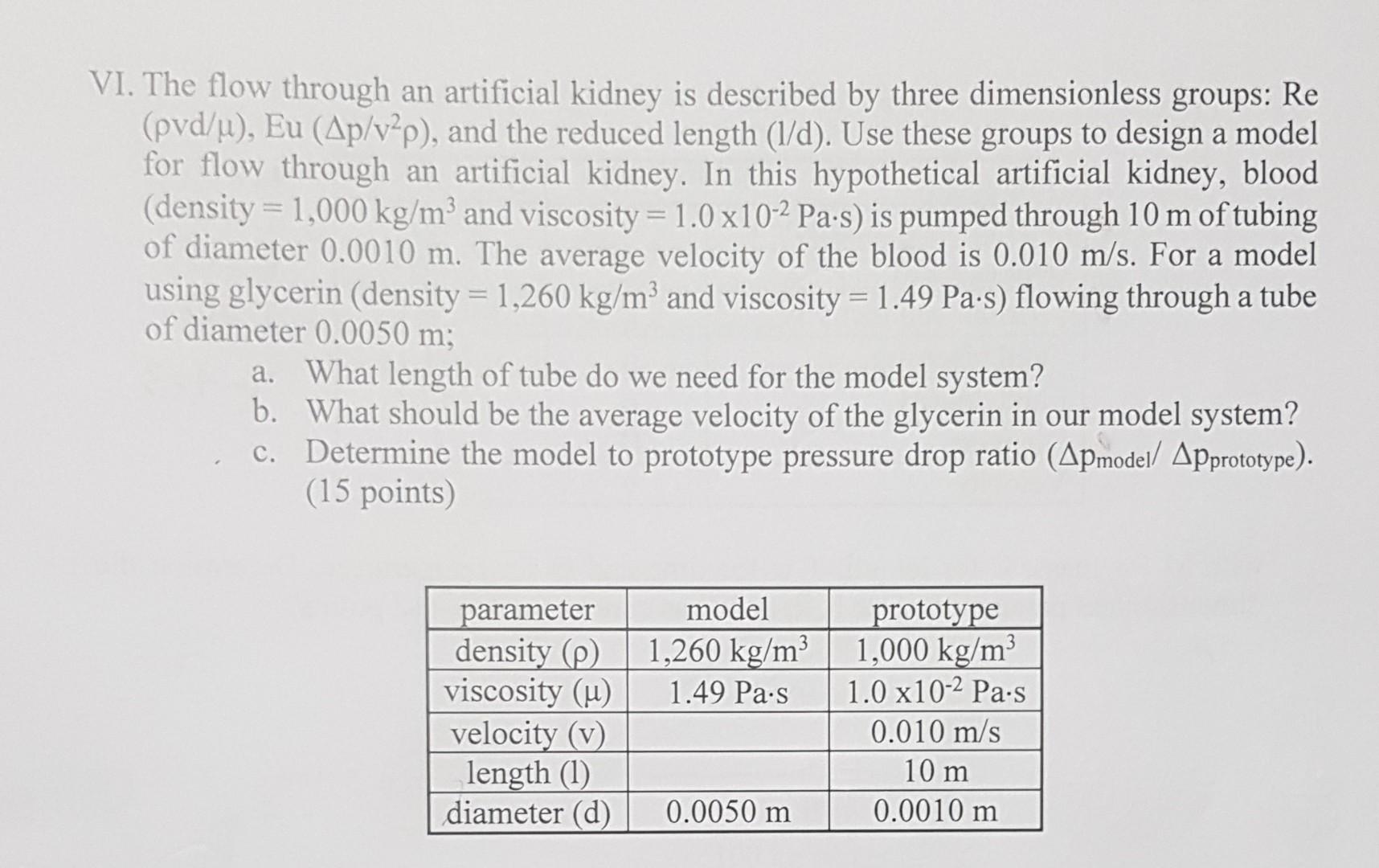
Apprototype) c. Determine the model to prototype pressure drop ratio (Apmodel/ Apprototype).
VI. The flow through an artificial kidney is described by three dimensionless groups: Re (vd/),Eu(p/v2), and the reduced length (1/d). Use these groups to design a model for flow through an artificial kidney. In this hypothetical artificial kidney, blood (density =1,000kg/m3 and viscosity =1.0102Pas) is pumped through 10m of tubing of diameter 0.0010m. The average velocity of the blood is 0.010m/s. For a model using glycerin (density =1,260kg/m3 and viscosity =1.49Pas ) flowing through a tube of diameter 0.0050m; a. What length of tube do we need for the model system? b. What should be the average velocity of the glycerin in our model system? c. Determine the model to prototype pressure drop ratio (pmodel/pprototype). (15 points)
Step by Step Solution
There are 3 Steps involved in it

Get step-by-step solutions from verified subject matter experts
 Study Help