







Question: Please help the correct answer for these multiple chooce Name: Version 2 Part 1: Multiple Choice (12 points each) 1. A worker currently earns $60k
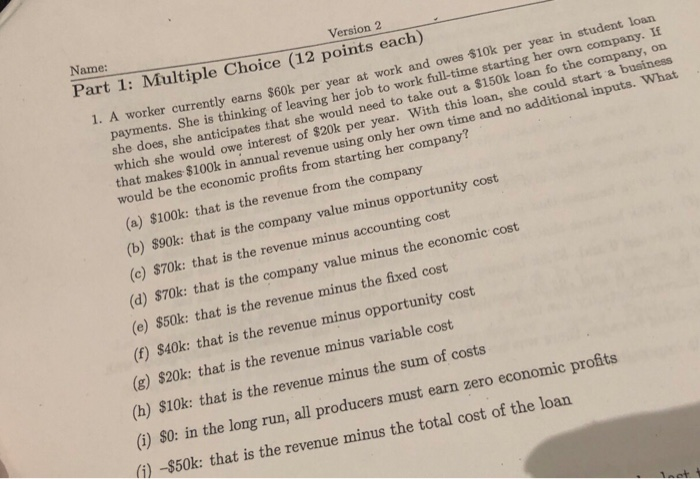
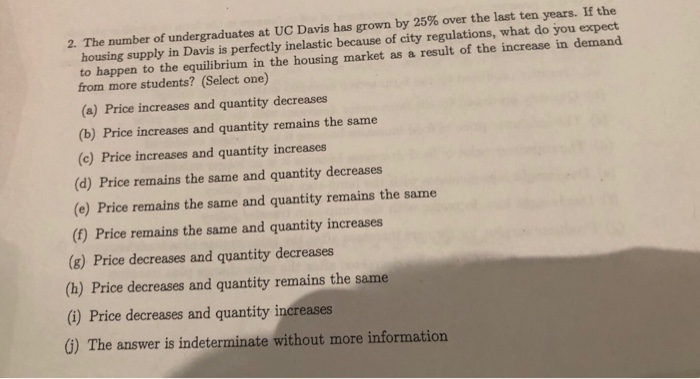
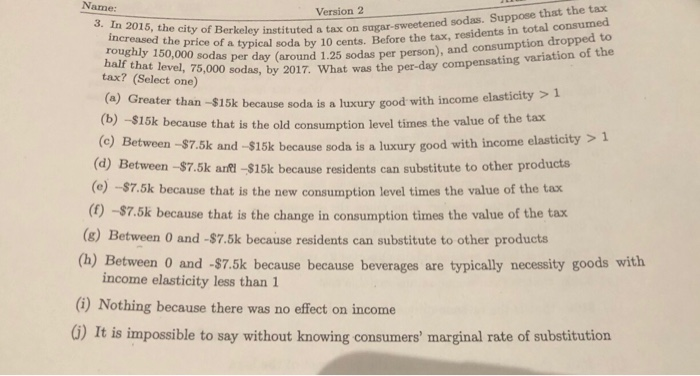
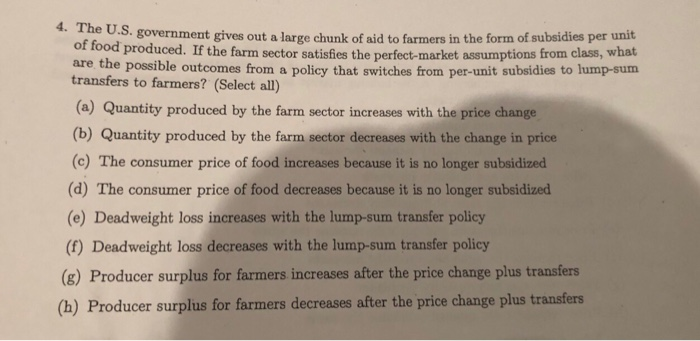
Name: Version 2 Part 1: Multiple Choice (12 points each) 1. A worker currently earns $60k per year at work and owes $10k per year in student loan If payments. She is thinking of leaving her job to work full-time starting her own company. she does, she anticipates that she would need to take out a $150k loan fo the company, on which she would owe interest of $20k per year. With this loan, she could start a business that makes $100k in annual revenue using only her own time and no additional in would be the economic profits from starting her company? puts. What (a) S100k: that is the revenue from the company (b) 890k: that is the company value minus opportunity cost (c) S70k: that is the revenue minus accounting cost (d) $70k: that is the company value minus the economic cost (e) $50k: that is the revenue minus the fixed cost (f) S40k: that is the revenue minus opportunity cost (g) $20k: that is the revenue minus variable cost (h) S10k: that is the revenue minus the sum of costs (i) S0: in the long run, all producers must earn zero economic proits (i) -$50k: that is the revenue minus the total cost of the loan number of undergraduates at UC Davis has grown by 25% over the last ten years. If the housing supply in Davis is perfectly inelastic because of city regulations, what do you expect to happen to the equilibrium from more students? (Select one) in the housing market as a result of the increase in demand (a) Price increases and quantity decreases (b) Price increases and quantity remains the same (c) Price increases and quantity increases (d) Price remains the same and quantity decreases (e) Price remains the same and quantity remains the same (f) Price remains the same and quantity increases (g) Price decreases and quantity decreases (h) Price decreases and quantity remains the same (G) Price decreases and quantity increases G) The answer is indeterminate without more information Name: a tax on sugar-sweetened sodas. Suppose that the tax soda by 10 cents. Before the tax, residents in total consumed as per day (around 1.25 sodas per person), and consumption dropped to 000 sodas, by 2017. What was the per-day compensating variation of the Version 2 3. In 2015, the city of Berkeley instituted increased the price of a typical roughly 150,000 sod half that level, 75, tax? (Select one) 10 cents. (a) Greater than -$15k because soda is a luxury good with income (b) -$15k because that is the old consumption level times the value of the tax (c) Between -S7.5k and -$15k because soda is a luxury good elasticity > 1 with income elasticity >1 (d) Between -$7.5k arti -$15k because residents can substitute to other products (e) -$7.5k because that is the new consumption level times the value of the tax ()-$7.5k because that is the change in consumption times the value of the tax (g) Between 0 and -S7.5k because residents can substitute to other products (h) Between 0 and -$7.5k because because beverages are typically necessity goods with 6) Nothing because there was no effect on income G) It is impossible to say without knowing consumers' marginal rate of substitution income elasticity less than 1 4. The U.s. government gives out a large chunk of aid to farmers in the form of subsidies per unit of food produced. If the farm sector satisfies the perfect-market assumptions from class, what are the possible outcomes from a policy that switches from per-unit subsidies to lump-sum transfers to farmers? (Select all) (a) Quantity produced by the farm sector increases with the price change (b) Quantity produced by the farm sector decreases with the change in price (c) The consumer price of food increases because it is no longer subsidized (d) The consumer price of food decreases because it is no longer subsidized (e) Deadweight loss increases with the lump-sum transfer policy (f) Deadweight loss decreases with the lump-sum transfer policy (g) Producer surplus for farmers increases after the price change plus transfers (h) Producer surplus for farmers decreases after the price change plus transfers
Step by Step Solution
There are 3 Steps involved in it

Get step-by-step solutions from verified subject matter experts
 Study Help