



Question: Please help The first part is listed in the picture. The second part is below. Exercise 15.2-2: Matrix Chain Multiplication Give a recursive algorithm MATRIX_CHAIN_MULTIPLY
Please help
The first part is listed in the picture.
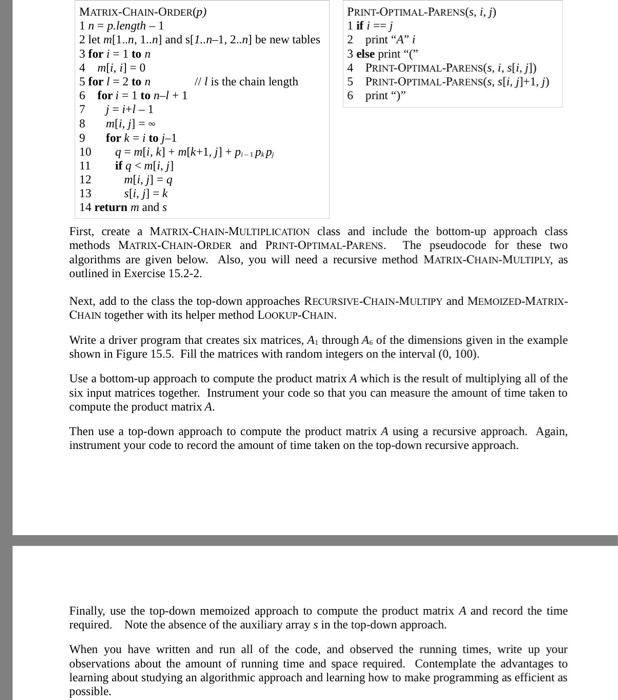
MATRIX-CHAIN-ORDER(p) PRINT-OPTIMAL-PARENS(s, i, ln p length -1 2 let ml1.n, 1., n] and s[1..n-1, 2., n] be new tables 2 print "A" i for 3 else print to 4 mli, i 30 4 PRINT-OPTIMAL PARENS(s, i, sli, jl) 5 for 2 to n //lis the chain length 5 PRINT-OPTIMAL-PARENS(s, sli, jl+1,j) 6 for i 1 to n-1 1 6 print m i, j] 9 for j-1 10 11 if q mli, j] 12 13 14 return m and s First, create a MATRIX-CHAIN-M class and include the bottom-up approach class ULTIPLICATION methods MATRIX-CHAIN-ORDER and PRINT-OPTIMAL-PARENS. The pseudocode for these two algorithms are given below. Also, you will need a recursive method MATRIX-CHAIN-MULTIPLY, as outlined in Exercise 15.2-2. Next, add to the class the top-down approaches RECURSIVE-CHAIN-MULTIPY and MEMOLzED-MATRIx- CHAIN together with its helper method LooKUP-CHAIN. Write a driver program that creates six matrices, Al through As of the dimensions given in the example shown in Figure 15.5. Fill the matrices with random integers on the interval (0, 100). Use a bottom-up approach to compute the product matrix A which is the result of multiplying all of the six input matrices together. Instrument your code so that you can measure the amount of time taken to compute the product matrix A Then use a top-down approach to compute the product matrix A using a recursive approach. Again, instrument your code to record the amount of time taken on the top-down recursive approach. Finally, use the top-down memoized approach to compute the product matrix A and record the time required Note the absence of the auxiliary array s in the top-down approach. When you have written and run all of the code, and observed the running times, write up your observations about the amount of running time and space required. Contemplate the advantages to learning about studying an algorithmic approach and learning how to make programming as efficient as possible
Step by Step Solution
There are 3 Steps involved in it

Get step-by-step solutions from verified subject matter experts