







Question: Please help, this is all one problem. Consider the Solow-Swan growth model, with a savings rate, s, a depreciation rate, , and a population growth
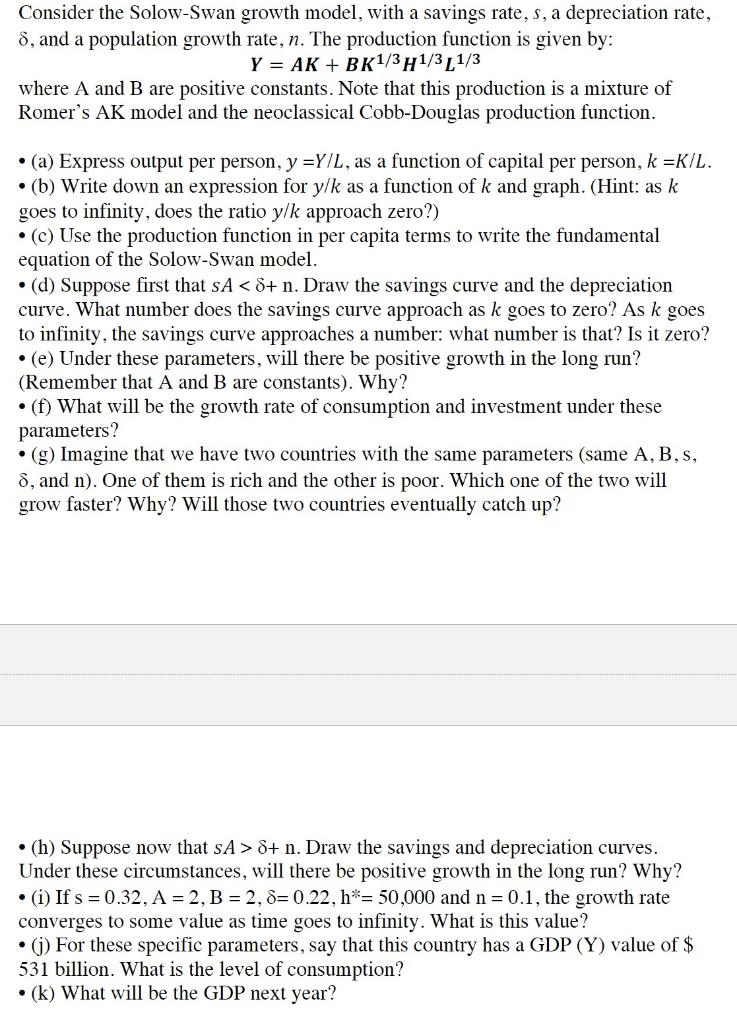
Please help, this is all one problem.
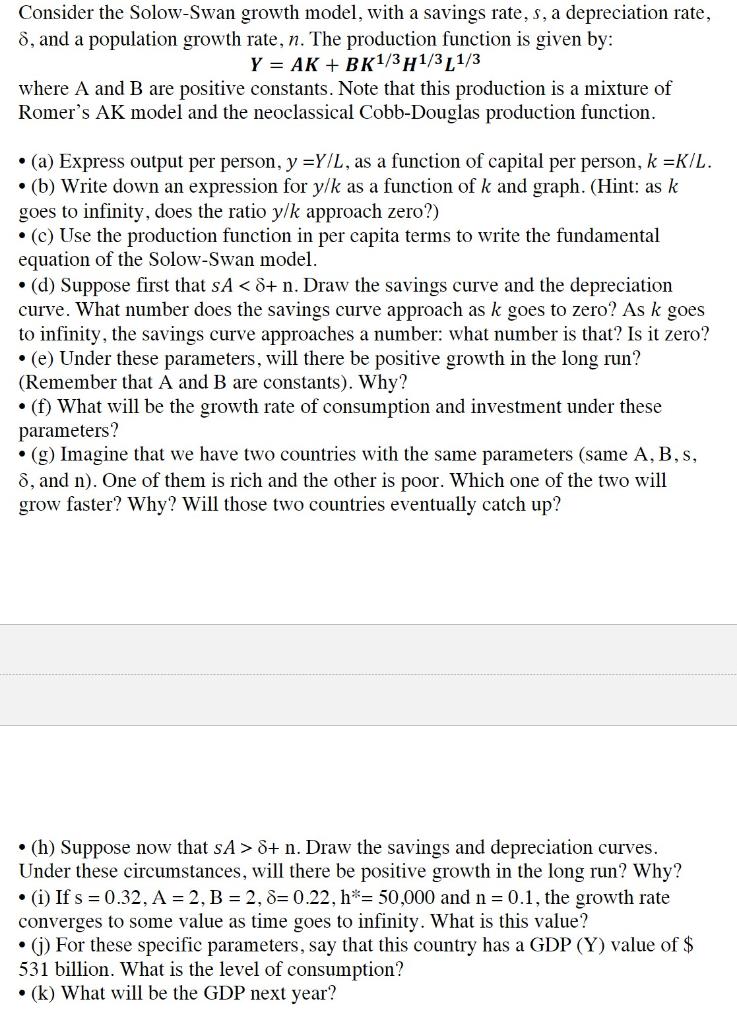
Consider the Solow-Swan growth model, with a savings rate, s, a depreciation rate, , and a population growth rate, n. The production function is given by: Y=AK+BK1/3H1/3L1/3 where A and B are positive constants. Note that this production is a mixture of Romer's AK model and the neoclassical Cobb-Douglas production function. - (a) Express output per person, y=Y/L, as a function of capital per person, k=K/L. - (b) Write down an expression for y/k as a function of k and graph. (Hint: as k goes to infinity, does the ratio y/k approach zero?) - (c) Use the production function in per capita terms to write the fundamental equation of the Solow-Swan model. - (d) Suppose first that SA+n. Draw the savings and depreciation curves. Under these circumstances, will there be positive growth in the long run? Why? - (i) If s=0.32,A=2,B=2,=0.22,h=50,000 and n=0.1, the growth rate converges to some value as time goes to infinity. What is this value? - (j) For these specific parameters, say that this country has a GDP (Y) value of \$ 531 billion. What is the level of consumption? - (k) What will be the GDP next year? Consider the Solow-Swan growth model, with a savings rate, s, a depreciation rate, , and a population growth rate, n. The production function is given by: Y=AK+BK1/3H1/3L1/3 where A and B are positive constants. Note that this production is a mixture of Romer's AK model and the neoclassical Cobb-Douglas production function. - (a) Express output per person, y=Y/L, as a function of capital per person, k=K/L. - (b) Write down an expression for y/k as a function of k and graph. (Hint: as k goes to infinity, does the ratio y/k approach zero?) - (c) Use the production function in per capita terms to write the fundamental equation of the Solow-Swan model. - (d) Suppose first that SA+n. Draw the savings and depreciation curves. Under these circumstances, will there be positive growth in the long run? Why? - (i) If s=0.32,A=2,B=2,=0.22,h=50,000 and n=0.1, the growth rate converges to some value as time goes to infinity. What is this value? - (j) For these specific parameters, say that this country has a GDP (Y) value of \$ 531 billion. What is the level of consumption? - (k) What will be the GDP next year
Step by Step Solution
There are 3 Steps involved in it

Get step-by-step solutions from verified subject matter experts
 Study Help