Question: Please help this the link for the video : https://www.youtube.com/watch?v=TMQdGqQuY5w Reference: Watch the video httpswwwyoutube.com/watch?v=TMQdGunY5w Sir Isaac Newton stated three basic laws of motion. The

Please help this the link for the video : https://www.youtube.com/watch?v=TMQdGqQuY5w
Please help this the link for the video :Please help this the link for the video :
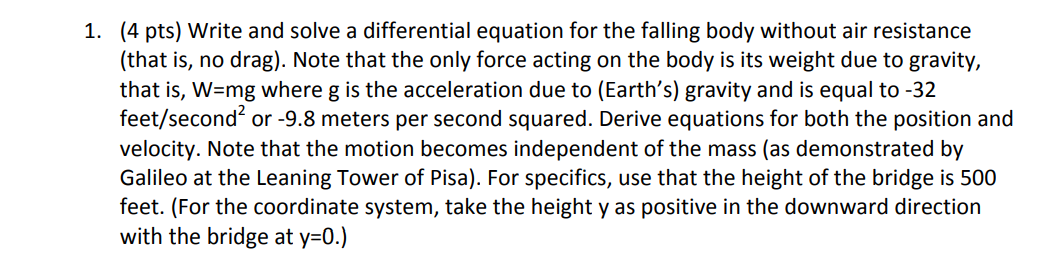
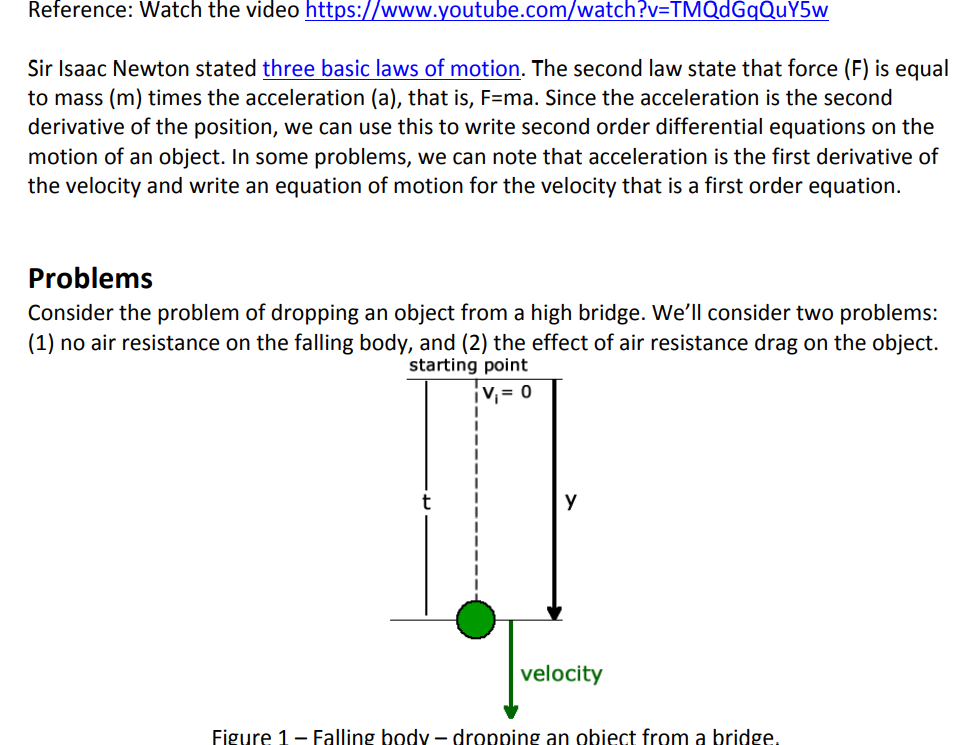
Reference: Watch the video httpswwwyoutube.com/watch?v=TMQdGunY5w Sir Isaac Newton stated three basic laws of motion. The second law state that force (F) is equal to mass (m) times the acceleration (a), that is, F=ma. Since the acceleration is the second derivative of the position, we can use this to write second order differential equations on the motion of an object. In some problems, we can note that acceleration is the first derivative of the velocity and write an equation of motion for the velocity that is a first order equation. Problems Consider the problem of dropping an object from a high bridge. We'll consider two problems: (1) no air resistance on the falling body, and (2) the effect of air resistance drag on the object. starting point IVI= D I I I I I i t I I I I I I velocity Figure 1 Falling hodv dropping an ohiect from a bridge. 1. (4 pts) Write and solve a differential equation for the falling body without air resistance (that is, no drag). Note that the onlyr force acting on the body is its weight due to gravity, that is, W=mg where g is the acceleration due to (Earth's) gravity and is equal to -32 feet/second2 or -9.8 meters per second squared. Derive equations for both the position and velocity. Note that the motion becomes independent of the mass (as demonstrated by Galileo at the Leaning Tower of Pisa). For specifics, use that the height of the bridge is 500 feet. (For the coordinate system, take the height y as positive in the downward direction with the bridge at y=0.)

Step by Step Solution

There are 3 Steps involved in it

1 Expert Approved Answer
Step: 1 Unlock blur-text-image

Question Has Been Solved by an Expert!

Get step-by-step solutions from verified subject matter experts

Step: 2 Unlock
Step: 3 Unlock

Students Have Also Explored These Related Mathematics Questions!