







Question: Please help Urgent! 10. Problem 7.10 (Current Yield, Capital Gains Yield, and Yield to Maturity) ER eBook Problem Walk-Through Pelzer Printing Inc. has bonds outstanding
 Please help Urgent!
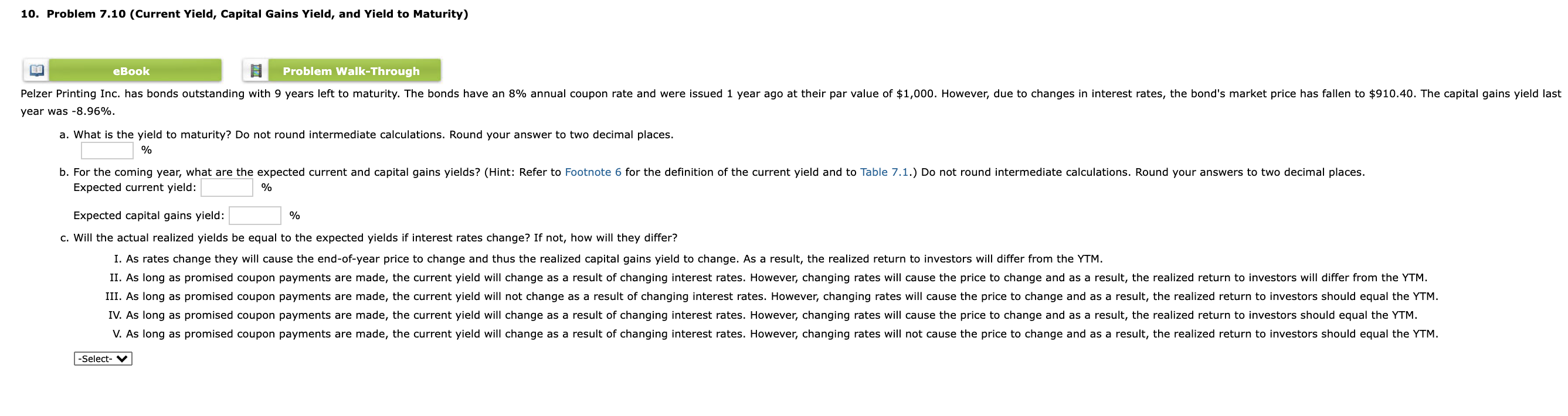
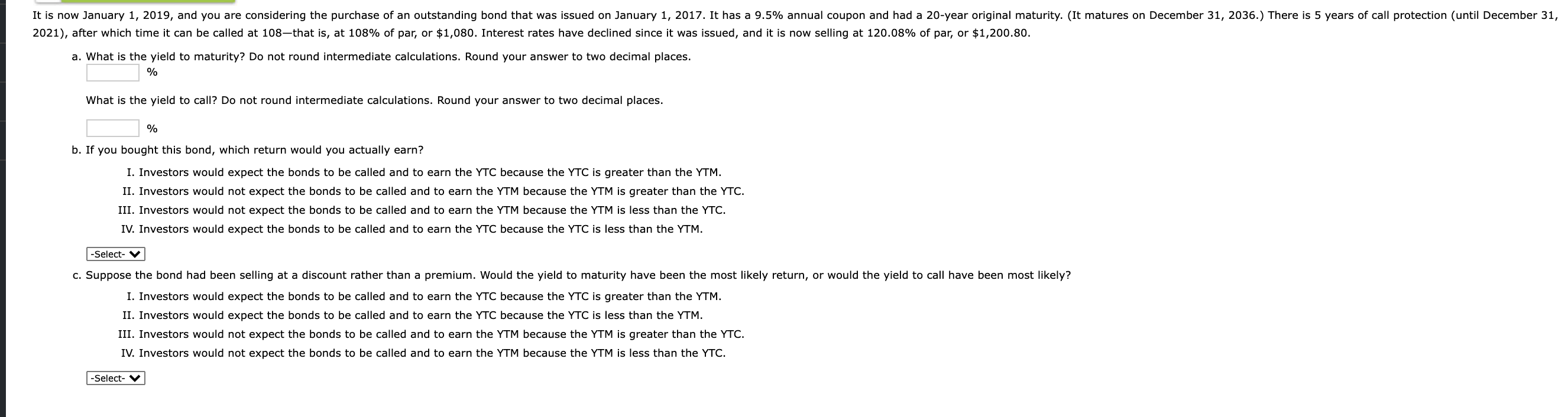
10. Problem 7.10 (Current Yield, Capital Gains Yield, and Yield to Maturity) ER eBook Problem Walk-Through Pelzer Printing Inc. has bonds outstanding with 9 years left to maturity. The bonds have an 8% annual coupon rate and were issued 1 year ago at their par value of $1,000. However, due to changes in interest rates, the bond's market price has fallen to $910.40. The capital gains yield last year was -8.96%. a. What is the yield to maturity? Do not round intermediate calculations. Round your answer to two decimal places. % b. For the coming year, what are the expected current and capital gains yields? (Hint: Refer to Footnote 6 for the definition of the current yield and to Table 7.1.) Do not round intermediate calculations. Round your answers to two decimal places. Expected current yield: % Expected capital gains yield: % c. Will the actual realized yields be equal to the expected yields if interest rates change? If not, how will they differ? I. As rates change they will cause the end-of-year price to change and thus the realized capital gains yield to change. As a result, the realized return to investors will differ from the YTM. II. As long as promised coupon payments are made, the current yield will change as a result of changing interest rates. However, changing rates will cause the price to change and as a result, the realized return to investors will differ from the YTM. III. As long as promised coupon payments are made, the current yield will not change as a result of changing interest rates. However, changing rates will cause the price to change and as a result, the realized return to investors should equal the YTM. IV. As long as promised coupon payments are made, the current yield will change as a result of changing interest rates. However, changing rates will cause the price to change and as a result, the realized return to investors should equal the YTM. V. As long as promised coupon payments are made, the current yield will change as a result of changing interest rates. However, changing rates will not cause the price to change and as a result, the realized return to investors should equal the YTM. -Select- It is now January 1, 2019, and you are considering the purchase of an outstanding bond that was issued on January 1, 2017. It has a 9.5% annual coupon and had a 20-year original maturity. (It matures on December 31, 2036.) There is 5 years of call protection (until December 31, 2021), after which time it can be called at 108that is, at 108% of par, or $1,080. Interest rates have declined since it was issued, and it is now selling at 120.08% of par, or $1,200.80. a. What is the yield to maturity? Do not round intermediate calculations. Round your answer to two decimal places. % What is the yield to call? Do not round intermediate calculations. Round your answer to two decimal places. % b. If you bought this bond, which return would you actually earn? I. Investors would expect the bonds to be called and to earn the YTC because the YTC is greater than the YTM. II. Investors would not expect the bonds to be called and to earn the YTM because the YTM is greater than the YTC. III. Investors would not expect the bonds to be called and to earn the YTM because the YTM is less than the YTC. IV. Investors would expect the bonds to be called and to earn the YTC because the YTC is less than the YTM. -Select- c. Suppose the bond had been selling at a discount rather than a premium. Would the yield to maturity have been the most likely return, or would the yield to call have been most likely? I. Investors would expect the bonds to be called and to earn the YTC because the YTC is greater than the YTM. II. Investors would expect the bonds to be called and to earn the YTC because the YTC is less than the YTM. III. Investors would not expect the bonds to be called and to earn the YTM because the YTM is greater than the YTC. IV. Investors would not expect the bonds to be called and to earn the YTM because the YTM is less than the YTC. -Select
Step by Step Solution
There are 3 Steps involved in it

Get step-by-step solutions from verified subject matter experts
 Study Help