







Question: Please help. We are not allowed to use Excel 7) An actuary wanted to develop a model to predict how long individuals will live. After
Please help. We are not allowed to use Excel
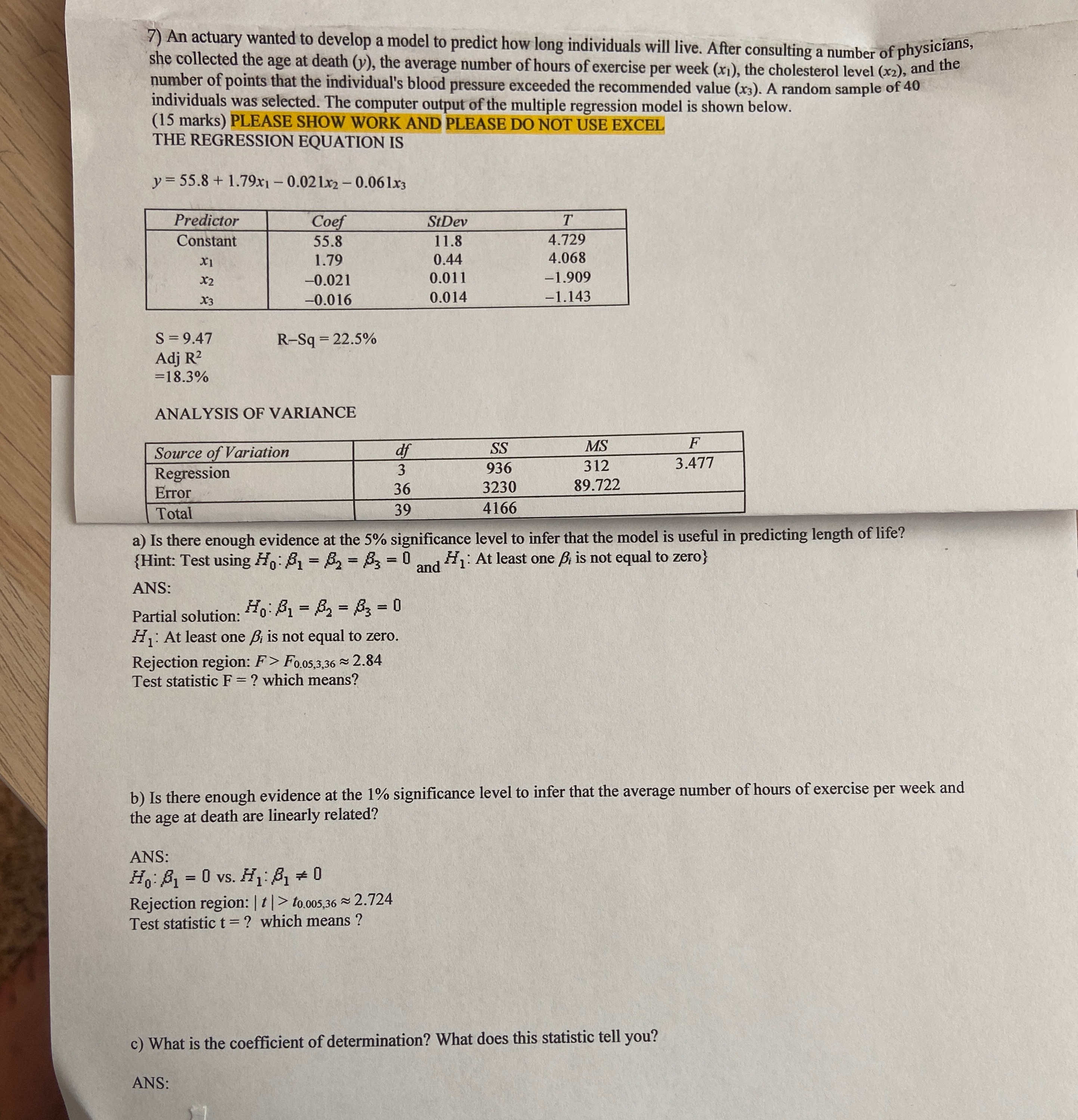
7) An actuary wanted to develop a model to predict how long individuals will live. After consulting a number of physicians, she collected the age at death (y), the average number of hours of exercise per week (x1), the cholesterol level (x2), and the number of points that the individual's blood pressure exceeded the recommended value (x3). A random sample of 40 individuals was selected. The computer output of the multiple regression model is shown below. (15 marks) PLEASE SHOW WORK AND PLEASE DO NOT USE EXCEL THE REGRESSION EQUATION IS y = 55.8 + 1.79x1 - 0.021x2 - 0.061x3 Predictor Coef StDev Constant 55.8 11.8 4.729 X1 1.79 0.44 4.068 X2 -0.021 0.011 -1.909 X3 -0.016 0.014 -1.143 S = 9.47 Adj R2 R-Sq =22.5% =18.3% ANALYSIS OF VARIANCE Source of Variation of SS MS F Regression 936 312 3.477 Error 36 3230 39.722 Total 39 4166 a) Is there enough evidence at the 5% significance level to infer that the model is useful in predicting length of life? {Hint: Test using Ho: 81 = 82 = $3 = and 1: At least one B, is not equal to zero} ANS: Partial solution: Ho: B1 = B2 = B3 = 0 H1: At least one Bi is not equal to zero. Rejection region: F > Fo.05,3,36 ~ 2.84 Test statistic F = ? which means? b) Is there enough evidence at the 1% significance level to infer that the average number of hours of exercise per week and the age at death are linearly related? ANS: Ho : B1 = 0 vs. H 1 : B1 = 0 Rejection region: | t | > to.005,36 ~ 2.724 Test statistic t = ? which means ? c) What is the coefficient of determination? What does this statistic tell you? ANS
Step by Step Solution
There are 3 Steps involved in it

Get step-by-step solutions from verified subject matter experts
 Study Help