







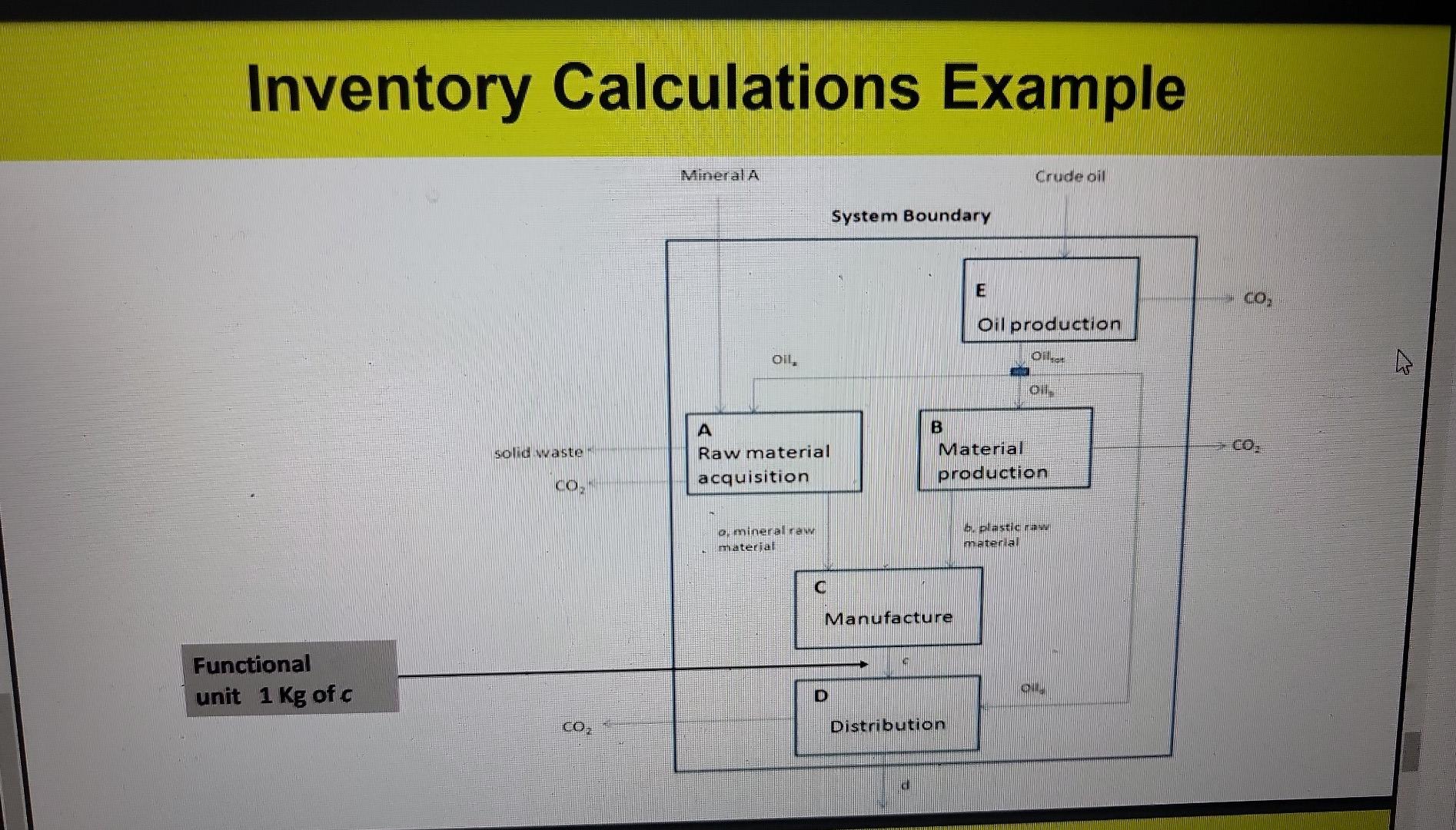
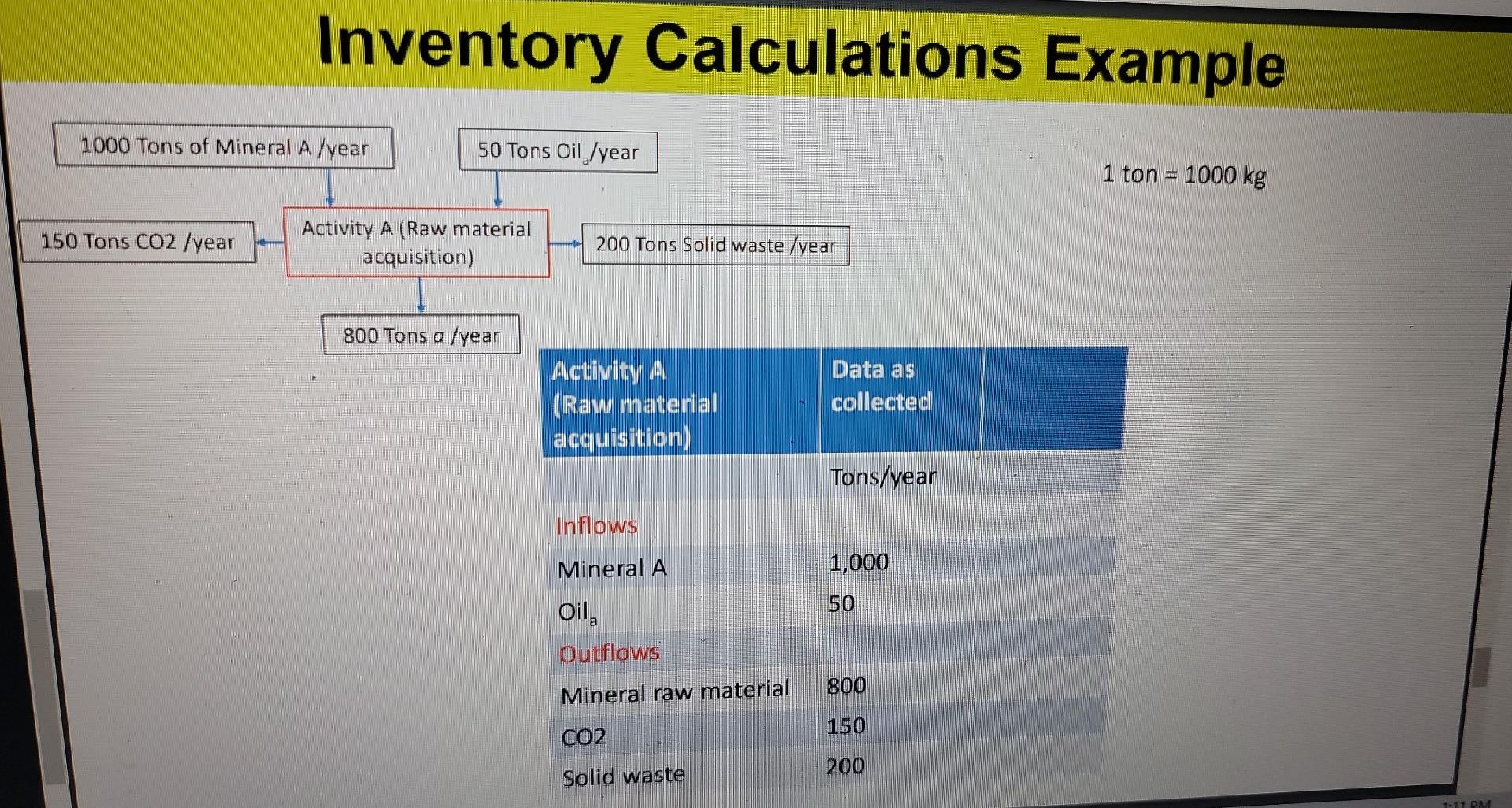
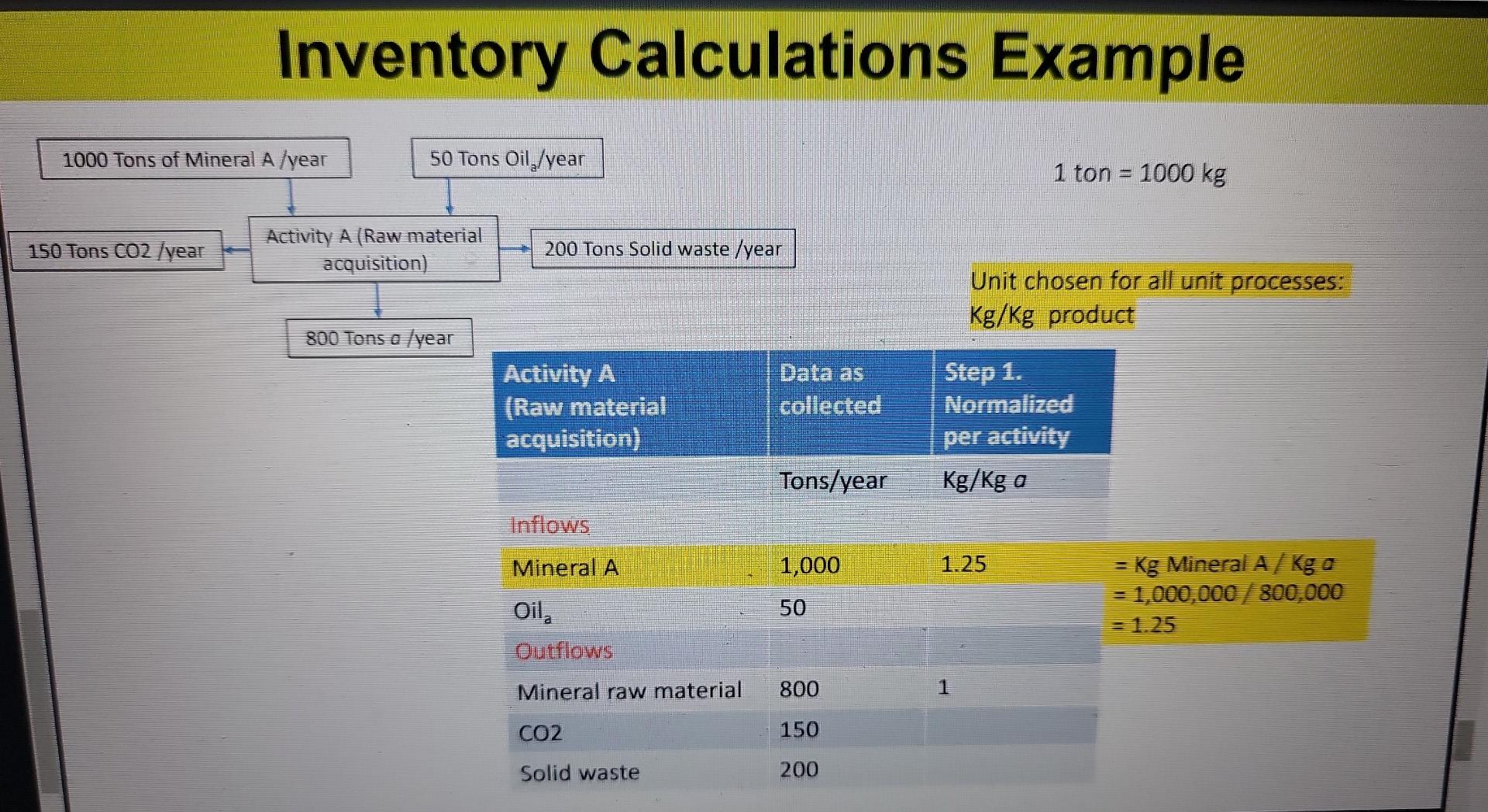
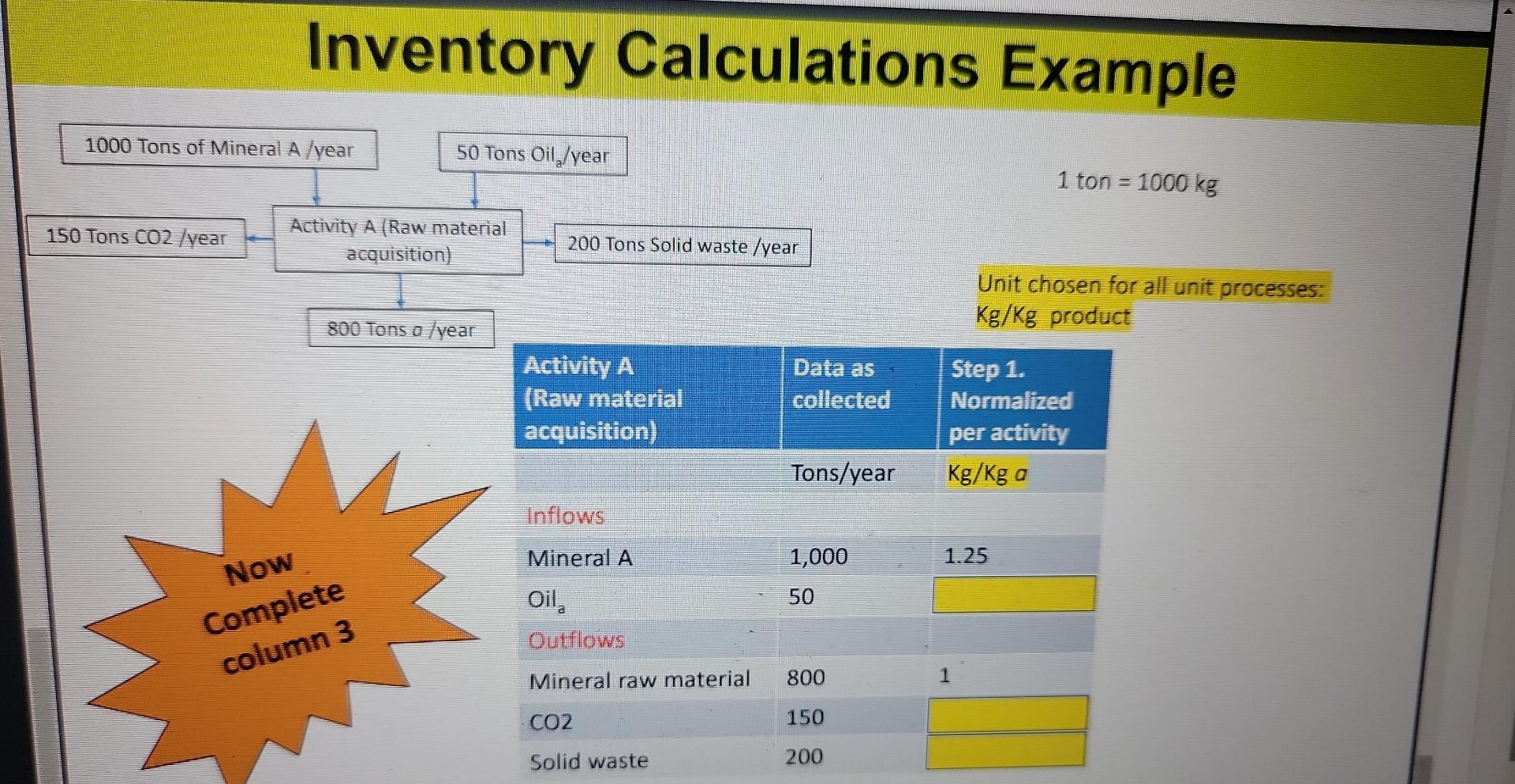
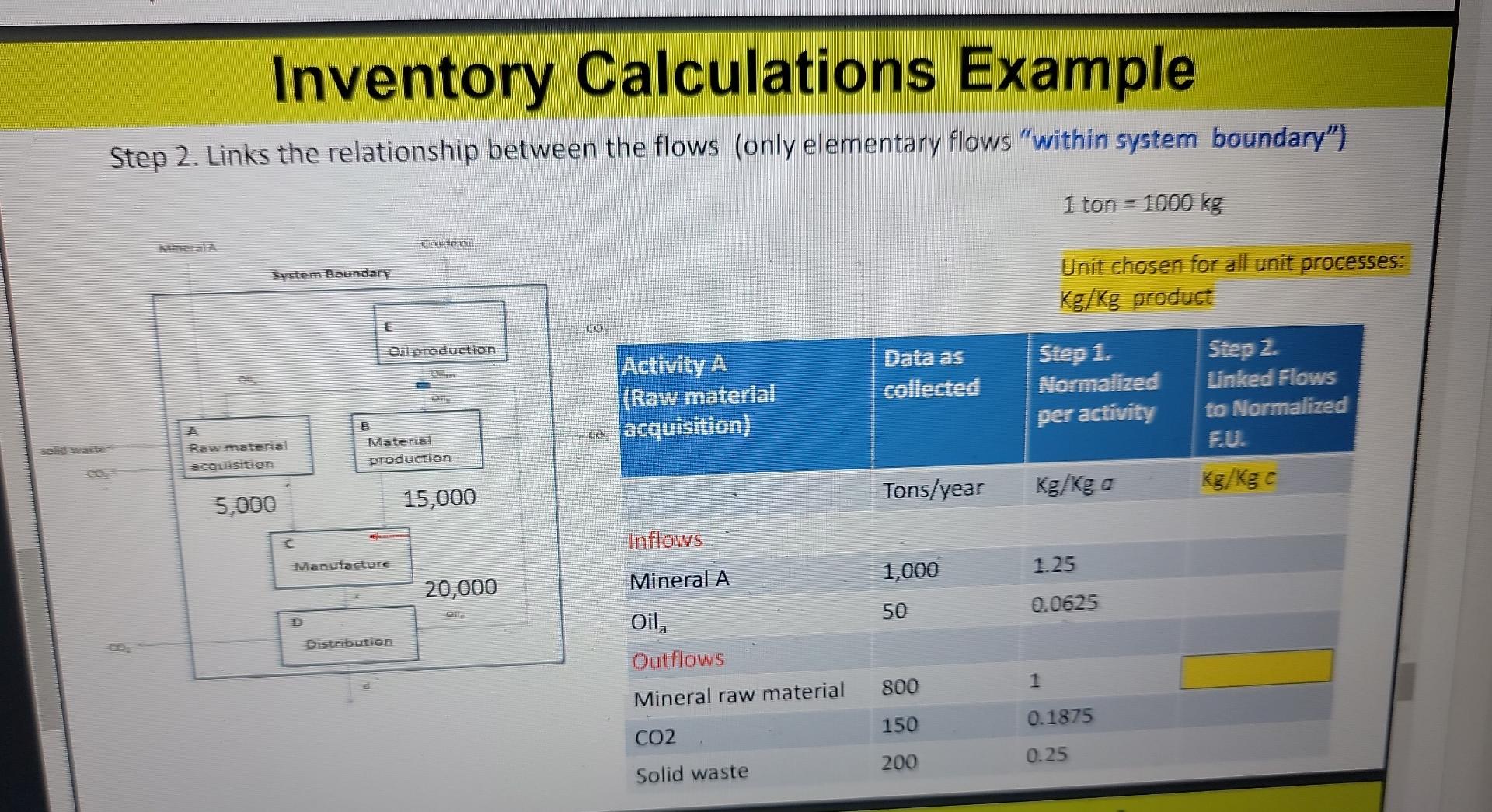
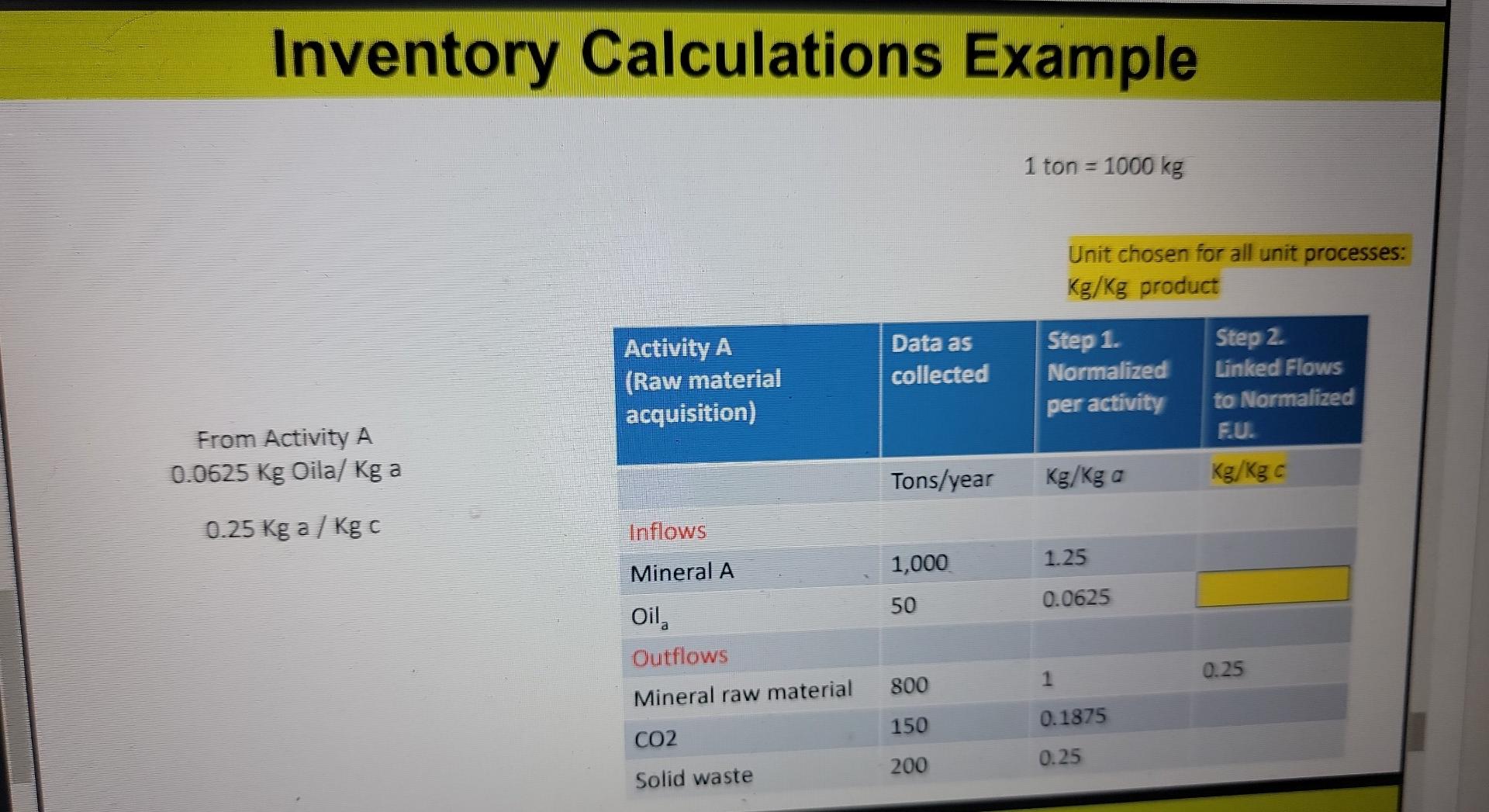
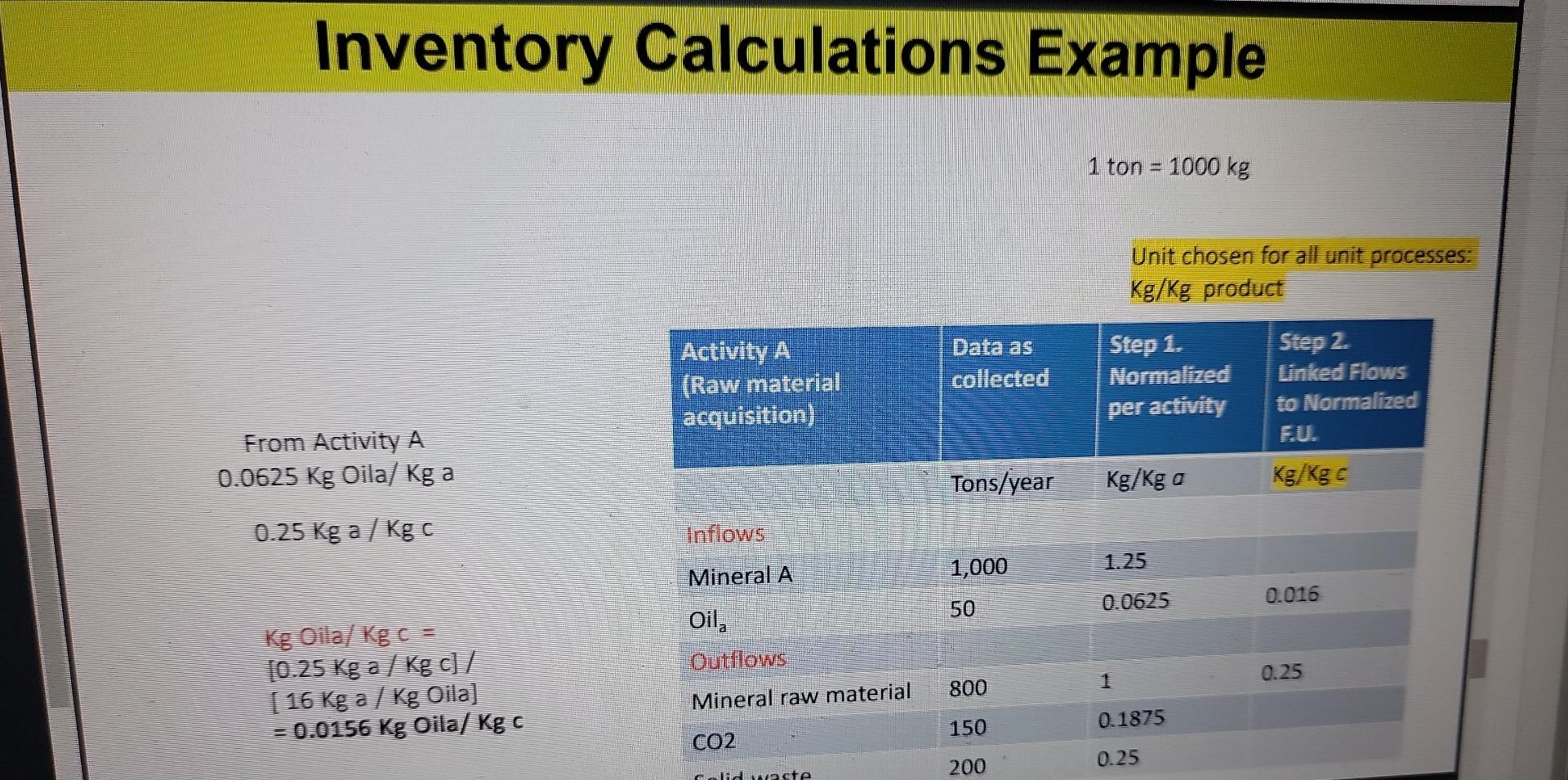
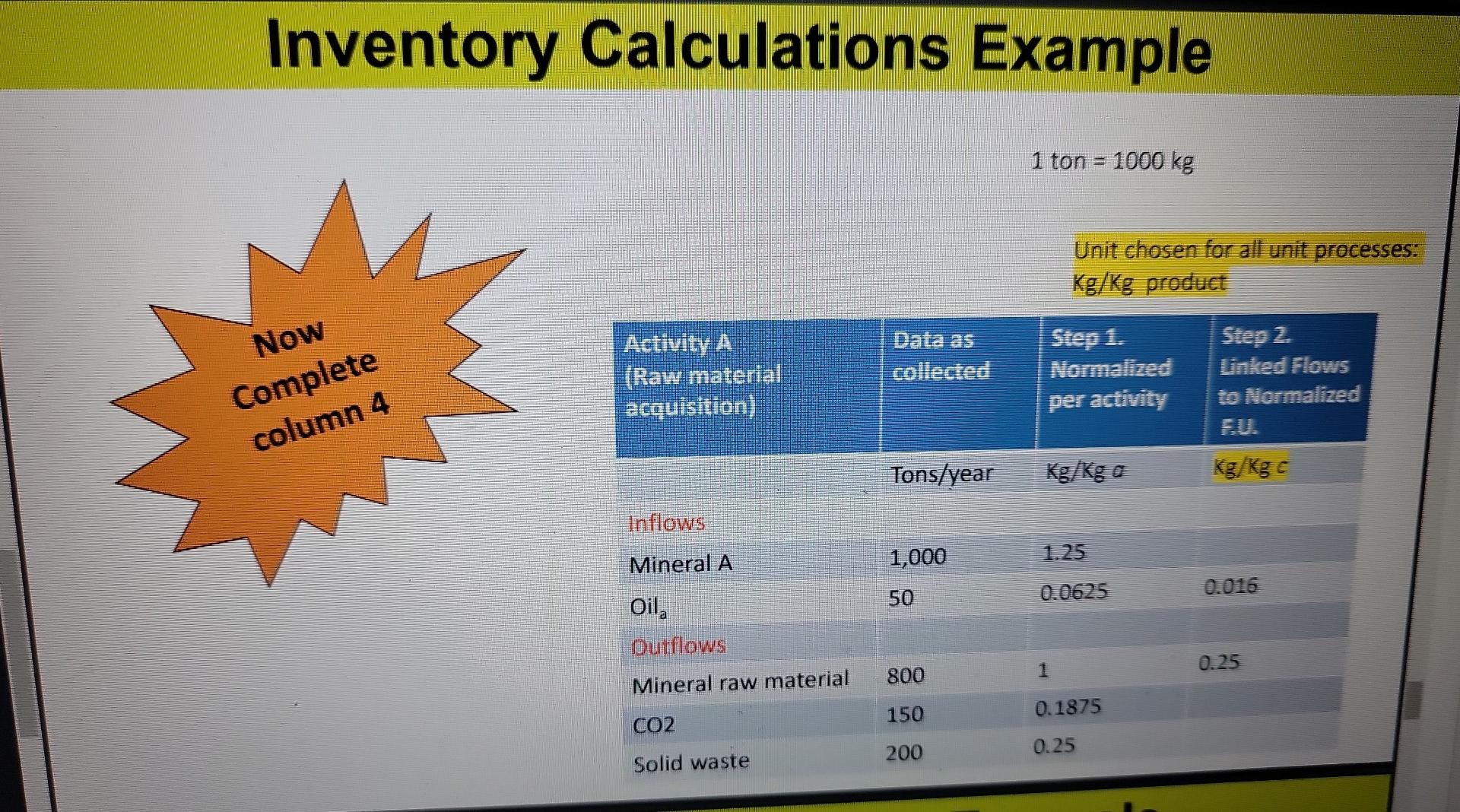
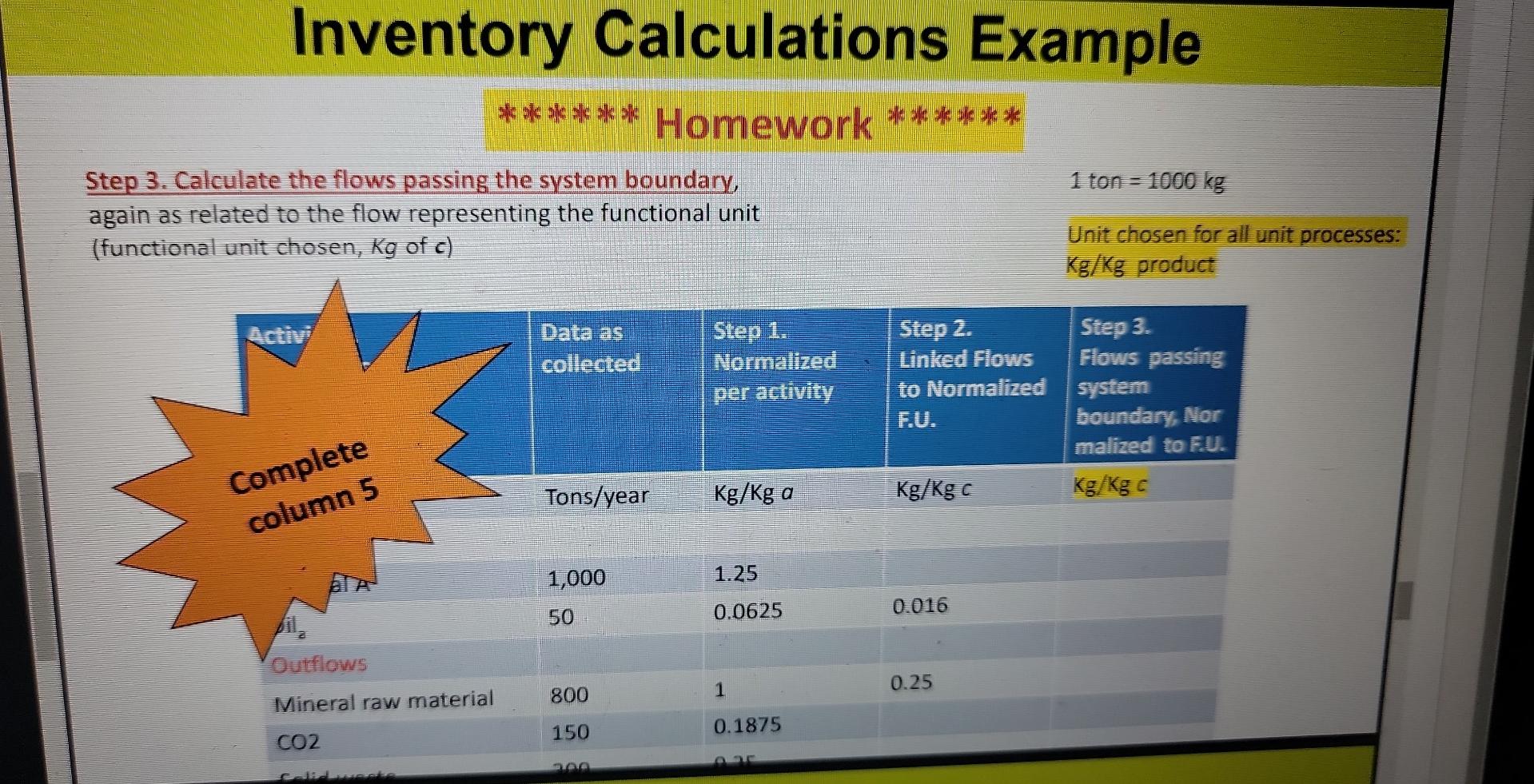
Question: please help what more info do you need Inventory Calculations Example Inventory Calculations Example Inflows MineralAOila1,00050 Outflows Mineral raw material 800 CO2Solidwaste150200 1ton=1000kg Unit chosen
please help
what more info do you need
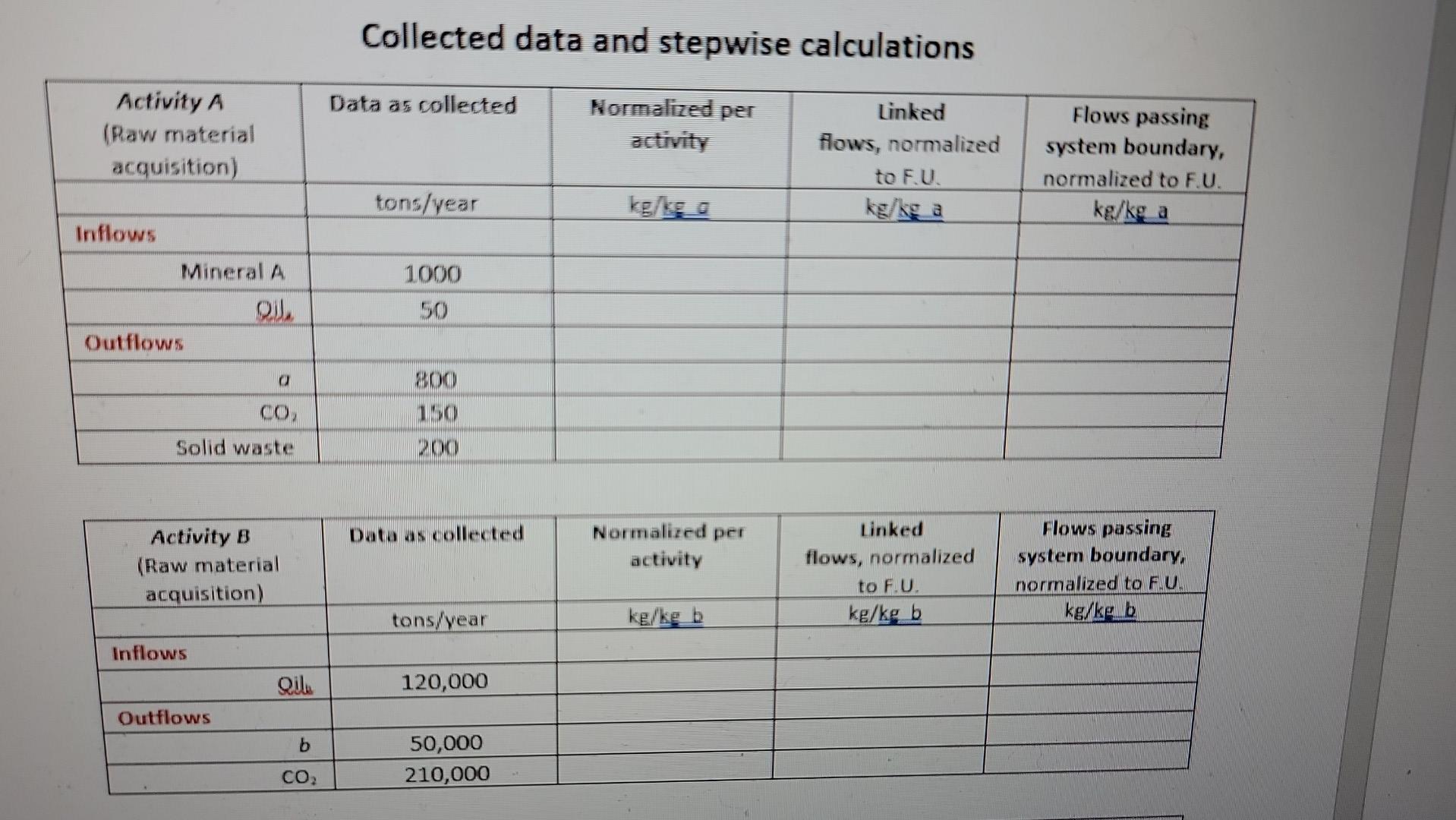
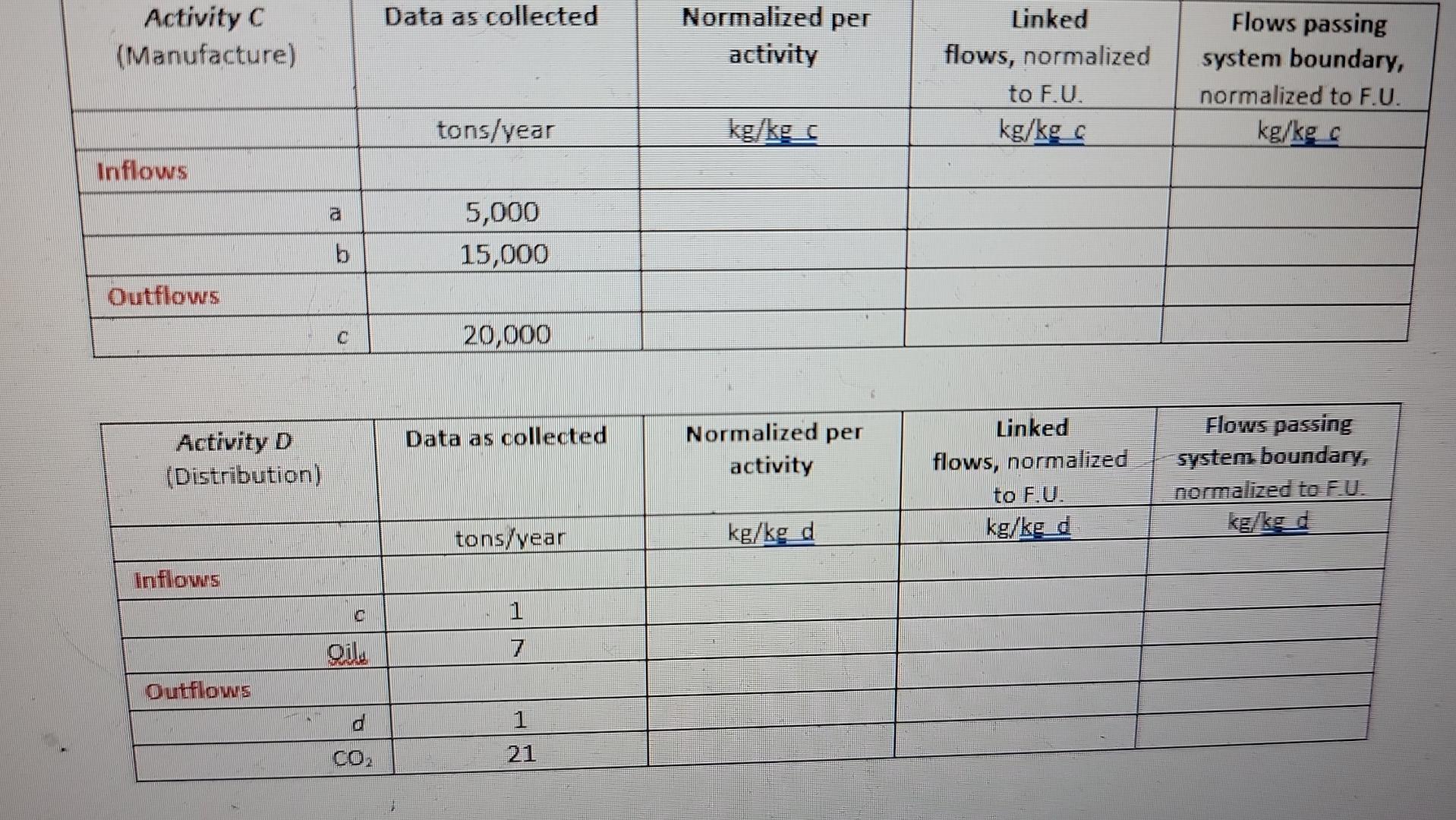
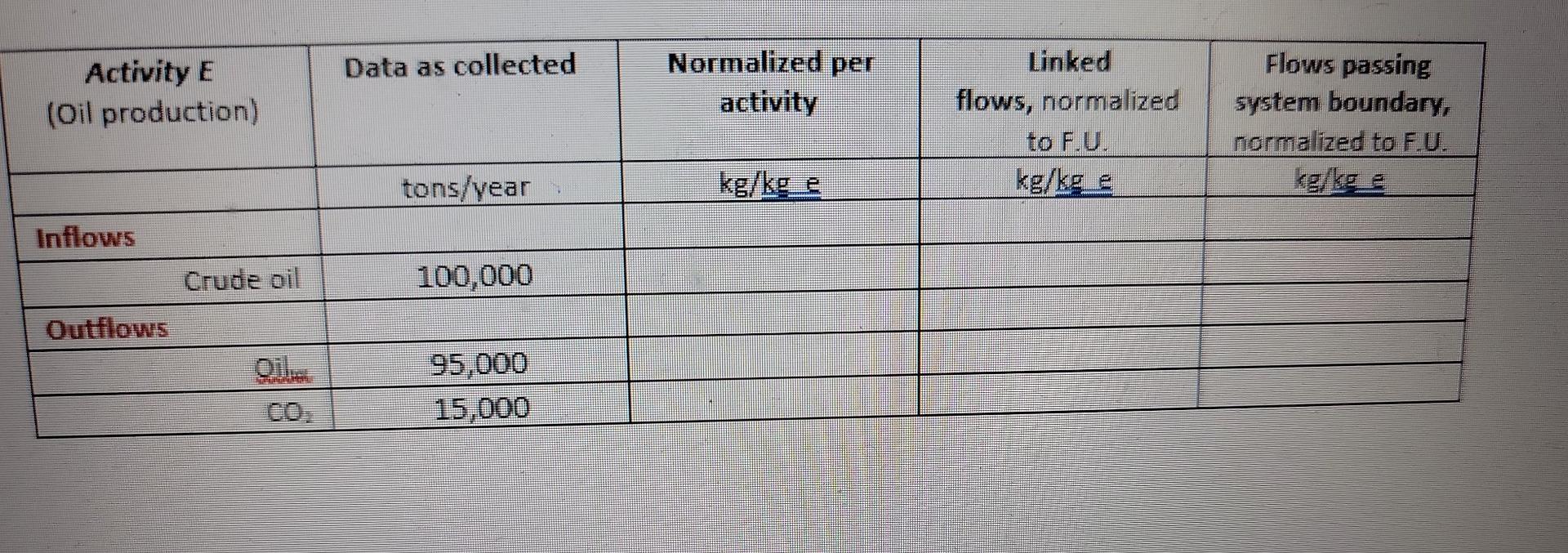
Inventory Calculations Example Inventory Calculations Example Inflows MineralAOila1,00050 Outflows Mineral raw material 800 CO2Solidwaste150200 1ton=1000kg Unit chosen for all unit processes: Kg/Kg product Inventory Calculations Example Kg/Kg product Step 2. Links the relationship between the flows (only elementary flows "within system boundary") 1ton=1000kg Unit chosen for all unit processes: Kg/Kg product 1ton=1000kg Unit chosen for all unit processes: Kg/Kg product Inventory Calculations Example 1 ton =1000kg Unit chosen for Kg/Kg product Inventory Calculations Example 1 ton =1000kg Inventory Calculations Example HOnne H Step 3. Calculate the flows passing the system boundary, 1ton=1000kg again as related to the flow representing the functional unit (functional unit chosen, Kg of c ) Unit chosen for all unit processes: Kg/Kg oroduct Collected data and stepwise calculations \begin{tabular}{|c|c|c|c|c|} \hline Activity E (Oil production) & Data as collected & Normalized per activity & Linked flows, normalized to F.U. & Flows passing system boundary, normalized to F.U. \\ \hline & tons/year & kg/kge & kg/kge \\ \hline Inflows & & & \\ \hline Crude oil & 100,000 & & \\ \hline Outflows & & & \\ \hline Oilse & 95,000 & & \\ \hline CO2 & 15,000 & & \\ \hline \end{tabular} Inventory Calculations Example Inventory Calculations Example Inflows MineralAOila1,00050 Outflows Mineral raw material 800 CO2Solidwaste150200 1ton=1000kg Unit chosen for all unit processes: Kg/Kg product Inventory Calculations Example Kg/Kg product Step 2. Links the relationship between the flows (only elementary flows "within system boundary") 1ton=1000kg Unit chosen for all unit processes: Kg/Kg product 1ton=1000kg Unit chosen for all unit processes: Kg/Kg product Inventory Calculations Example 1 ton =1000kg Unit chosen for Kg/Kg product Inventory Calculations Example 1 ton =1000kg Inventory Calculations Example HOnne H Step 3. Calculate the flows passing the system boundary, 1ton=1000kg again as related to the flow representing the functional unit (functional unit chosen, Kg of c ) Unit chosen for all unit processes: Kg/Kg oroduct Collected data and stepwise calculations \begin{tabular}{|c|c|c|c|c|} \hline Activity E (Oil production) & Data as collected & Normalized per activity & Linked flows, normalized to F.U. & Flows passing system boundary, normalized to F.U. \\ \hline & tons/year & kg/kge & kg/kge \\ \hline Inflows & & & \\ \hline Crude oil & 100,000 & & \\ \hline Outflows & & & \\ \hline Oilse & 95,000 & & \\ \hline CO2 & 15,000 & & \\ \hline \end{tabular}
Step by Step Solution
There are 3 Steps involved in it

Get step-by-step solutions from verified subject matter experts
 Study Help