







Question: PLEASE HELP WILL RATE ASAP QUESTION 18 14 points Consider the following potential car accident problem, where D is the driver/injurer and P is the
PLEASE HELP WILL RATE ASAP
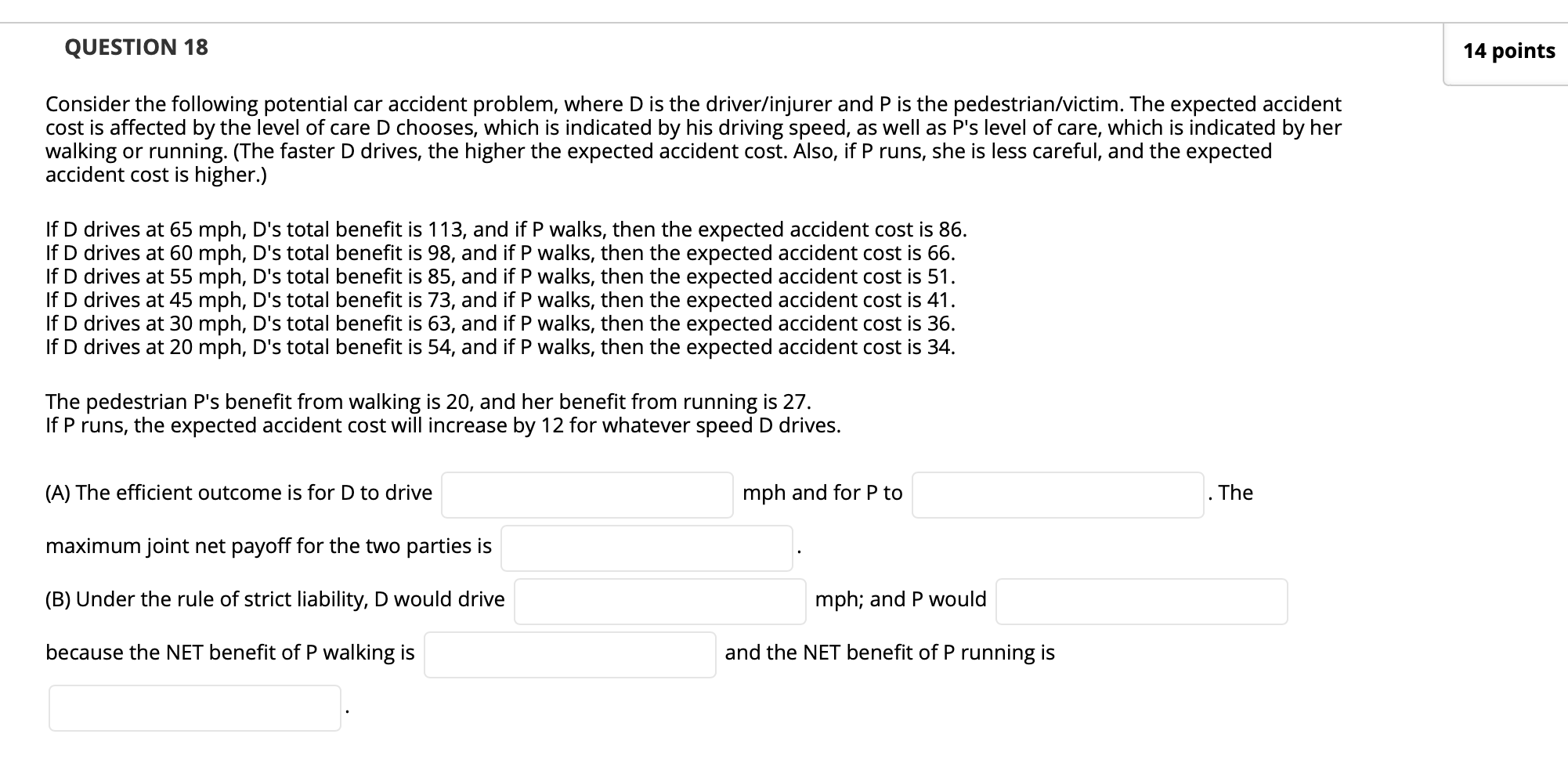
QUESTION 18 14 points Consider the following potential car accident problem, where D is the driver/injurer and P is the pedestrian/victim. The expected accident cost is affected by the level of care D chooses, which is indicated by his driving speed, as well as P's level of care, which is indicated by her walking or running. (The faster D drives, the higher the expected accident cost. Also, if P runs, she is less careful, and the expected accident cost is higher.) If D drives at 65 mph, D's total benefit is 1 13, and if P walks, then the expected accident cost is 86. If D drives at 60 mph, D's total benefit is 98, and if P walks, then the expected accident cost is 66. If D drives at 55 mph, D's total benefit is 85, and if P walks, then the expected accident cost is 51. If D drives at 45 mph, D's total benefit is 73, and if P walks, then the expected accident cost is 41. If D drives at 30 mph, D's total benefit is 63, and if P walks, then the expected accident cost is 36. If D drives at 20 mph, D's total benefit is 54, and if P walks, then the expected accident cost is 34. The pedestrian P's benefit from walking is 20, and her benet from running is 27. If P runs, the expected accident cost will increase by 12 for whatever speed D drives. (A) The efficient outcome is for D to drive mph and for P to . The maximum joint net payoff for the two parties is (B) Under the rule of strict liability, D would drive mph; and P would because the NET benet of P walking is and the NET benet of P running is
Step by Step Solution
There are 3 Steps involved in it

Get step-by-step solutions from verified subject matter experts
 Study Help