







Question: Please help with 1-4 QUESTION 1 If f (x) changes sign from positive to negative (function f(x) is changing from increasing to decreasing) as we
Please help with 1-4
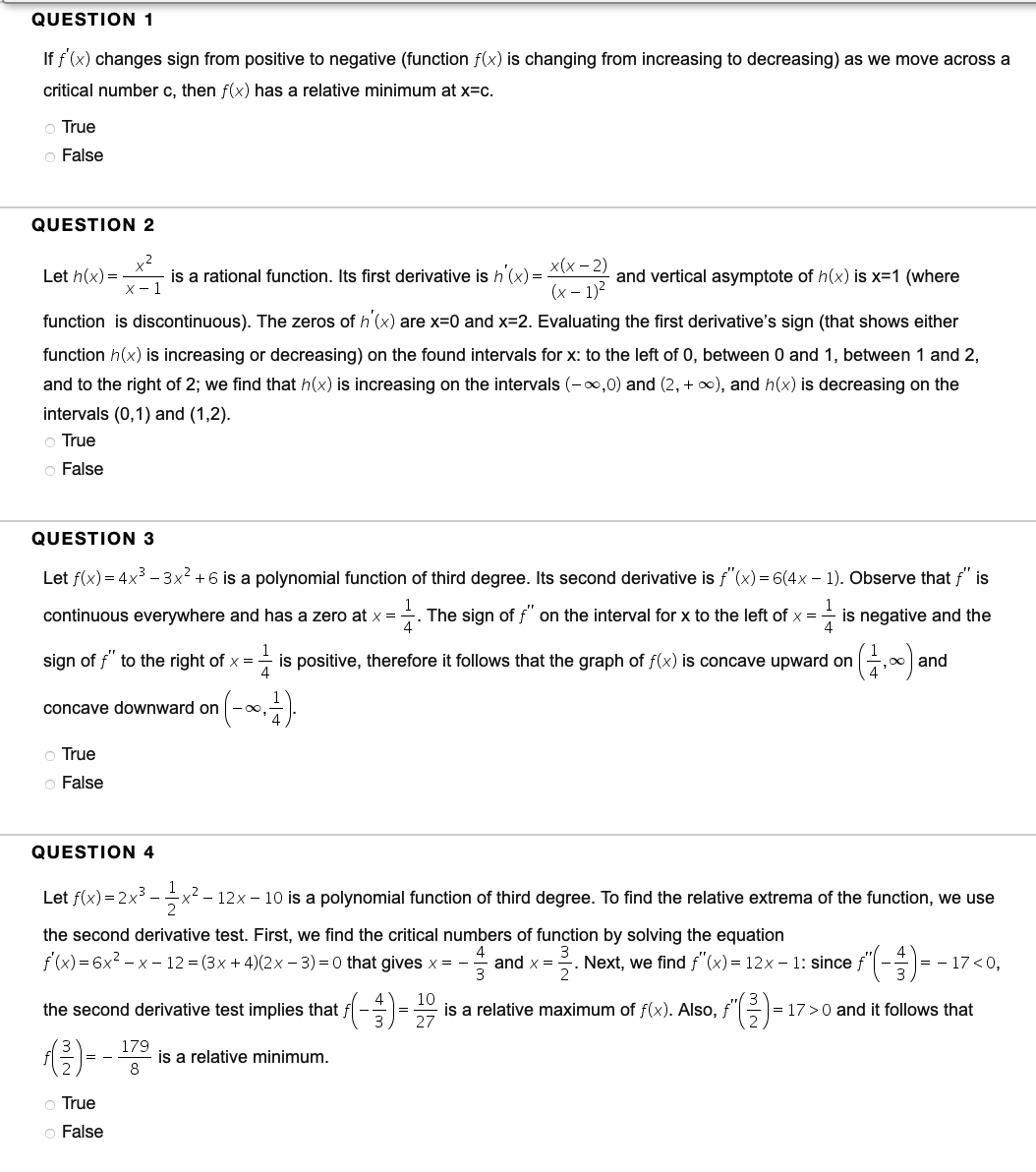
QUESTION 1 If f (x) changes sign from positive to negative (function f(x) is changing from increasing to decreasing) as we move across a critical number c, then f(x) has a relative minimum at x=c. o True o False QUESTION 2 Let h(x) = = X - X - 1 is a rational function. Its first derivative is h'(x) = *(x - 2) (x - 1) 2 and vertical asymptote of h(x) is x=1 (where function is discontinuous). The zeros of h (x) are x=0 and x=2. Evaluating the first derivative's sign (that shows either function h(x) is increasing or decreasing) on the found intervals for x: to the left of 0, between 0 and 1, between 1 and 2, and to the right of 2; we find that h(x) is increasing on the intervals (-oo,0) and (2, + co), and h(x) is decreasing on the intervals (0,1) and (1,2). o True o False QUESTION 3 Let f(x) =4x3 -3x- + 6 is a polynomial function of third degree. Its second derivative is f (x) =6(4x - 1). Observe that f" is continuous everywhere and has a zero at x = = 4 . . The sign of fon the interval for x to the left of x = = is negative and the sign of f" to the right of x = = is positive, therefore it follows that the graph of f(x) is concave upward on (, . ) and concave downward on (- oo, - ). o True o False QUESTION 4 Let f(x)=2x3 - -x2 - 12x - 10 is a polynomial function of third degree. To find the relative extrema of the function, we use the second derivative test. First, we find the critical numbers of function by solving the equation f'(x) =6x2 -x- 12 =(3x + 4)(2x -3)=0 that gives x = - - and x = . Next, we find f"(x) = 12x - 1: since f"(- )= -170 and it follows that (3)= - 16 is a relative minimum. 8 True o False
Step by Step Solution
There are 3 Steps involved in it

Get step-by-step solutions from verified subject matter experts
 Study Help