







Question: Please help with 1.71 1.67. Find an exact closed-form formula for T in each of the following recursions when n=2m for mZ+: (i) T(n)=8T(2n)+n. (ii)
Please help with 1.71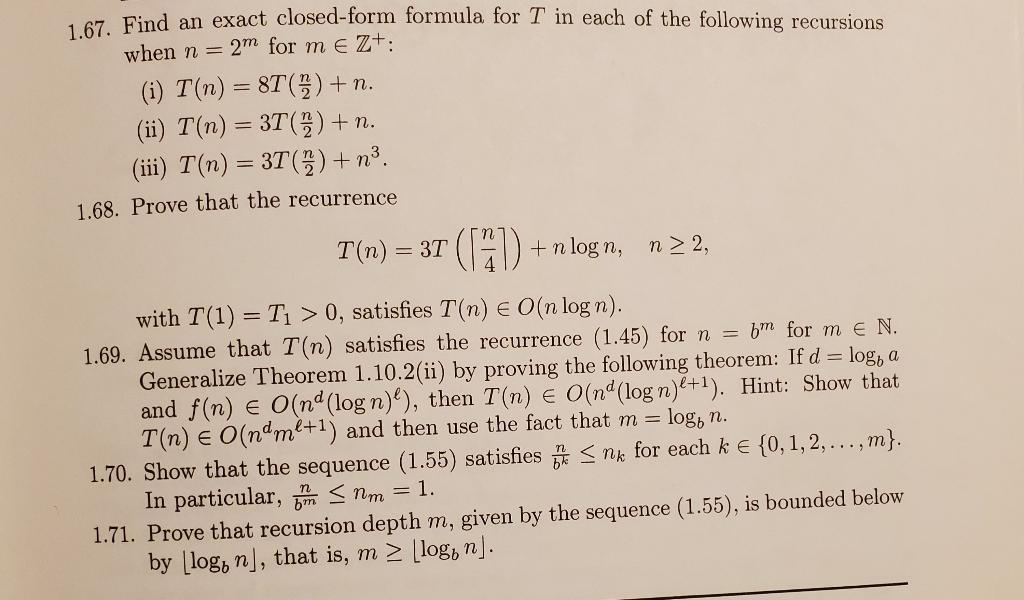
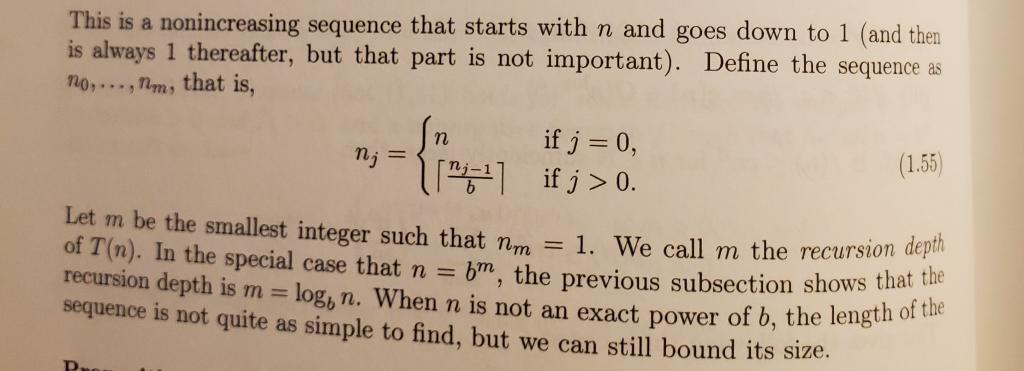
1.67. Find an exact closed-form formula for T in each of the following recursions when n=2m for mZ+: (i) T(n)=8T(2n)+n. (ii) T(n)=3T(2n)+n. (iii) T(n)=3T(2n)+n3. 1.68. Prove that the recurrence T(n)=3T([4n)+nlogn,n2, with T(1)=T1>0, satisfies T(n)O(nlogn). 1.69. Assume that T(n) satisfies the recurrence (1.45) for n=bm for mN. Generalize Theorem 1.10.2(ii) by proving the following theorem: If d=logba and f(n)O(nd(logn)), then T(n)O(nd(logn)+1). Hint: Show that T(n)O(ndm+1) and then use the fact that m=logbn. 1.70. Show that the sequence (1.55) satisfies bknnk for each k{0,1,2,,m}. In particular, bmnnm=1. 1.71. Prove that recursion depth m, given by the sequence (1.55), is bounded below by logbn, that is, mlogbn. This is a nonincreasing sequence that starts with n and goes down to 1 (and then is always 1 thereafter, but that part is not important). Define the sequence as n0,,nm, that is nj={nbnj1ifj=0ifj>0 Let m be the smallest integer such that nm=1. We call m the recursion depth of T(n). In the special case that n=bm, the previous subsection shows that the recursion depth is m=logbn. When n is not an exact power of b, the length of the sequence is not quite as simple to find, but we can still bound its size. 1.67. Find an exact closed-form formula for T in each of the following recursions when n=2m for mZ+: (i) T(n)=8T(2n)+n. (ii) T(n)=3T(2n)+n. (iii) T(n)=3T(2n)+n3. 1.68. Prove that the recurrence T(n)=3T([4n)+nlogn,n2, with T(1)=T1>0, satisfies T(n)O(nlogn). 1.69. Assume that T(n) satisfies the recurrence (1.45) for n=bm for mN. Generalize Theorem 1.10.2(ii) by proving the following theorem: If d=logba and f(n)O(nd(logn)), then T(n)O(nd(logn)+1). Hint: Show that T(n)O(ndm+1) and then use the fact that m=logbn. 1.70. Show that the sequence (1.55) satisfies bknnk for each k{0,1,2,,m}. In particular, bmnnm=1. 1.71. Prove that recursion depth m, given by the sequence (1.55), is bounded below by logbn, that is, mlogbn. This is a nonincreasing sequence that starts with n and goes down to 1 (and then is always 1 thereafter, but that part is not important). Define the sequence as n0,,nm, that is nj={nbnj1ifj=0ifj>0 Let m be the smallest integer such that nm=1. We call m the recursion depth of T(n). In the special case that n=bm, the previous subsection shows that the recursion depth is m=logbn. When n is not an exact power of b, the length of the sequence is not quite as simple to find, but we can still bound its size
Step by Step Solution
There are 3 Steps involved in it

Get step-by-step solutions from verified subject matter experts
 Study Help