







Question: Please help with a step by step on how to draw these graphs in excell. Assignment 1 aims to establish your familiarity with Microsoft Excel
Please help with a step by step on how to draw these graphs in excell.
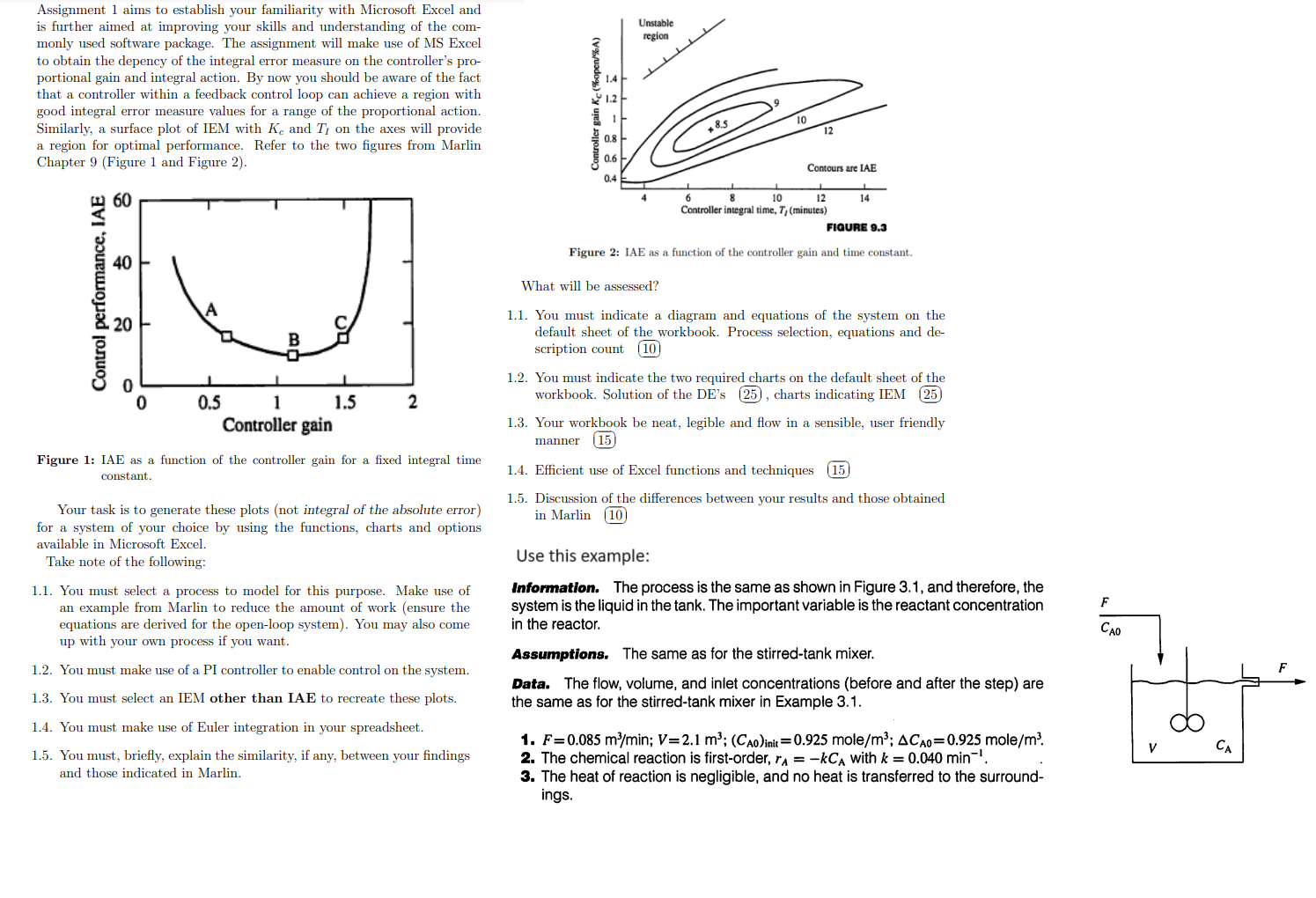
Assignment aims to establish your familiarity with Microsoft Excel and is further aimed at improving your skills and understanding of the commonly used software package. The assignment will make use of MS Excel to obtain the depency of the integral error measure on the controller's proportional gain and integral action. By now you should be aware of the fact that a controller within a feedback control loop can achieve a region with good integral error measure values for a range of the proportional action. Similarly, a surface plot of IEM with and on the axes will provide a region for optimal performance. Refer to the two figures from Marlin Chapter Figure and Figure
Figure : IAE as a function of the controller gain and time constant.
What will be assessed?
You must indicate a diagram and equations of the system on the default sheet of the workbook. Process selection, equations and description count
You must indicate the two required charts on the default sheet of the workbook. Solution of the DE's charts indicating IEM
Your workbook be neat, legible and flow in a sensible user friendly manner
Efficient use of Excel functions and techniques
Discussion of the differences between your results and those obtained in Marlin
Use this example to draw the new graphs:
Information:
The process is the same as shown in Figure and therefore, the
system is the liquid in the tank. The important variable is the reactant concentration in the reactor.
Assumptions.:
The same as for the stirredtank mixer.
Data.:
The flow, volume, and inlet concentrations before and after the step are the same as for the stirredtank mixer in Example
;;mol;mol
The chemical reaction is firstorder, with
The heat of reaction is negligible, and no heat is transferred to the surroundings.
Step by Step Solution
There are 3 Steps involved in it
1 Expert Approved Answer
Step: 1 Unlock

Question Has Been Solved by an Expert!
Get step-by-step solutions from verified subject matter experts
Step: 2 Unlock
Step: 3 Unlock
 Study Help