







Question: please help with a-b and double check the multiple choice answers thank you Avalanche forecasters measure the temperature gradient d'T , which is the rate
please help with a-b and double check the multiple choice answers thank you
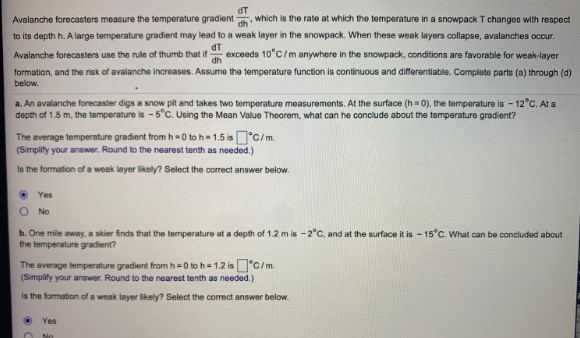
Avalanche forecasters measure the temperature gradient d'T , which is the rate at which the temperature in a snowpack T changes with respect to its depth h. A large temperature gradient may lead to a weak layer in the snowpack. When these weak layers collapse, avalanches occur. Avalanche forecasters use the rule of thumb that if - exceeds 10"C /m anywhere in the snowpack, conditions are favorable for weak-layer formation, and the risk of avalanche increases, Assume the temperature function is continuous and differentiable. Complete parts (a) through (d) below. a. An avalanche forecaster digs a snow pit and takes two temperature measurements, At the surface (h = 0), the temperature is - 12"C. At a depth of 1.5 m, the temperature is -5"C. Using the Mean Value Theorem, what can he conclude about the temperature gradient? The average temperature gradient from h = 0 to h = 1.5 is |"c/m. (Simplify your answer, Round to the nearest tenth as needed.) Is the formation of a weak layer likely? Select the correct answer below. Yes No b. One mile away, a skier finds that the temperature at a depth of 1.2 m is -2"C. and at the surface it is - 15"C. What can be concluded about the temperature gradient? The average temperature gradient from h = 0 to h = 1.2 is |"C/m. (Simplify your answer. Round to the nearest tenth as needed. ) is the fomation of a weak layer likely? Select the correct answer below. You
Step by Step Solution
There are 3 Steps involved in it

Get step-by-step solutions from verified subject matter experts
 Study Help