







Question: PLEASE HELP WITH ALL PARTS INCLUDE STEPS. Great, Inc. uses a standard cost system and provides the following information. (Click the icon to view the
PLEASE HELP WITH ALL PARTS INCLUDE STEPS.
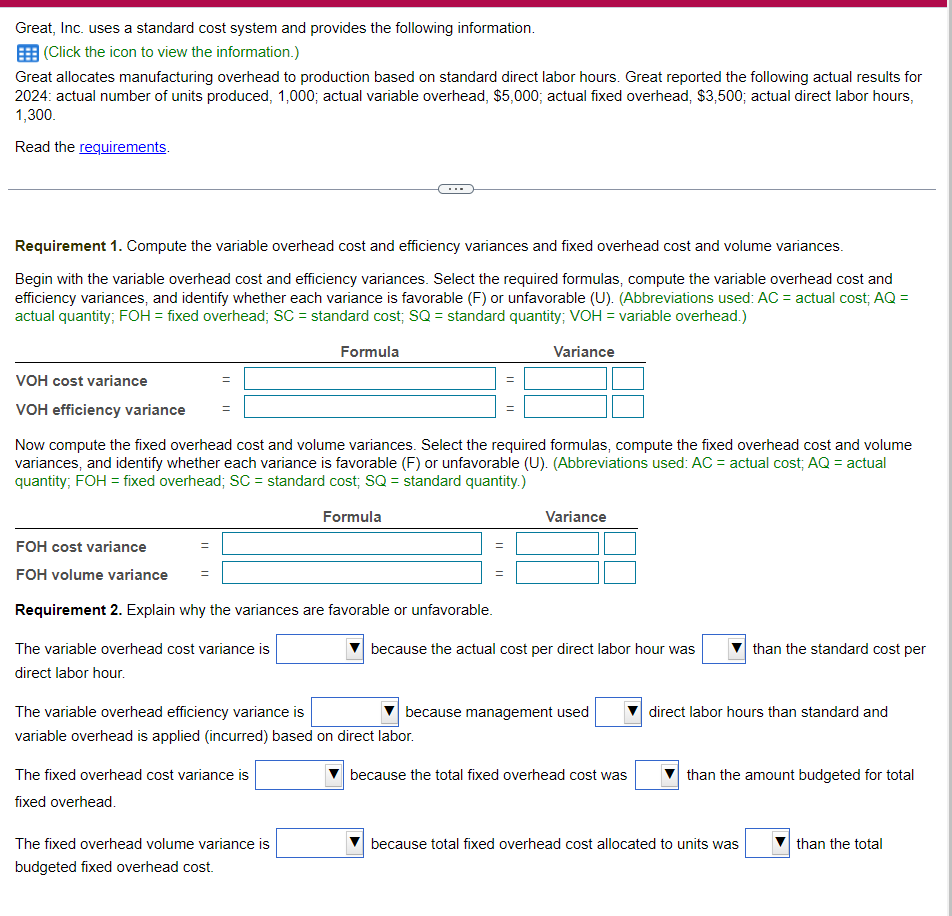
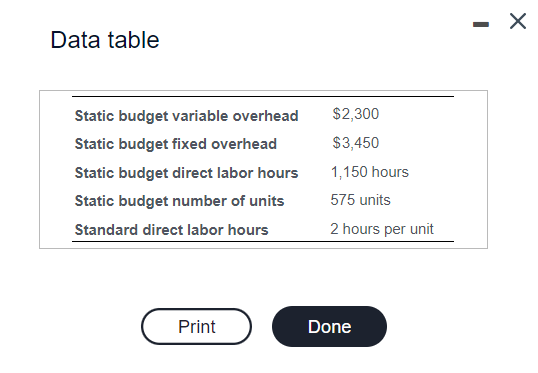
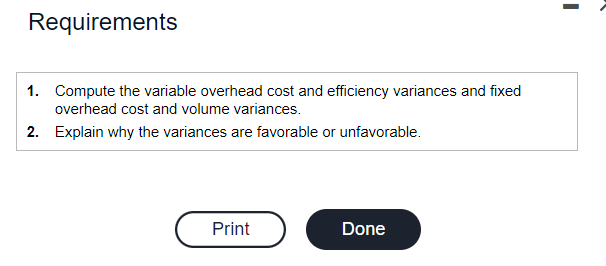
Great, Inc. uses a standard cost system and provides the following information. (Click the icon to view the information.) Great allocates manufacturing overhead to production based on standard direct labor hours. Great reported the following actual results for 2024: actual number of units produced, 1,000 ; actual variable overhead, $5,000; actual fixed overhead, $3,500; actual direct labor hours, 1,300. Read the Requirement 1. Compute the variable overhead cost and efficiency variances and fixed overhead cost and volume variances. Begin with the variable overhead cost and efficiency variances. Select the required formulas, compute the variable overhead cost and efficiency variances, and identify whether each variance is favorable (F) or unfavorable (U). (Abbreviations used: AC= actual cost; AQ= actual quantity; FOH= fixed overhead; SC= standard cost; SQ = standard quantity; VOH= variable overhead.) Now compute the fixed overhead cost and volume variances. Select the required formulas, compute the fixed overhead cost and volume variances, and identify whether each variance is favorable (F) or unfavorable (U). (Abbreviations used: AC= actual cost; AQ= actual quantity; FOH = fixed overhead; SC= standard cost; SQ = standard quantity.) Requirement 2. Explain why the variances are favorable or unfavorable. The variable overhead cost variance is because the actual cost per direct labor hour was than the standard cost per direct labor hour. The variable overhead efficiency variance is because management used direct labor hours than standard and variable overhead is applied (incurred) based on direct labor. The fixed overhead cost variance is because the total fixed overhead cost was than the amount budgeted for total fixed overhead. The fixed overhead volume variance is because total fixed overhead cost allocated to units was than the total budgeted fixed overhead cost. Data table Requirements 1. Compute the variable overhead cost and efficiency variances and fixed overhead cost and volume variances. 2. Explain why the variances are favorable or unfavorable
Step by Step Solution
There are 3 Steps involved in it

Get step-by-step solutions from verified subject matter experts
 Study Help