







Question: Please help with answers using the information below. Mini Case 1: Hair Salon Question 1 : Which digital marketing or social media marketing tactics or
Please help with answers using the information below.
Mini Case 1: Hair Salon
Question 1: Which digital marketing or social media marketing tactics or promotions should Sarah consider trying to bring her customers back to the salon upon reopening?
Question 2: Which tactics or promotions should she leverage for existing customers?
Question 3: Which tactics or promotions should she leverage for potential new customers?
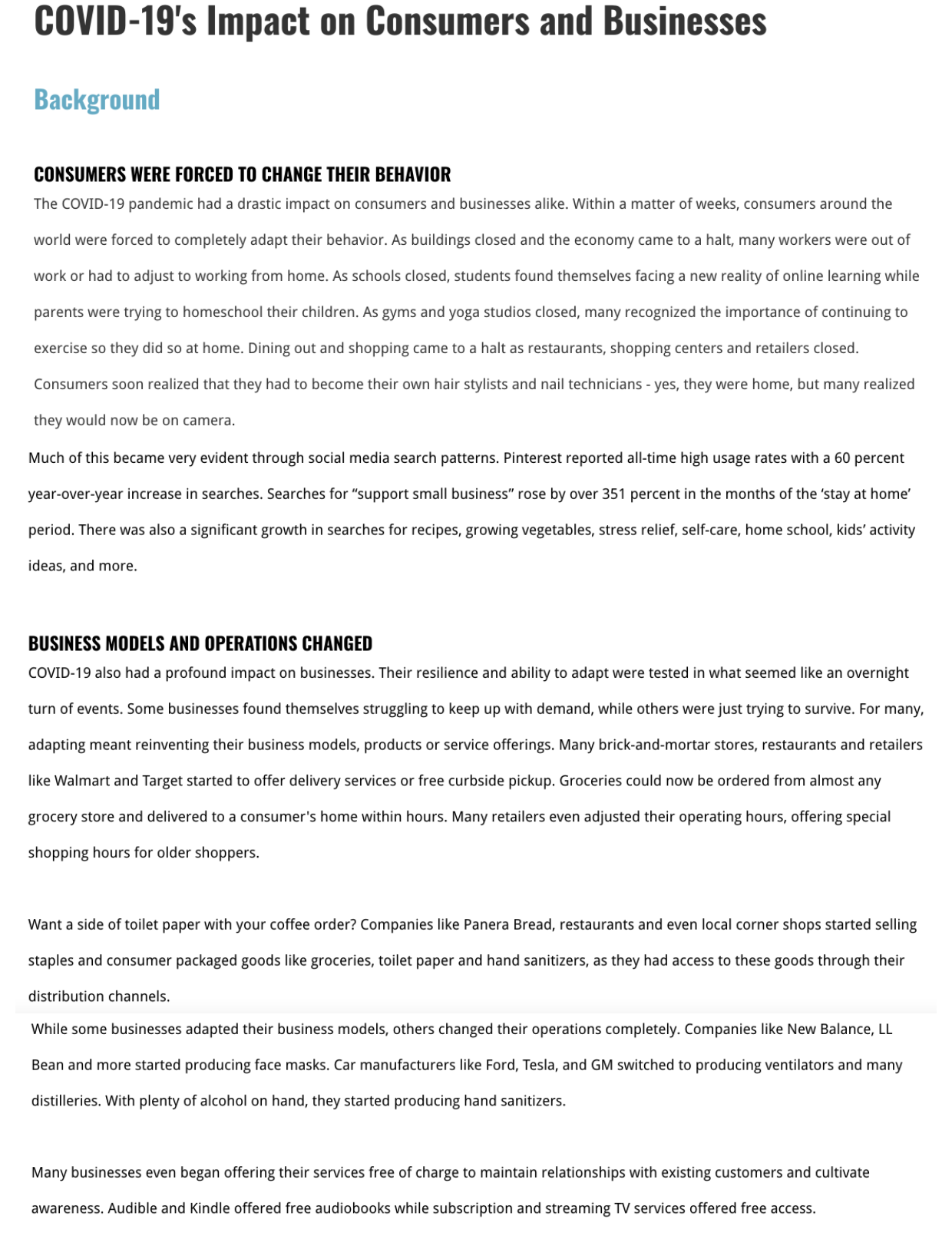
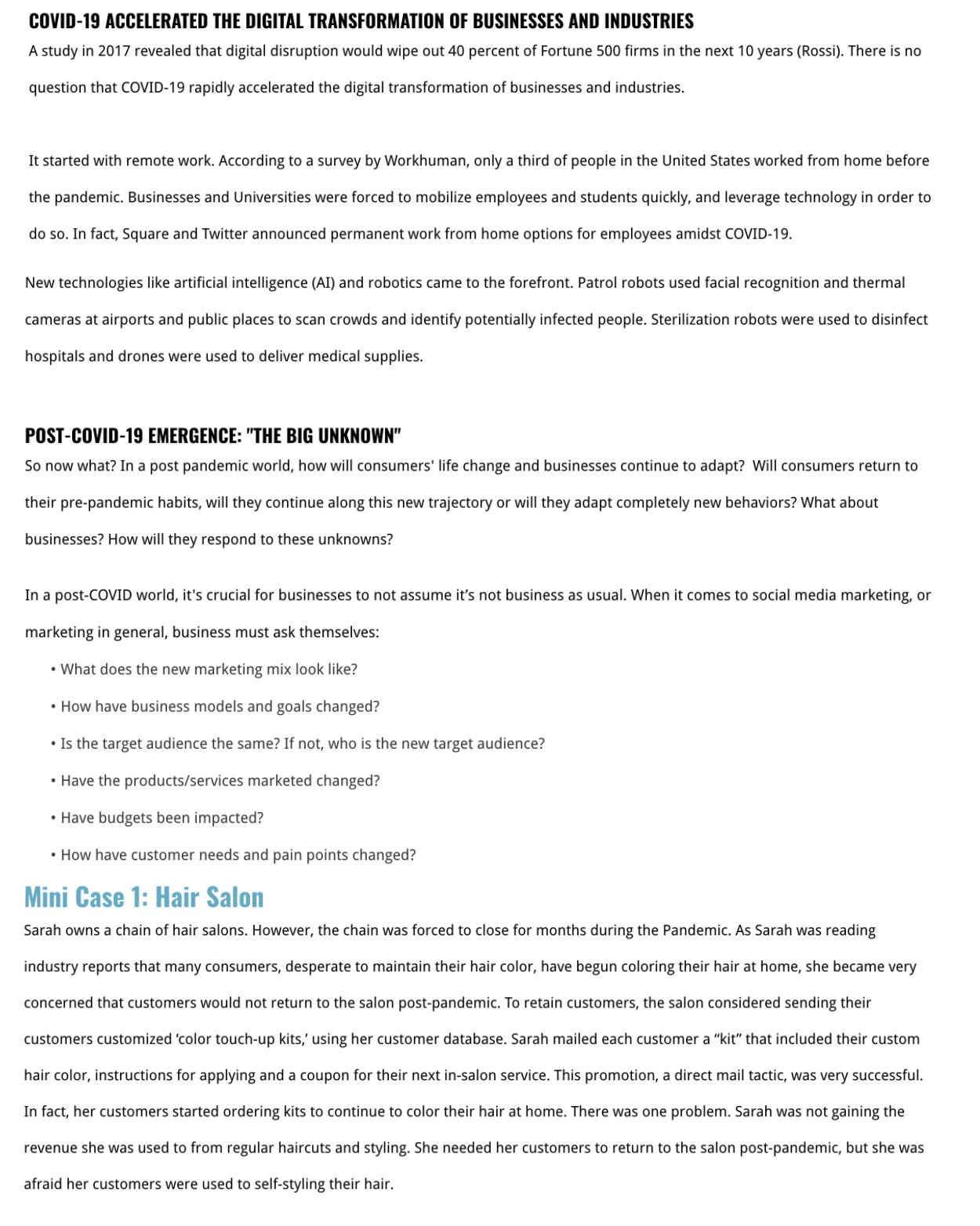
COVIIHB's Impact on Consumers and Businesses Background OOIISlIlAERS HERE EOROEO TO OIIAIIEE THEIR BEHAVIOR The COVID-19 pandemic had a drastic impact on consumers and businesses alike. Within a matter of weeks, consumers around the world were forced to completely adapt their behavior. As buildings closed and the economy came to a halt, many workers were out of work or had to adjust to working from home. As schools closed, students found themselves facing a new reality of online learning while parents were trying to homeschool their children. As gyms and yoga studios closed, many recognized the importance of continuing to exercise so they did so at home. Dining out and shopping came to a halt as restaurants, shopping centers and retailers closed. Consumers soon realized that they had to become their own hair stylists and nail technicians - yes. they were home. but many realized they would now be on camera. Much of this became very evident through social media search patterns. Pinterest reported all-time high usage rates with a 60 percent year-over-year increase in searches. Searches for "support small business" rose by over 351 percent in the months of the 'stay at home' period. There was also a signicant growth in searches for recipes, growing vegetables, stress relief. self-care, home school, kids' activity ideas. and more. BOSIIIESS MODELS AND OPERATIONS OIIANOEO COVlD-19 also had a profound impact on businesses. Their resilience and ability to adapt were tested in what seemed like an overnight turn of events. Some businesses found themselves struggling to keep up with demand, while others were just trying to survive. For many, adapting meant reinventing their business mod els. products or service offerings. Many brick-and-mortar stores. restaurants and retailers like Walmart and Target started to offer delivery services or free curbside pickup. Groceries could now be ordered from almost any grocery store and delivered to a consumer's home within hours. Many retailers even adjusted their operating hours, offering special shopping hours for older shoppers. Want a side of toilet paper with your coffee order? Companies like Panera Bread, restaurants and even local corner shops started selling staples and consumer packaged goods like groceries, toilet paper and hand sanitizers, as they had access to these goods through their distribution channels. While some businesses adapted their business models, others changed their operations completely. Companies like New Balance, LL Bean and more started producing face masks. Car manufacturers like Ford. Tesla. and GM switched to producing ventilators and many distilleries. With plenty of alcohol on hand, they started producing hand sanitizers. Many businesses even began offering their services free of charge to maintain relationships with existing customers and cultivate awareness. Audible and Kindle offered free audiobooks while subscription and streaming TV services offered free access. CTIIl-IS ACEEIERATEII THE DIGITAL TRANSFORMATION [If BUSINESSES ANI] INDUSTRIES A study in 2017 revealed that digital disruption would wipe out 40 percent of Fortune 500 rms in the next 10 years (Rossi). There is no question that COVID-19 rapidly accelerated the digital transformation of businesses and industries. It started with remote work. According to a survey by Workhuman, only a third of people in the United States worked from home before the pandemic. Businesses and Universities were forced to mobilize employees and students quickly, and leverage technology in order to do so. In fact. Square and Twitter announced permanent work from home options for employees amidst COVID-19. New technologies like articial intelligence (AI) and robotics ca me to the forefront. Patrol robots used facial recognition and thermal cameras at airports and public places to scan crowds and identify potentially infected people. Sterilization robots were used to disinfect hospitals and drones were used to deliver medical supplies. POST-BBVIII-IS EMERGENBE: "THE BIII IINIINIII'IN"I So now what? In a post pandemic world. how will consumers' life change and businesses continue to adapt? Will consumers return to their pre-pandemic habits. will they continue along this new trajectory or will they adapt completely new behaviors? What about businesses? How will they respond to these unknowns? In a post-COVID world, it's crucial for businesses to not assume it's not business as usual. When it comes to social media ma rketing, or marketing in general, business must ask themselves: ' What does the new marketing mix look like? ' How have business models and goals changed? . Is the target audience the same? If not, who is the new target audience? - Have the productslservices marketed changed? ' Have budgets been impeded? - How have Customer needs and pain points changed? Mini Case 1: Hair Salon Sarah owns a chain of hair salons. However, the chain was forced to close for months during the Pandemic. As Sarah was reading industry reports that many consumers, desperate to maintain their hair color. have begun coloring their hair at home, she became very concerned that customers would not return to the salon post-pa ndemic. To retain customers, the salon considered sending their customers customized 'color touch-up kits.' using her customer database. Sarah mailed each customer a "kit" that included their custom hair color, instructions for applying and a coupon for their next in-salon service. This promotion, a direct mail tactic, was very successful. In fact. her customers started ordering kits to continue to color their hair at home. There was one problem. Sarah was not gaining the revenue she was used to from regular haircuts and styling. She needed her customers to return to the salon post-pandemic. but she was afraid her customers were used to self-styling their hair
Step by Step Solution
There are 3 Steps involved in it

Get step-by-step solutions from verified subject matter experts
 Study Help