







Question: Please help with calculations part equations are provided Raw Data: Lab #1 - Fluid Statics and Manometry Liquid Level Measurement Using a Level Scale Liquid
Please help with calculations part equations are provided
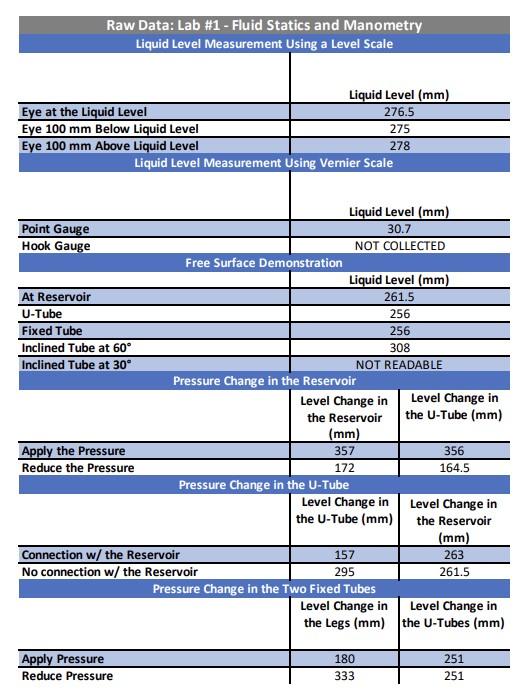
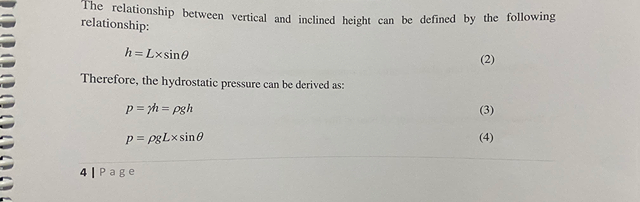
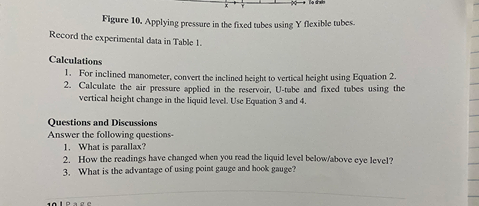
Raw Data: Lab #1 - Fluid Statics and Manometry Liquid Level Measurement Using a Level Scale Liquid Level (mm) Eye at the Liquid Level 276.5 Eye 100 mm Below Liquid Level 275 Eye 100 mm Above Liquid Level 278 Liquid Level Measurement Using Vernier Scale Liquid Level (mm) Point Gauge 30.7 Hook Gauge NOT COLLECTED Free Surface Demonstration Liquid Level (mm) At Reservoir 261.5 U-Tube 256 Fixed Tube 256 Inclined Tube at 60 308 Inclined Tube at 30 NOT READABLE Pressure Change in the Reservoir Level Change in Level Change in the Reservoir the U-Tube (mm) (mm) Apply the Pressure 357 356 Reduce the Pressure 172 164.5 Pressure Change in the U-Tube Level Change in Level Change in the U-Tube (mm) the Reservoir (mm) Connection w/ the Reservoir 157 263 No connection w/ the Reservoir 295 261.5 Pressure Change in the Two Fixed Tubes Level Change in Level Change in the Legs (mm) the U-Tubes (mm) Apply Pressure Reduce Pressure 180 333 251 251 The relationship between vertical and inclined height can be defined by the following relationship: h=Lxsin (2) Therefore, the hydrostatic pressure can be derived as: p= th=pgh (3) p = pgLxsin 4 Page Figure 10. Applying pressure in the fixed tubes using Y flexible tubes. Record the experimental data in Table 1. Calculations 1. For inclined manometer, convert the inclined height to vertical height using Equation 2. 2. Calculate the air pressure applied in the reservoir, U-tube and fixed tubes using the vertical height change in the liquid level. Use Equation 3 and 4. Questions and Discussions Answer the following questions. 1. What is parallax? 2. How the readings have changed when you read the liquid level below/above eye level? 3. What is the advantage of using point gauge and hook gauge? 10 Page Raw Data: Lab #1 - Fluid Statics and Manometry Liquid Level Measurement Using a Level Scale Liquid Level (mm) Eye at the Liquid Level 276.5 Eye 100 mm Below Liquid Level 275 Eye 100 mm Above Liquid Level 278 Liquid Level Measurement Using Vernier Scale Liquid Level (mm) Point Gauge 30.7 Hook Gauge NOT COLLECTED Free Surface Demonstration Liquid Level (mm) At Reservoir 261.5 U-Tube 256 Fixed Tube 256 Inclined Tube at 60 308 Inclined Tube at 30 NOT READABLE Pressure Change in the Reservoir Level Change in Level Change in the Reservoir the U-Tube (mm) (mm) Apply the Pressure 357 356 Reduce the Pressure 172 164.5 Pressure Change in the U-Tube Level Change in Level Change in the U-Tube (mm) the Reservoir (mm) Connection w/ the Reservoir 157 263 No connection w/ the Reservoir 295 261.5 Pressure Change in the Two Fixed Tubes Level Change in Level Change in the Legs (mm) the U-Tubes (mm) Apply Pressure Reduce Pressure 180 333 251 251 The relationship between vertical and inclined height can be defined by the following relationship: h=Lxsin (2) Therefore, the hydrostatic pressure can be derived as: p= th=pgh (3) p = pgLxsin 4 Page Figure 10. Applying pressure in the fixed tubes using Y flexible tubes. Record the experimental data in Table 1. Calculations 1. For inclined manometer, convert the inclined height to vertical height using Equation 2. 2. Calculate the air pressure applied in the reservoir, U-tube and fixed tubes using the vertical height change in the liquid level. Use Equation 3 and 4. Questions and Discussions Answer the following questions. 1. What is parallax? 2. How the readings have changed when you read the liquid level below/above eye level? 3. What is the advantage of using point gauge and hook gauge? 10 Page
Step by Step Solution
There are 3 Steps involved in it

Get step-by-step solutions from verified subject matter experts
 Study Help