







Question: Please help with discrete structures 1.1Check the box if it's simple [2/ ea =8] 1.2If it isn't simple, draw a simple version by removing as
Please help with discrete structures 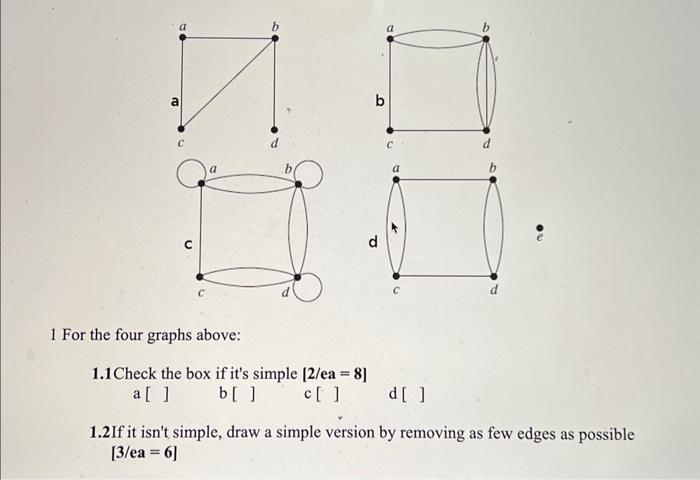
![ea =8] 1.2If it isn't simple, draw a simple version by removing](https://s3.amazonaws.com/si.experts.images/answers/2024/09/66d7f177dff60_08766d7f1778fe7e.jpg)
![as few edges as possible [3/ea=6] 2 Draw the following graphs (see](https://s3.amazonaws.com/si.experts.images/answers/2024/09/66d7f1787a954_08866d7f1781e93a.jpg)
![slides/textbook) [2/ea=8] a) K7 b) K4,4 d) C7 e) W7 3 For](https://s3.amazonaws.com/si.experts.images/answers/2024/09/66d7f1790495f_08866d7f178ad6f6.jpg)
1.1Check the box if it's simple [2/ ea =8] 1.2If it isn't simple, draw a simple version by removing as few edges as possible [3/ea=6] 2 Draw the following graphs (see slides/textbook) [2/ea=8] a) K7 b) K4,4 d) C7 e) W7 3 For the following graphs attempt a two-colorization to show or refute that it's bipartite. [3/each = 6] Hint: Try it on a separate page first, it can get messy! 4 The complementary graph co(G) of a simple graph G has the same vertices as G. Two distinct vertices are adjacent in co((G) if and only if they are not adjacent in G. Draw the graph co(K2,3)[8]
Step by Step Solution
There are 3 Steps involved in it
1 Expert Approved Answer
Step: 1 Unlock

Question Has Been Solved by an Expert!
Get step-by-step solutions from verified subject matter experts
Step: 2 Unlock
Step: 3 Unlock
 Study Help