







Question: Please help with exercise problems 7 through 9. CASE STUDY: A TOTAL COST MODEL FOR A TRAINING PROGRAM In this application, we set up a
Please help with exercise problems 7 through 9.
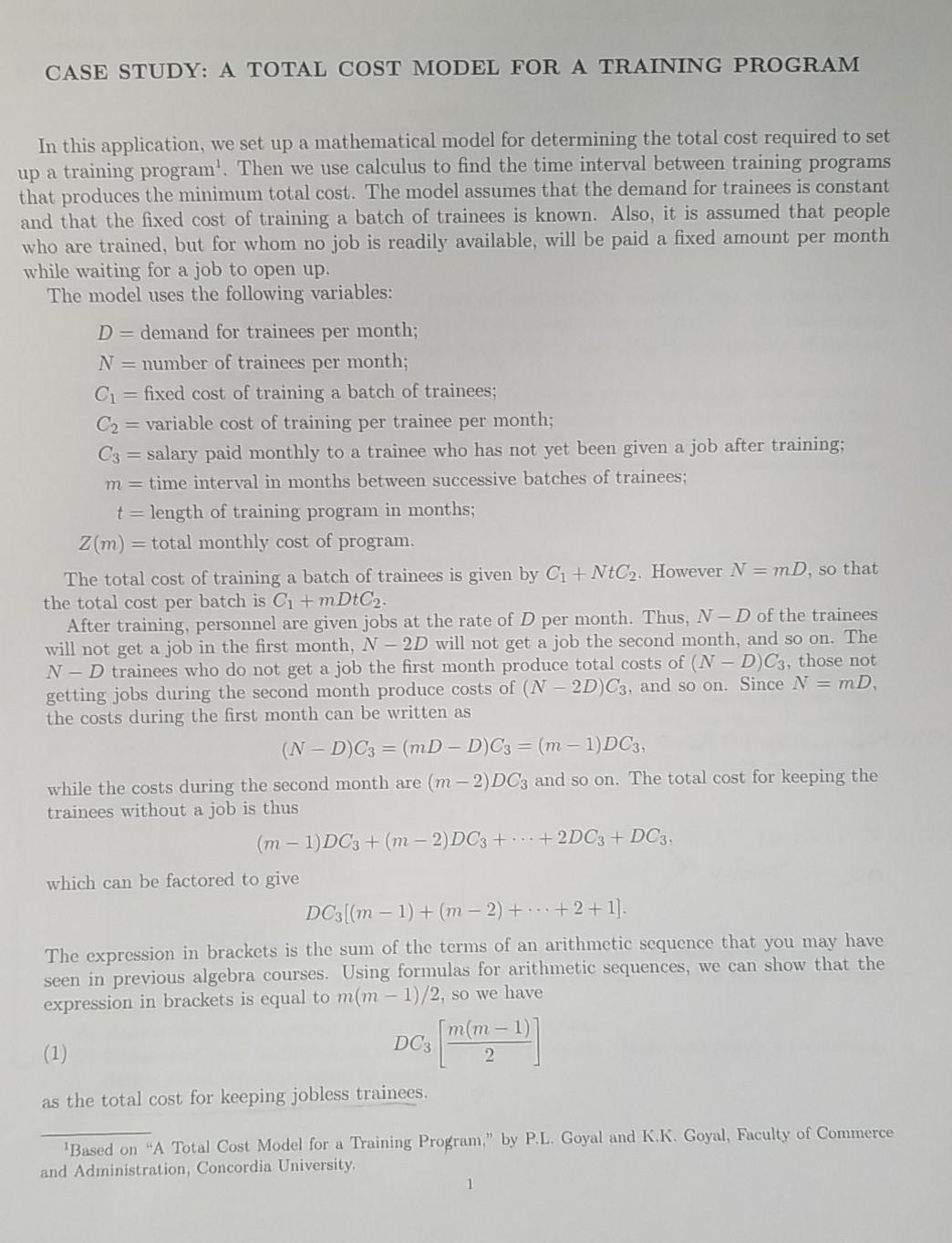
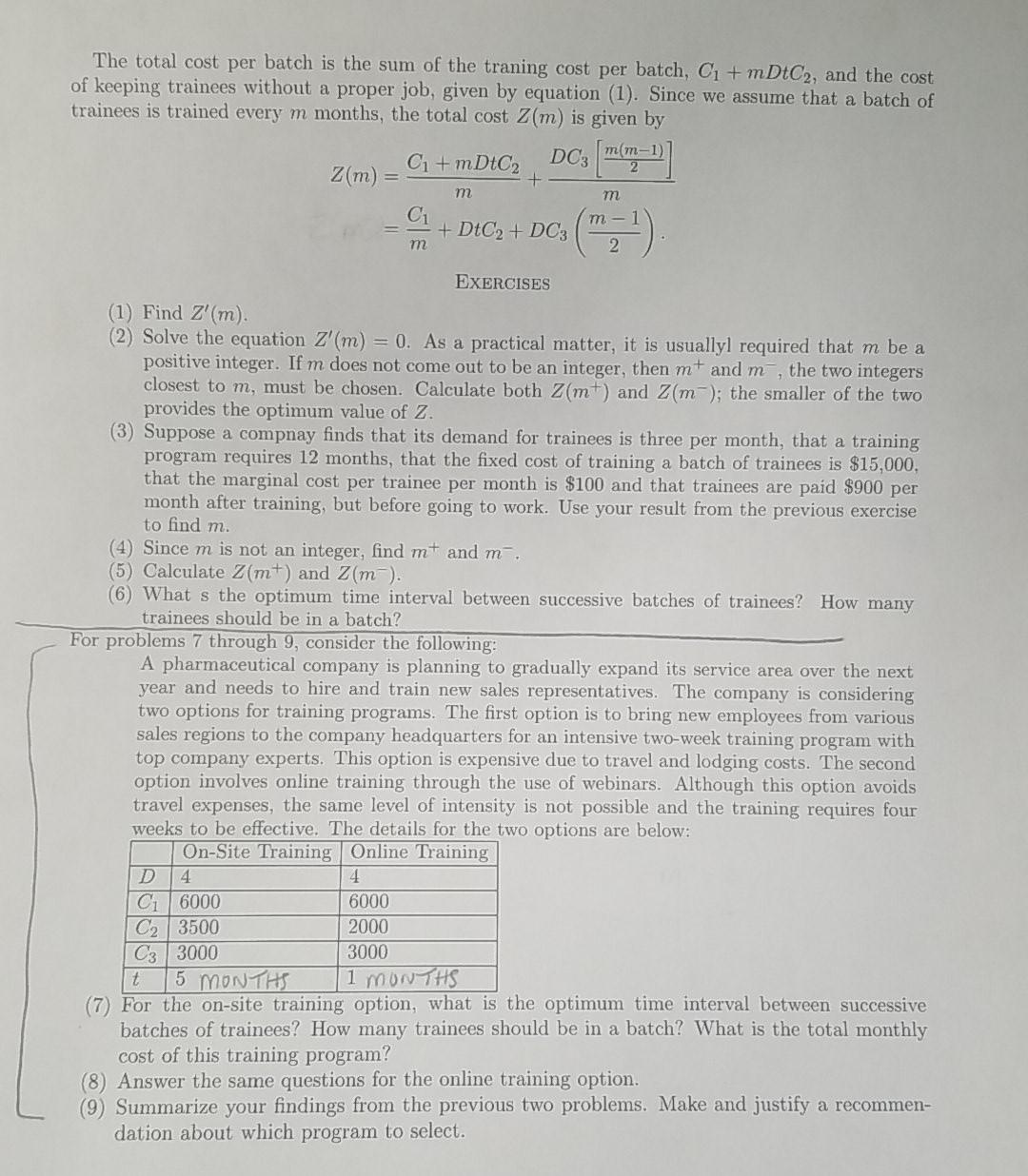
CASE STUDY: A TOTAL COST MODEL FOR A TRAINING PROGRAM In this application, we set up a mathematical model for determining the total cost required to set up a training program'. Then we use calculus to find the time interval between training programs that produces the minimum total cost. The model assumes that the demand for trainees is constant and that the fixed cost of training a batch of trainees is known. Also, it is assumed that people who are trained, but for whom no job is readily available, will be paid a fixed amount per month while waiting for a job to open up. The model uses the following variables: D = demand for trainees per month; N = number of trainees per month; C1 = fixed cost of training a batch of trainees; C2 = variable cost of training per trainee per month; C3 = salary paid monthly to a trainee who has not yet been given a job after training; m = time interval in months between successive batches of trainees; t = length of training program in months; Z(m) = total monthly cost of program. The total cost of training a batch of trainees is given by C1 +Nt2. However N = mD, so that the total cost per batch is C +mDtC2. After training, personnel are given jobs at the rate of D per month. Thus, N-D of the trainees will not get a job in the first month, N 2D will not get a job the second month, and so on. The N - D trainees who do not get a job the first month produce total costs of (N DC3, those not getting jobs during the second month produce costs of (N 2D)C3, and so on. Since N = mD, the costs during the first month can be written as (N DC3 = (mD - DC3 = (m - 1)DC3, while the costs during the second month are (m - 2)DC3 and so on. The total cost for keeping the trainees without a job is thus (m - 1)DC3 + (m 2)DC3 + ... +2DC3 + DC3, which can be factored to give DC3[(m 1) + (m - 2) + ... +2 +1]. The expression in brackets is the sum of the terms of an arithmetic sequence that you may have seen in previous algebra courses. Using formulas for arithmetic sequences, we can show that the expression in brackets is equal to mm - 1)/2, so we have [m(m-1) 2 as the total cost for keeping jobless trainees. Based on "A Total Cost Model for a Training Program." by P.L. Goyal and K.K. Goyal, Faculty of Commerce and Administration, Concordia University, The total cost per batch is the sum of the traning cost per batch, C1 + mDtC2, and the cost of keeping trainees without a proper job, given by equation (1). Since we assume that a batch of trainees is trained every m months, the total cost Z(m) is given by DC; mm-1] Ci + mDtC2 Z(m): + m C m - 1 + DtC2 + DC3 m 2 m EXERCISES (1) Find Z'(m). (2) Solve the equation Z' (m) = 0. As a practical matter, it is usuallyl required that m be a positive integer. If m does not come out to be an integer, then m+ and m , the two integers closest to m, must be chosen. Calculate both Z(mt) and Z(m); the smaller of the two provides the optimum value of Z. (3) Suppose a compnay finds that its demand for trainees is three per month, a training program requires 12 months, that the fixed cost of training a batch of trainees is $15,000, that the marginal cost per trainee per month is $100 and that trainees are paid $900 per month after training, but before going to work. Use your result from the previous exercise to find m. (4) Since m is not an integer, find m+ and m. (5) Calculate Z(mt) and Z(m). (6) What s the optimum time interval between successive batches of trainees? How many trainees should be in a batch? For problems 7 through 9, consider the following: A pharmaceutical company is planning to gradually expand its service area over the next year and needs to hire and train new sales representatives. The company is considering two options for training programs. The first option is to bring new employees from various sales regions to the company headquarters for an intensive two-week training program with top company experts. This option is expensive due to travel and lodging costs. The second option involves online training through the use of webinars. Although this option avoids travel expenses, the same level of intensity is not possible and the training requires four weeks to be effective. The details for the two options are below: On-Site Training Online Training D 4 4 C 6000 6000 C2 3500 2000 C: 3000 3000 t 5 MONTHS 1 MONTHS (7) For the on-site training option, what is the optimum time interval between successive batches of trainees? How many trainees should be in a batch? What is the total monthly cost of this training program? (8) Answer the same questions for the online training option. (9) Summarize your findings from the previous two problems. Make and justify a recommen- dation about which program to select. CASE STUDY: A TOTAL COST MODEL FOR A TRAINING PROGRAM In this application, we set up a mathematical model for determining the total cost required to set up a training program'. Then we use calculus to find the time interval between training programs that produces the minimum total cost. The model assumes that the demand for trainees is constant and that the fixed cost of training a batch of trainees is known. Also, it is assumed that people who are trained, but for whom no job is readily available, will be paid a fixed amount per month while waiting for a job to open up. The model uses the following variables: D = demand for trainees per month; N = number of trainees per month; C1 = fixed cost of training a batch of trainees; C2 = variable cost of training per trainee per month; C3 = salary paid monthly to a trainee who has not yet been given a job after training; m = time interval in months between successive batches of trainees; t = length of training program in months; Z(m) = total monthly cost of program. The total cost of training a batch of trainees is given by C1 +Nt2. However N = mD, so that the total cost per batch is C +mDtC2. After training, personnel are given jobs at the rate of D per month. Thus, N-D of the trainees will not get a job in the first month, N 2D will not get a job the second month, and so on. The N - D trainees who do not get a job the first month produce total costs of (N DC3, those not getting jobs during the second month produce costs of (N 2D)C3, and so on. Since N = mD, the costs during the first month can be written as (N DC3 = (mD - DC3 = (m - 1)DC3, while the costs during the second month are (m - 2)DC3 and so on. The total cost for keeping the trainees without a job is thus (m - 1)DC3 + (m 2)DC3 + ... +2DC3 + DC3, which can be factored to give DC3[(m 1) + (m - 2) + ... +2 +1]. The expression in brackets is the sum of the terms of an arithmetic sequence that you may have seen in previous algebra courses. Using formulas for arithmetic sequences, we can show that the expression in brackets is equal to mm - 1)/2, so we have [m(m-1) 2 as the total cost for keeping jobless trainees. Based on "A Total Cost Model for a Training Program." by P.L. Goyal and K.K. Goyal, Faculty of Commerce and Administration, Concordia University, The total cost per batch is the sum of the traning cost per batch, C1 + mDtC2, and the cost of keeping trainees without a proper job, given by equation (1). Since we assume that a batch of trainees is trained every m months, the total cost Z(m) is given by DC; mm-1] Ci + mDtC2 Z(m): + m C m - 1 + DtC2 + DC3 m 2 m EXERCISES (1) Find Z'(m). (2) Solve the equation Z' (m) = 0. As a practical matter, it is usuallyl required that m be a positive integer. If m does not come out to be an integer, then m+ and m , the two integers closest to m, must be chosen. Calculate both Z(mt) and Z(m); the smaller of the two provides the optimum value of Z. (3) Suppose a compnay finds that its demand for trainees is three per month, a training program requires 12 months, that the fixed cost of training a batch of trainees is $15,000, that the marginal cost per trainee per month is $100 and that trainees are paid $900 per month after training, but before going to work. Use your result from the previous exercise to find m. (4) Since m is not an integer, find m+ and m. (5) Calculate Z(mt) and Z(m). (6) What s the optimum time interval between successive batches of trainees? How many trainees should be in a batch? For problems 7 through 9, consider the following: A pharmaceutical company is planning to gradually expand its service area over the next year and needs to hire and train new sales representatives. The company is considering two options for training programs. The first option is to bring new employees from various sales regions to the company headquarters for an intensive two-week training program with top company experts. This option is expensive due to travel and lodging costs. The second option involves online training through the use of webinars. Although this option avoids travel expenses, the same level of intensity is not possible and the training requires four weeks to be effective. The details for the two options are below: On-Site Training Online Training D 4 4 C 6000 6000 C2 3500 2000 C: 3000 3000 t 5 MONTHS 1 MONTHS (7) For the on-site training option, what is the optimum time interval between successive batches of trainees? How many trainees should be in a batch? What is the total monthly cost of this training program? (8) Answer the same questions for the online training option. (9) Summarize your findings from the previous two problems. Make and justify a recommen- dation about which program to select
Step by Step Solution
There are 3 Steps involved in it

Get step-by-step solutions from verified subject matter experts
 Study Help