Question: please help with how many possible at least 3-4. 1. (17 pts) When baking potatoes, the main limiting factor is getting the temperature of the
please help with how many possible at least 3-4.
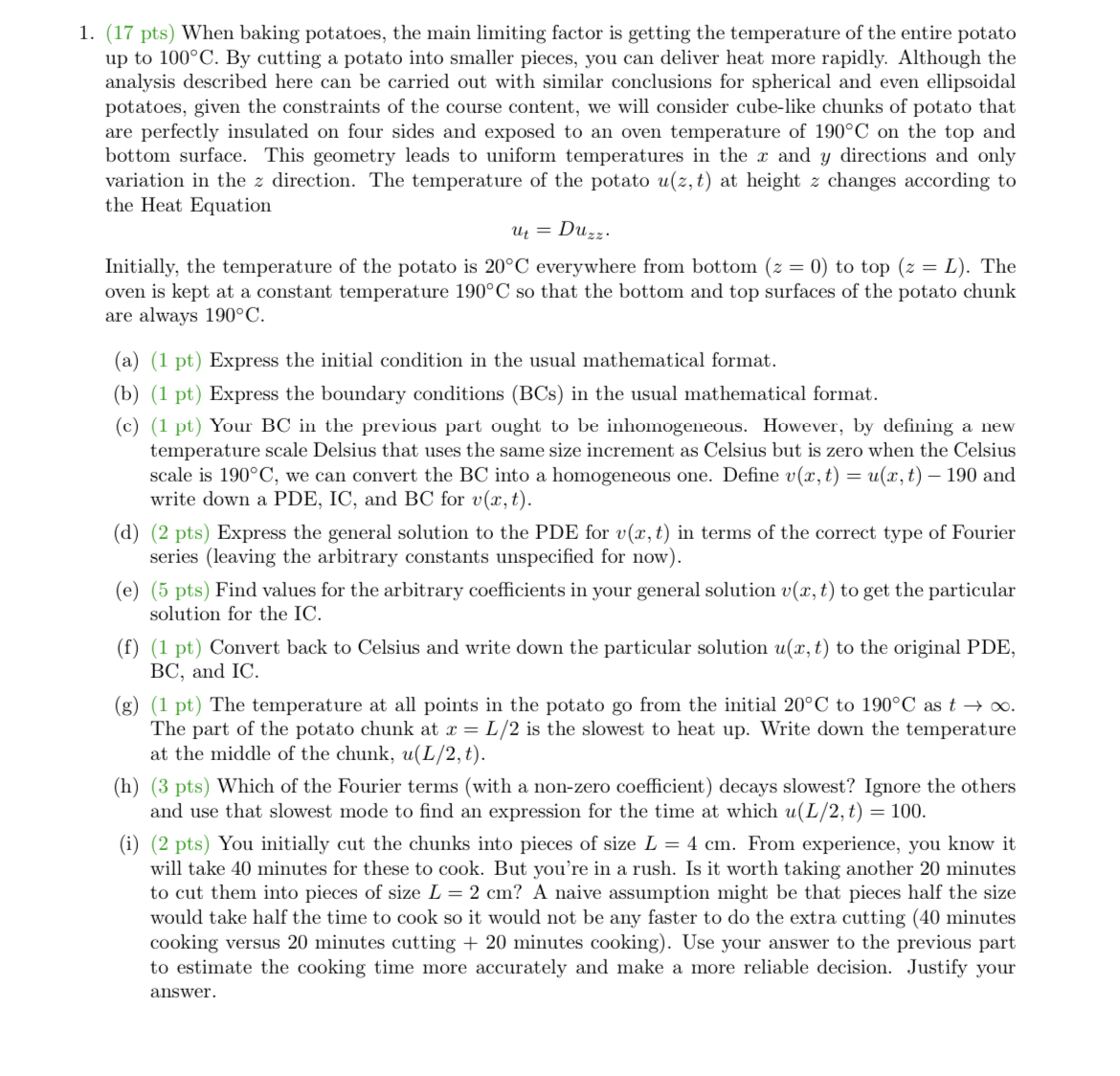
1. (17 pts) When baking potatoes, the main limiting factor is getting the temperature of the entire potato up to 100C. By cutting a potato into smaller pieces, you can deliver heat more rapidly. Although the analysis described here can be carried out with similar conclusions for spherical and even ellipsoidal potatoes, given the constraints of the course content, we will consider cube-like chunks of potato that are perfectly insulated on four sides and exposed to an oven temperature of 190C on the top and bottom surface. This geometry leads to uniform temperatures in the x and y directions and only variation in the z direction. The temperature of the potato u(z, t) at height 2 changes according to the Heat Equation a, = Dun. Initially, the temperature of the potato is 20C everywhere from bottom (2 = 0) to top (2 = L). The oven is kept at a constant temperature 190C so that the bottom and top surfaces of the potato chunk are always 190C. (a) (1 pt) Express the initial condition in the usual mathematical format. (b) [1 pt) Express the boundary conditions (BCs) in the usual mathematical format. (:3) (1 pt) Your BC in the previous part ought to be inhomogeneous. However, by dening a. new temperature scale Delsius that uses the same size increment as Celsius but is zero when the Celsius scale is 190C, we can convert the BC into a homogeneous one. Dene 0(25, t) : u(a:, t) 190 and write down a PDE, IC, and BC for v(.r,t). (d) (2 pts) Express the general solution to the PDE for v(.z, t) in terms of the correct type of Fourier series (leaving the arbitrary constants unspecied for now). (e) [5 pts) Find values for the arbitrary coefcients in your general solution u(3:, t) to get the particular solution for the IC. (f) (1 pt) Convert back to Celsius and write down the particular solution u(:r, t) to the original PDE, BC, and IC. (g) (1 pt) The temperature at all points in the potato go from the initial 20C to 190C as t ) 00. The part of the potato chunk at :1: : L/ 2 is the slowest to heat up. Write down the temperature at the middle of the chunk, u(L/2,t). (h) [3 pts] Which of the Fourier terms (with a non-zero coefficient) decays slowest? Ignore the others and use that slowest mode to nd an expression for the time at which u(L/ 2, t) = 100. (i) [2 pts) You initially cut the chunks into pieces of size L = 4 cm. Hom experience, you know it will take 40 minutes for these to cook. But you're in a rush. Is it worth taking another 20 minutes to cut them into pieces of size L = 2 cm? A naive assumption might be that pieces half the size would take half the time to cook so it would not be any faster to do the extra cutting (40 minutes cooking versus 20 minutes cutting + 20 minutes cooking). Use your answer to the previous part to estimate the cooking time more accurately and make a more reliable decision. Justify your
Step by Step Solution
There are 3 Steps involved in it
1 Expert Approved Answer
Step: 1 Unlock
Question Has Been Solved by an Expert!
Get step-by-step solutions from verified subject matter experts
Step: 2 Unlock
Step: 3 Unlock
Students Have Also Explored These Related Mathematics Questions!









 Study Help