







Question: Please help with Java Programming Project outcomes: Develop a Java program that 1. Uses selection constructs (if, and if else) 2 Uses the Java iteration
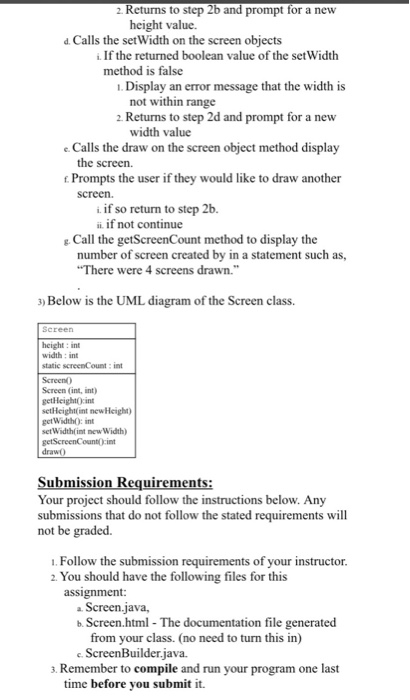
Project outcomes: Develop a Java program that 1. Uses selection constructs (if, and if else) 2 Uses the Java iteration constructs (while, do, for). 3. Uses static variables. 4. Ensure integer variables input are within a range that will not cause integer overflow. 5.Uses proper design techniques including reading UML Class Diagrams Preparatory Readings: Absolute Java textbook, chapter 1-5 Background Information: The Unified Modeling Language (UML) provides a useful notation for designing and developing object-oriented software systems. One of the basic components of the UML is a class diagram, which are used to depict the attributes and behaviors of a class. A basic class diagram (as shown in the figure below) has three components. The first is the class name. The second component includes the class's attributes or fields. Each attribute is followed by a colon and its data type. The third component includes the class's behaviors or methods. If the method takes parameters, their types are included in parentheses. Each behavior is also followed by a colon and its retum type. If the return value of a method is void, the return type can be omitted. For more information on the UML, refer to http://www.uml.org/ Project Requirements: a. Screen structure The pixels are represented by dots b Static Variables: screenCount-a static integer variable that represents the number of screen objects created in a given run of the program Instance variables height an integer representing the height of the screen, in pixels an integer representing the width of width the screen, in pixels d. Constructors Default (no parameter constructor) i.sets the instance variables and static variable to
Step by Step Solution
There are 3 Steps involved in it

Get step-by-step solutions from verified subject matter experts
 Study Help