







Question: Please help with only problem 4 and 5 The economic recession that ended around the summer of 2009 has enabled the OEM to expand production
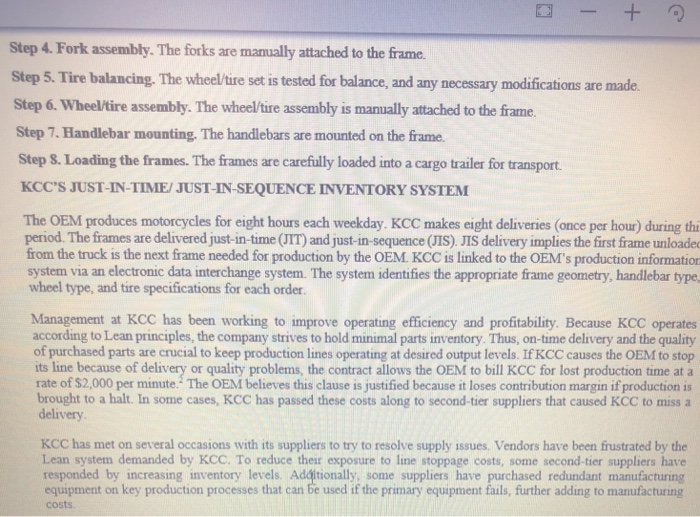
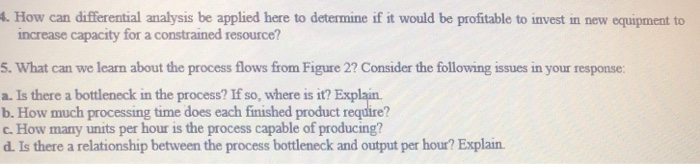
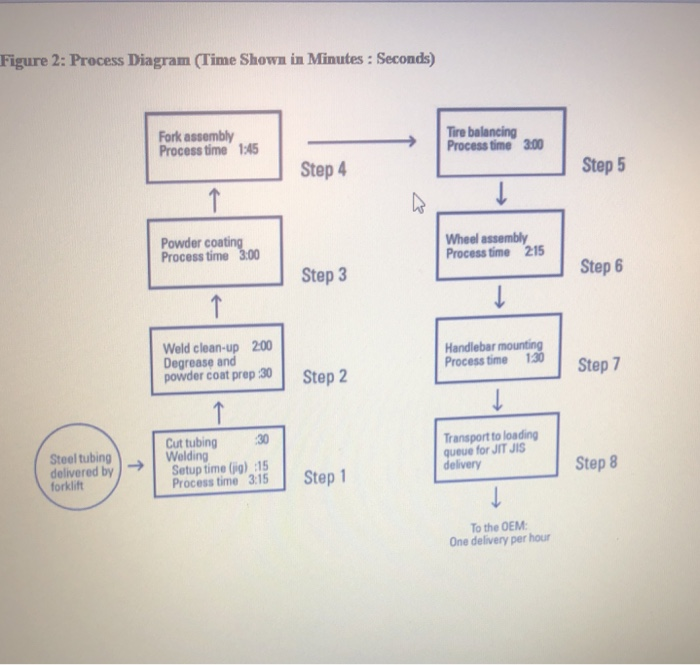
The economic recession that ended around the summer of 2009 has enabled the OEM to expand production and sales The company's sales have increased by 1,000 units per year since 2010. By 2015, KCC was delivering 30,000 unitst the OEM; management believes this level of output represents capacity. Thus, production above 30,000 units is no possible without staff overtime or an investment in additional plant resources that will increase hourly throughput Management at KCC has received notice that the OEM plans to increase production by 3,750 units next year (12.5%) and to demand price concessions of $200 per unit as specified in the contract THE PRODUCT MIX AND OUTSOURCED PARTS The OEM produces motorcycles for three different market niches; therefore, KCC produces three distinctly different frame geometries as follows Sport bikes emphasize speed and agility. Customers expect rapid acceleration and responsive handling. Cruising bikes emphasize power and comfort. They allow riders to enjoy long-distance touring. Retro bikes appeal to customers who appreciate classic designs. They are typically smaller than cruising bikes and more stable than sport bikes For each frame geometry, the OEM offers three possible handlebar types. Because riders are various sizes, handlebars can be configured in a variety of heights, widths, and lengths (straight bars or bars pulled back toward the rider). The OEM offers three different wheel set possibilities. Wheel sets consist of one front wheel and one rear wheel. The different wheel designs are: Chrome spokes Cast aluminum polished (silver) alloy wheels Cast aluminum anodized (black) alloy wheels The OEM offers four unique tire choices for each frame type. Thus, KCC could purchase as many as 12 different tire models to meet market demand (three frame types x four different tires per frame). Factors that differentiate the tires include: Bias-ply (characterized by a round profile and tall sidewalls) Radial (characterized by a flat profile and short sidewalls) Grip (soft better road grip but shorter tread life, hard poorer road grip, but longer tread life) Tread design (differences in the number of grooves in the tire pattern). Number of layers (known as plies) from which the tire is constructed, using more layers results in a stiffer tire. The OEM contracts directly with the tire manufacturer to supply speific tires to the wheel manufacturer. Much engineering effort has gone into identifying the pr oper tires and wheels for each type of motorcycl e. receives and mounts the appropriate tire on the wheel set and then delivers the set to KCC. The tire manufacturer sells its products to different OEMs, as well as to aftermarket customers Recently, the OEM has complained to KCC about chassis that vibrate and exhibit poor handling qualities when the completed motorcycle is test driven. Engineers at KCC have traced the source of the problem to the tire manufacturer. A properly causes vibration and is a control and safety issue. The solution requires placing the wheel/tire set on a machine to determine the location of the imperfection causing the small weight is attached to the wheel to offset the tire imperfection and to remove the vibration. Because of pressure fr the OEM to deliver a quality chassis, KCC purchased a on their chassis. The quality delivered to the OEM has improved, but management at KCC is unhappy because the OEM refuses to increase the contract price to help offiset KCC's additional cost of equipment and labor wheel balancing machine and tested each set before installing it The supply chain has additional complications. One of KCC's suppliers (a second-tier supplier that produces handlebars) is also a subsidiary of the holding company that owns KCC. This supplier has contracts with manufacturers of bicycl chairs. On several occasions, this supplier has missed scheduled deliveries. When confronted management explained they had external customers iwhose orders must be filled. At certain times of the year, demand exceeds the supplier's ability to meet it. As a result, KCC management has scrambled to find suitable suppliers (at much greater cost) in order to meet their own delivery schedules Step 4. Fork assembly. The forks are manually attached to the frame. Step 5. Tire balancing. The wheel/tire set is tested for balance, and any necessary modifications are made. Step 6. Wheel/tire assembly. The wheel/tire assembly is manually attached to the frame. Step 7. Handlebar mounting. The handlebars are mounted on the frame. Step S. Loading the frames. The frames are carefully loaded into a cargo trailer for transport KCCS JUST-IN-TIME/ JUST-IN-SEQUENCE INVENTORY SYSTEM The OEM produces motorcycles for eight hours each weekday. KCC makes eight deliveries (once per hour) during thi period. The frames are delivered just-in-time (JIT) and just-in-sequence (JIS). JIS delivery implies the first frame unloade from the truck is the next frame needed for production by the OEM KCC is linked to the OEM's production information system via an electronic data interchange system. The system identifies the appropriate frame geometry, handlebar type wheel type, and tire specifications for each order Management at KCC has been working to improve operating efficiency and profitability. Because KCC operates according to Lean principles, the company strives to hold minimal parts inventory. Thus, on-time delivery and the quality of purchased parts are crucial to keep production lines operating at desired output levels. If KCC causes the OEM to stop its line because of delivery or quality problems, the contract allows the OEM to bill KCC for lost production time at a rate of $2,000 per minute. The OEM believes this clause is justified because it loses contribution margin if production is brought to a halt. In some cases, KCC has passed these costs along to second-tier suppliers that caused KCC to miss a delivery KCC has met on several occasions with its suppliers to try to resolve supply issues. Vendors have been frustrated by the Lean system demanded by KCC. To reduce their exposure to line stoppage costs, some second-tier suppliers have responded by increasing inventory levels. Additionally, some suppliers have purchased redundant manufacturing equipment on key production processes that can be used if the primary equipment fails, further adding to manufacturing costs THE MANAGEMENT DILEMMA KCC's management operates as one participant in a complex supply chain. They are managing relationships involving multitier suppliers and a demanding delivery schedule. Further, stockholders are expressing concern over KCC's declining profitability in recent years. Management has not developed a plan for addressing the increase in production required by the OEM, nor have they developed an understanding of the financial consequences of accepting the new contract Required . How can differential analysis be applied here to determine if it would be profitable to invest in new equipment to increase capacity for a constrained resource? 5. What can we learn about the process flows from Figure 2? Consider the following issues in your response: a. Is there a bottleneck in the process? If so, where is it? Explain. b. How much processing time does each finished product require? c. How many units per hour is the process capable of producing? d. Is there a relationship between the process bottleneck and output per hour? Explain Figure 2: Process Diagram (Time Shown in Minutes: Seconds) Fork assembly Process time 1:45 Tire balancing Process time 3.00 Step 4 Step 5 Powder coa Process time 300 Wheel assembly Process time 215 Step 3 Step 6 Weld clean-up Degrease a powder coat prep 3 2:00 Handlebar mounting Process time 130 Step 2 Step 7 Cut tubing 30 Welding Setup time (io) Process time 3:15 Step Transport to loading queue for JIT JIS Steel tubing delivered by forklift delveryStep 8 To the OEM One delivery per hour
Step by Step Solution
There are 3 Steps involved in it

Get step-by-step solutions from verified subject matter experts
 Study Help