



Question: Please help with PART C ONLY. I included the rest incase it is helpful in solving part (c). I know that by F-test of no
Please help with PART C ONLY. I included the rest incase it is helpful in solving part (c). I know that by F-test of no regression they mean the beta's are zero. Isn't F-static not necessarily continuous? Please help. Thank you!
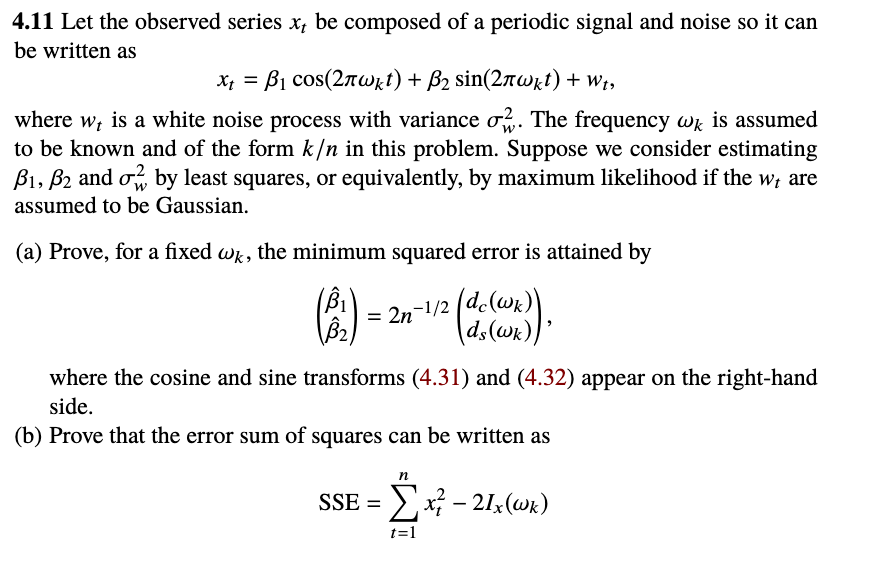

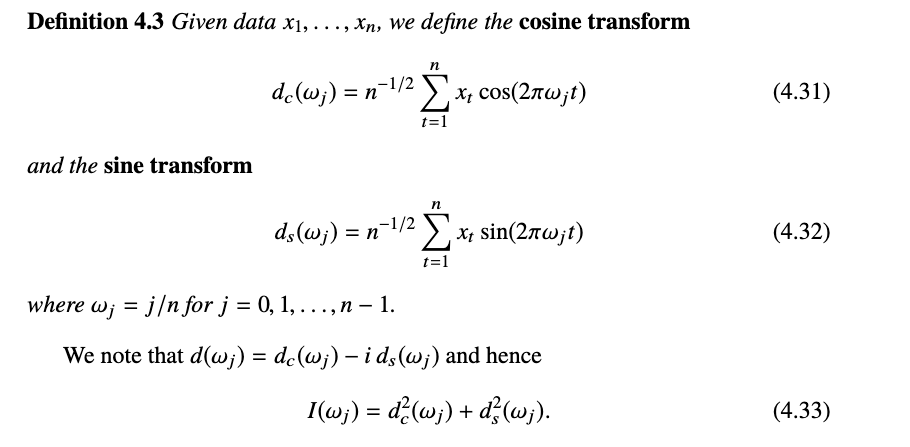
4.11 Let the observed series It be composed of a periodic signal and noise so it can be written as x, = .31 cos(21rwkr) + 32 sin(22rwkt) + w,, where W; is a white noise process with variance 0'3\". The frequency wk is assumed to be known and of the form k in this problem. Suppose we consider estimating [33, g and 0'3, by least squares, or equivalently, by maximum likelihood if the wt are assumed to be Gaussian. (a) Prove, for a xed wk , the minimum squared error is attained by 31 t,f2 dc (wk) A = 2 5 (132) n d5 (wk) where the cosine and sine transforms (4.31) and (4.32) appear on the right-hand side. (b) Prove that the error sum of squares can be written as SSE = 2 x3 2cm) 1] so that the value of wk that minimizes squared error is the same as the value that maximizes the periodogram Ix (wk) estimator (4.28). (e) Under the Gaussian assumption and xed wk, show that the F-test of no regression leads to an F-statistic that is a monotone function of {1(wk). Definition 4.3 Given data X1, . .., Xn, we define the cosine transform n do(w; ) = n-1/2 M X, COS(2nWit) (4.31) 1=1 and the sine transform n ds(w; ) = n-1/2 M x sin(2nwjt) (4.32) 1= 1 where w; = j for j = 0, 1, . ..,n - 1. We note that d(wj) = dc(wj) - ids(w;) and hence I ( w; ) = d=(w; ) + d's (w; ). (4.33)
Step by Step Solution
There are 3 Steps involved in it

Get step-by-step solutions from verified subject matter experts