







Question: Please help with problem 2.1.4. Thanks We will briefly review IPv4 addressing and CIDR and also have a look at the concept of address aggregation.
Please help with problem 2.1.4. Thanks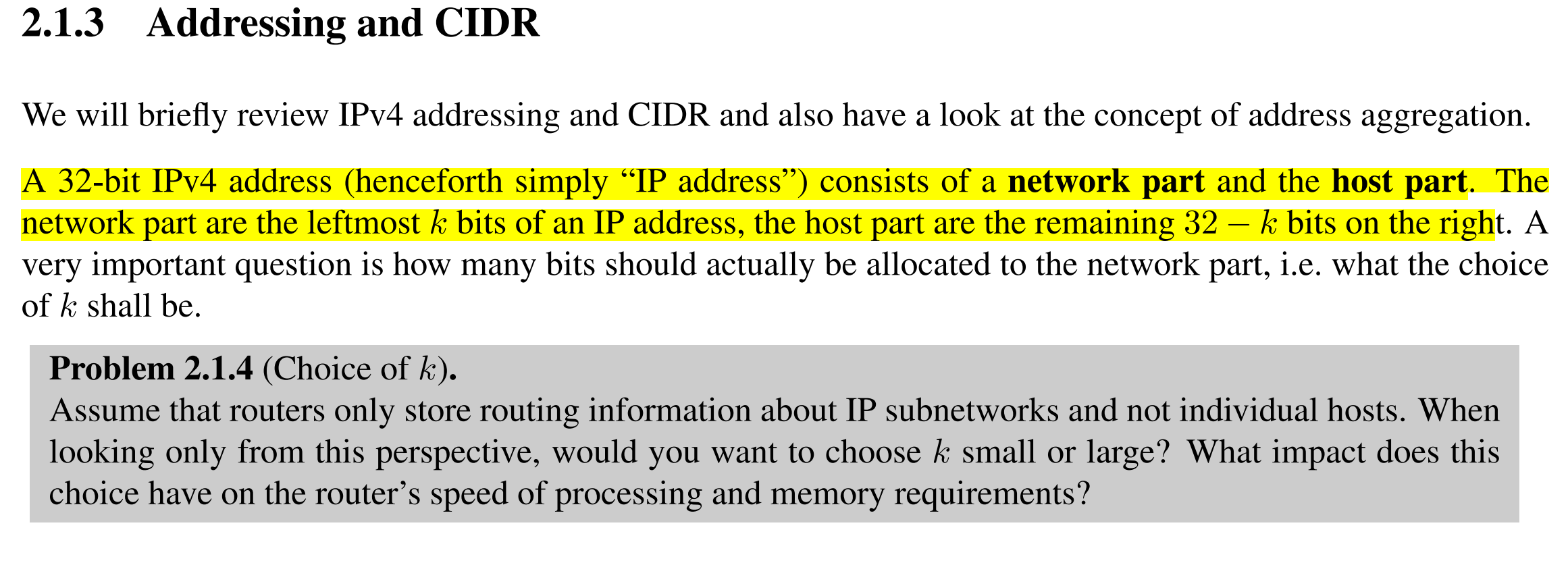
We will briefly review IPv4 addressing and CIDR and also have a look at the concept of address aggregation. A 32-bit IPv4 address (henceforth simply "IP address") consists of a network part and the host part. The network part are the leftmost k bits of an IP address, the host part are the remaining 32k bits on the right. A very important question is how many bits should actually be allocated to the network part, i.e. what the choice of k shall be. Problem 2.1.4 (Choice of k ). Assume that routers only store routing information about IP subnetworks and not individual hosts. When looking only from this perspective, would you want to choose k small or large? What impact does this choice have on the router's speed of processing and memory requirements
Step by Step Solution
There are 3 Steps involved in it

Get step-by-step solutions from verified subject matter experts
 Study Help