







Question: Please help with question 13 AND 14. They are from the same prompt (use question 12 prompt to get the information for questions 13 &
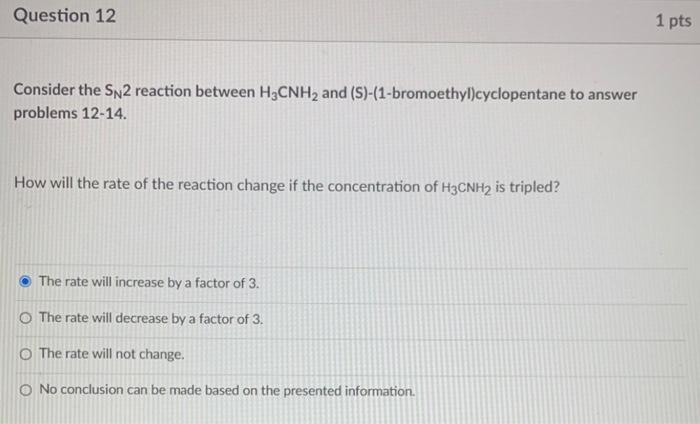
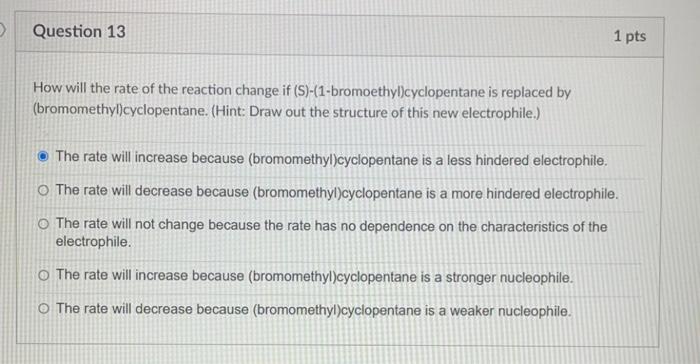
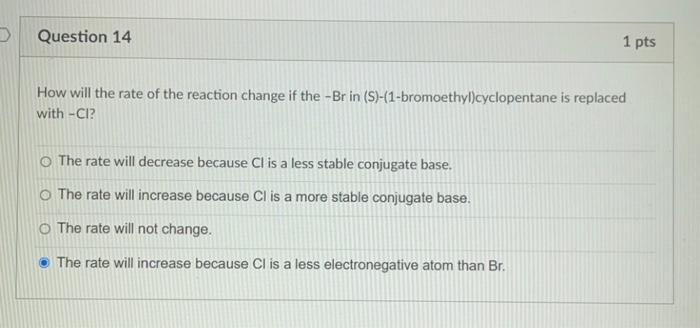
Consider the SN2 reaction between H3CNH2 and (S)-(1-bromoethyl)cyclopentane to answer problems 12-14. How will the rate of the reaction change if the concentration of H3CNH2 is tripled? The rate will increase by a factor of 3 . The rate will decrease by a factor of 3 . The rate will not change. No conclusion can be made based on the presented information. How will the rate of the reaction change if (S)-(1-bromoethyl)cyclopentane is replaced by (bromomethyl)cyclopentane. (Hint: Draw out the structure of this new electrophile.) The rate will increase because (bromomethyl)cyclopentane is a less hindered electrophile. The rate will decrease because (bromomethyl)cyclopentane is a more hindered electrophile. The rate will not change because the rate has no dependence on the characteristics of the electrophile. The rate will increase because (bromomethyl)cyclopentane is a stronger nucleophile. The rate will decrease because (bromomethyl)cyclopentane is a weaker nucleophile. How will the rate of the reaction change if the Br in (S)-(1-bromoethyl)cyclopentane is replaced with Cl ? The rate will decrease because Cl is a less stable conjugate base. The rate will increase because Cl is a more stable conjugate base. The rate will not change. The rate will increase because Cl is a less electronegative atom than Br
Step by Step Solution
There are 3 Steps involved in it

Get step-by-step solutions from verified subject matter experts
 Study Help