







Question: PLease help with simple explain or calculation, just want to learn sth no need to rigourous, thank youBonus Problem 1 ( Optional , 1 0
PLease help with simple explain or calculation, just want to learn sth no need to rigourous, thank youBonus Problem Optional marks
In this problem, you are going to derive general formula for computing the Macaulay
duration and modified convexity of the bond,
We consider a year coupon bond. The face value of the bond is and it pays coupon of
amount at times dots, respectively. We let be the annual effective yield rate of
the bond.
a Derive a formula for the Macaulay duration of the bond. Express your answer in
terms of and In addition, your answer must be free from summation.
b Derive a formula for the Modified convexity of the bond. Express your answer in
terms of and In addition, your answer must be free from summation.
Hint:
The following summation formula will be useful:
The derivation of these formula can be found from the Appendix of this assignment
In this problem, you are going to derive general formula for computing the Macaulay
duration and modified convexity of the bond,
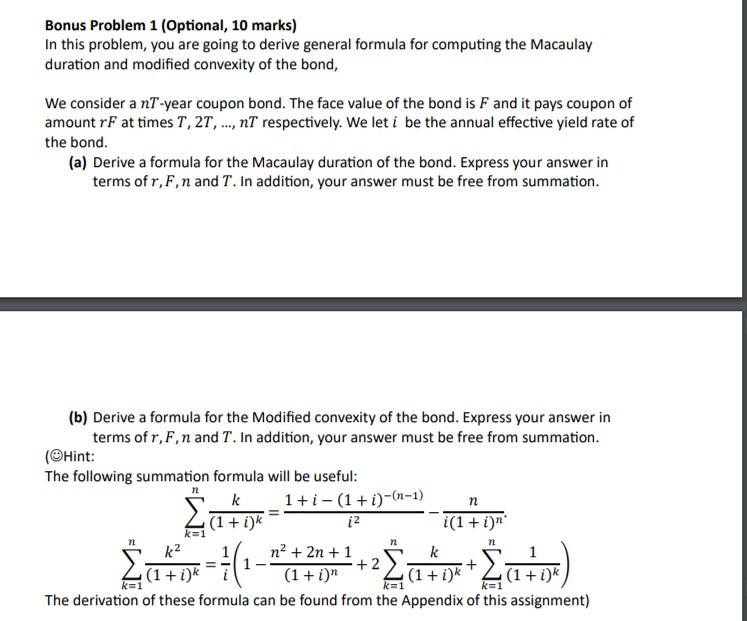
We consider a nTyear coupon bond. The face value of the bond is F and it pays coupon of
amount rF at times TTdots,nT respectively. We let i be the annual effective yield rate of
the bond.
a Derive a formula for the Macaulay duration of the bond. Express your answer in
terms of rFn and T In addition, your answer must be free from summation.
b Derive a formula for the Modified convexity of the bond. Express your answer in
terms of rFn and T In addition, your answer must be free from summation.
Hint:
The following summation formula will be useful:
sumkn kikiininiin
sumkn kikinninsumkn kiksumkn ik
The derivation of these formula can be found from the Appendix of this assignment
Step by Step Solution
There are 3 Steps involved in it
1 Expert Approved Answer
Step: 1 Unlock

Question Has Been Solved by an Expert!
Get step-by-step solutions from verified subject matter experts
Step: 2 Unlock
Step: 3 Unlock
 Study Help