







Question: please help with steps. i will upvote! (Hint: Look at the derivation of the osmotic pressure for an ideal, dilute solution as presented in class.)
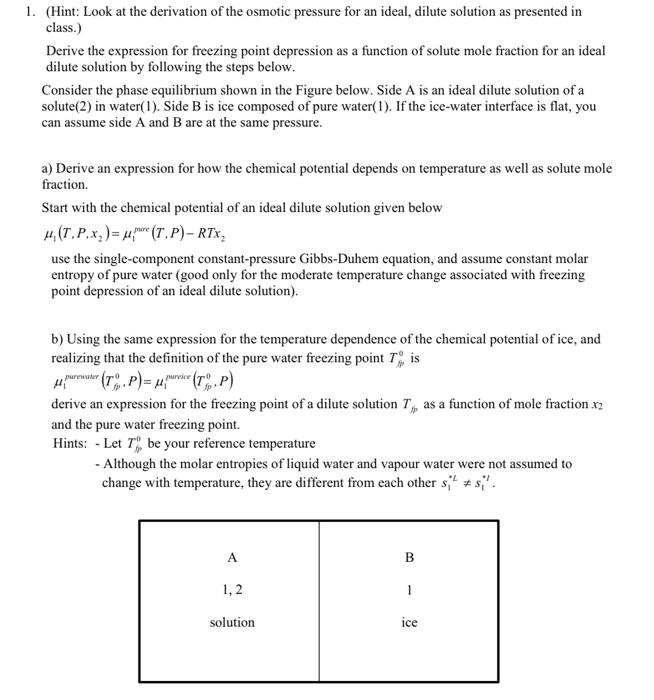
(Hint: Look at the derivation of the osmotic pressure for an ideal, dilute solution as presented in class.) Derive the expression for freezing point depression as a function of solute mole fraction for an ideal dilute solution by following the steps below. Consider the phase equilibrium shown in the Figure below. Side A is an ideal dilute solution of a solute(2) in water(1). Side B is ice composed of pure water(1). If the ice-water interface is flat, you can assume side A and B are at the same pressure. a) Derive an expression for how the chemical potential depends on temperature as well as solute mole fraction. Start with the chemical potential of an ideal dilute solution given below 1(T,P,x2)=1pure(T,P)RTx2 use the single-component constant-pressure Gibbs-Duhem equation, and assume constant molar entropy of pure water (good only for the moderate temperature change associated with freezing point depression of an ideal dilute solution). b) Using the same expression for the temperature dependence of the chemical potential of ice, and realizing that the definition of the pure water freezing point T20 is 1purewate(Tfp0,P)=1pureine(Tfp0,P) derive an expression for the freezing point of a dilute solution Tjp as a function of mole fraction x2 and the pure water freezing point. Hints: - Let Tf0 be your reference temperature - Although the molar entropies of liquid water and vapour water were not assumed to change with temperature, they are different from each other s1L=s1I
Step by Step Solution
There are 3 Steps involved in it

Get step-by-step solutions from verified subject matter experts
 Study Help