







Question: Please help with that question. Don't hand-write please! 1. The table below contains a training dataset of 6 observations, 3 predictors and 1 qualitative outcome
Please help with that question. Don't hand-write please!
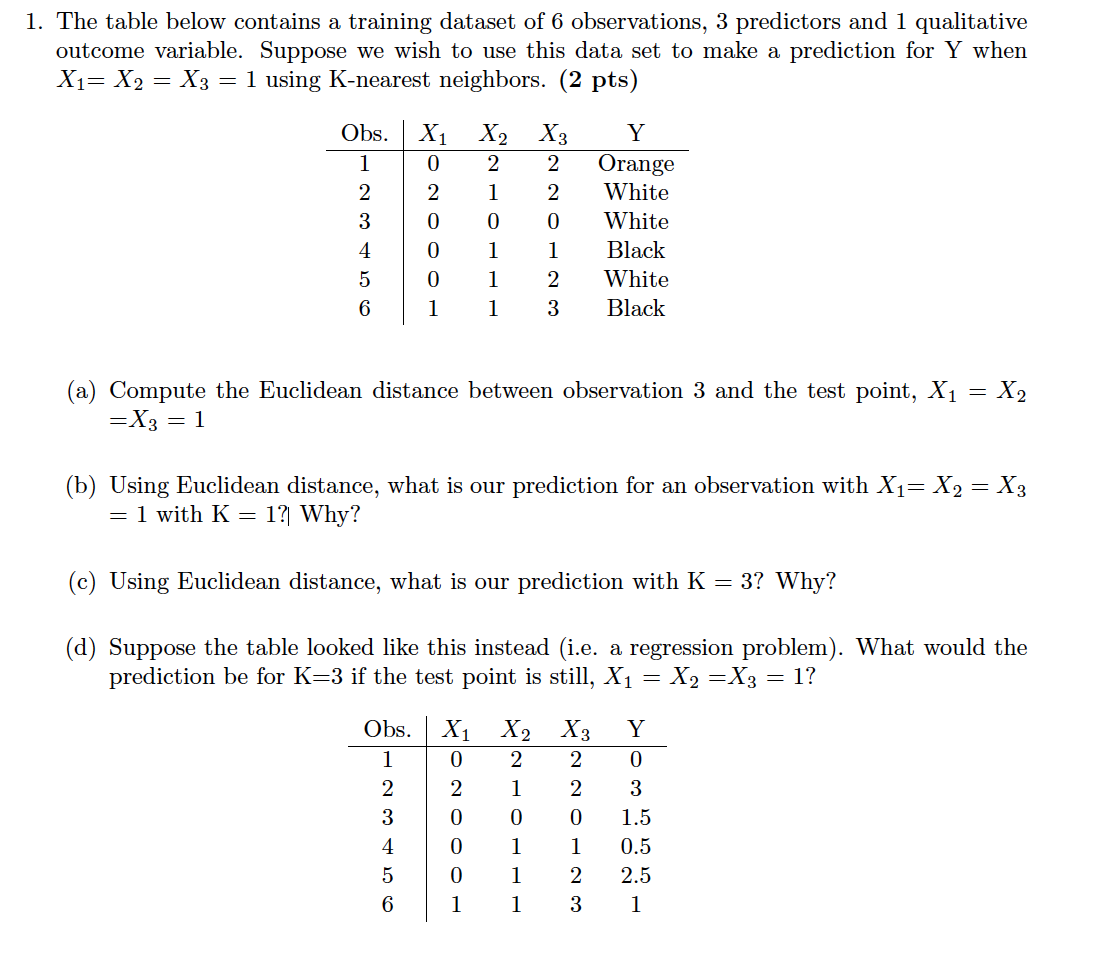
1. The table below contains a training dataset of 6 observations, 3 predictors and 1 qualitative outcome variable. Suppose we wish to use this data set to make a prediction for Y when X1: X2 : X3 = 1 using K-nearest neighbors. (2 pts) Obs. ' X1 X2 X3 Y 1 0 2 2 Orange 2 2 1 2 White 3 0 0 0 White 4 0 1 1 Black 5 0 1 2 White 6 1 1 3 Black (a) Compute the Euclidean distance between observation 3 and the test point, X1 2 X2 (b) Using Euclidean distance, what is our prediction for an observation with X1: X2 : X3 : 1 with K : 1?| Why? (c) Using Euclidean distance, what is our prediction with K = 3'? Why? (d) Suppose the table looked like this instead (i.e. a regression problem). What would the prediction be for K23 if the test point is still, X1 2 X2 2X3 = 1? Obs. ' X1 X2 X3 Y 1 0 2 2 0 2 2 1 2 3 3 0 0 O 1.5 4 0 1 1 0.5 5 0 1 2 2.5 6 1 1 3 1
Step by Step Solution
There are 3 Steps involved in it

Get step-by-step solutions from verified subject matter experts
 Study Help