







Question: Please help with the case study question two. (not the some keys to making a Steinway.) gree gree gree fare. ree ee CHAPTER 2 TRADITIONAL
Please help with the case study question two. (not the some keys to making a Steinway.)
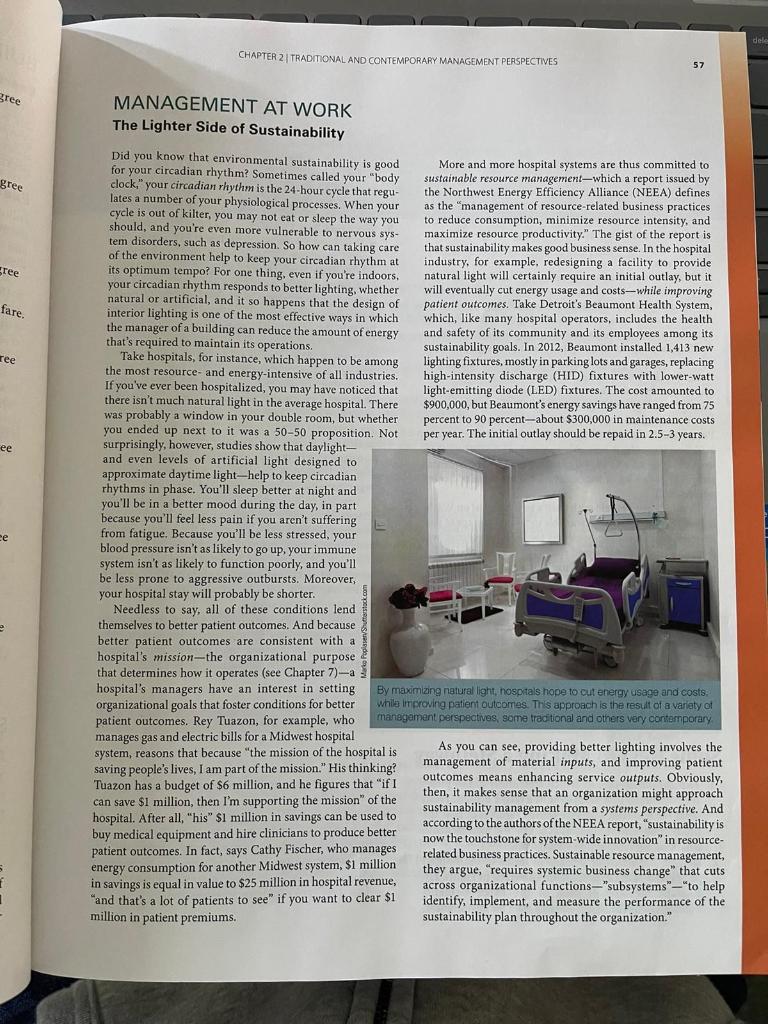
gree gree gree fare. ree ee CHAPTER 2 TRADITIONAL AND CONTEMPORARY MANAGEMENT PERSPECTIVES MANAGEMENT AT WORK The Lighter Side of Sustainability Did you know that environmental sustainability is good for your circadian rhythm? Sometimes called your "body clock," your circadian rhythm is the 24-hour cycle that regu- lates a number of your physiological processes. When your cycle is out of kilter, you may not eat or sleep the way you should, and you're even more vulnerable to nervous sys- tem disorders, such as depression. So how can taking care of the environment help to keep your circadian rhythm at its optimum tempo? For one thing, even if you're indoors, your circadian rhythm responds to better lighting, whether natural or artificial, and it so happens that the design of interior lighting is one of the most effective ways in which the manager of a building can reduce the amount of energy that's required to maintain its operations. Take hospitals, for instance, which happen to be among the most resource- and energy-intensive of all industries. If you've ever been hospitalized, you may have noticed that there isn't much natural light in the average hospital. There was probably a window in your double room, but whether you ended up next to it was a 50-50 proposition. Not surprisingly, however, studies show that daylight- and even levels of artificial light designed. approximate daytime light-help to keep circadian rhythms in phase. You'll sleep better at night and you'll be in a better mood during the day, in part because you'll feel less pain if you aren't suffering from fatigue. Because you'll be less stressed, your blood pressure isn't as likely to go up, your immune system isn't as likely to function poorly, and you'll be less prone to aggressive outbursts. Moreover, your hospital stay will probably be shorter. POKA Needless to say, all of these conditions lend themselves to better patient outcomes. And because patient accom better patient outcomes are consistent with a hospital's mission-the sion-the organizational purpose national that determines how mnes how it operates (see Chapter 7)-a I have an interest in setting ospital's managers organizational goals that foster conditions for better patient outcomes. Rey Tuazon, for example, who manages gas and electric bills for a Midwest hospital system, reasons that because "the mission of the hospital is com D the miccion the mission" of the Lo saving people's lives, I am part of the mission." His thinking? Tuazon has a budget of $6 million, and figures that "if I can save $1 million, then I'm a supporting hospital. After all, "his" $1 million in savings can be used to buy medical equipment and hire clinicians to produce better patient outcomes. In fact, says Cathy Fischer, who manages energy consumption for another Midwest system, $1 million in savings is equal in value to $25 million in hospital revenue, "and that's a lot of patients to see" if you want to clear $1 million in patient premiums. 57 More and more hospital systems are thus committed to sustainable resource management-which a report issued by the Northwest Energy Efficiency Alliance (NEEA) defines as the "management f resource-related business practices to reduce consumption, minimize resource intensity, and maximize resource productivity." The gist of the report is that sustainability makes good business sense. In the hospital industry, for example, redesigning a facility to provide natural light will certainly require an initial outlay, but it will eventually cut energy usage and costs-while improving patient outcomes. Take Detroit's Beaumont Health System, which, like many hospital operators, includes the health and safety of its community and its employees among its sustainability goals. In 2012, Beaumont installed 1,413 new lighting fixtures, mostly in parking lots and garages, replacing high-intensity discharge (HID) fixtures with lower-watt light-emitting diode (LED) fixtures. The cost amounted to $900,000, but Beaumont's energy savings have ranged from 75 percent to 90 percent-about $300,000 in maintenance costs per year. The initial outlay should be repaid in 2.5-3 years. By maximizing natural light, hospitals hope to cut energy usage and costs. while improving patient outcomes. This approach is the result of a variety of management perspectives, some traditional and others very contemporary. As you can see, providing better lighting involves the management of material inputs, and improving patient outcomes means enhancing service outputs. Obviously, then, it makes sense that an organization might approach sustainability management from a systems perspective. And according to the authors of the NEEA report, "sustainability is now the touchstone for system-wide innovation" in resource- related business s practices. Sustainable resource management, they argue, "requires systemic business change" that cuts across organizational functions-"subsystems"-"to help identify, implement, and measure the performance of the sustainability plan throughout the organization." Com 58 PART 1 | Introducing Management The authors single out several "health care systems"- organizations in the hospital industry-as innovators who "operate more efficiently by standardizing systemwide. resource-management policies." In particular, they point to PeaceHealth, a ten-hospital system serving Washington, Oregon, and Alaska, which initiated a strategic energy management plan (or SEMP) in 2007. The PeaceHealth plan-which covers much more than just lighting- started by benchmarking the system's energy-use practices against those of other systems, setting energy efficiency goals, and identifying projects that would help to meet those goals. In the first go-round, a systemwide team discovered that incremental efforts could cut energy use by 10 percent and save the organization $800,000 annually. One project, for instance, called for retrocommissioning certain energy-use systems, which facilities director Gary Hall describes as "taking existing building systems and putting them back in a fine-tuned operating mode. It's kind of low-hanging fruit," he explains, because "it doesn't take a lot of invest- ment-just some focused time to get systems operating effi- andler to run 10 ciently." Reprogramming a building's air hours a day instead of 24 doesn't cost anything, and when PeaceHealth decided to spend $500,000 to computerize building controls, it was able to combine $300,000 of its own money with a $200,000 grant from a local utility com- pany. "There's a lot of money available for these projects," advises Hall. Finally, when PeaceHealth built a new hospital on Wash- ington's San Juan Island, it was able to take advantage of pas- sive cooling and heating-systems for both preventing heat from entering a building and removing it as necessary-by simply optimizing the building's orientation to the sun. The facility also uses a ground-source heat pump-a central heating/cooling system that transfers heat to and from the ground-as well as low-flow sinks and toilets. The result is one of the most energy-efficient hospitals in North Amer- ica-one that uses 63 percent less energy than comparable hospitals." Case QuestionsTMEMEDHAM 1. How might an integrating framework be used to enhance a sustainability strategy in a company whose management perspective is primarily quantitative? In one that depends primarily on a contingency perspective? Conversely, how might a quantitative perspective lend itself to the development and deployment of a sustainability strategy? How about a contingency perspective? 2. Wisconsin-based Gundersen Health System partners with its local solid waste department to pump enough landfill gas to run a 350,000-square-foot facility. It runs a dairy-digester system (including 2,000 cows) at three local farms in order to produce its own electricity, and it needs, because it now produces more electricity than it it sells the surplus to local utilities. In 2014, Gundersen became the nation's first energy-independent health system, producing more fossil fuel than it consumes. Gundersen thus depends on a certain systems-based strategy discussed in the text. What is it? Why isn't it the strategy of choice for more health care systems? How might your school take advantage of this strategy? 3. According to the NEEA report "The Business Imperative for Sustainability," "Failure to pursue sustainable business practices has moral, ethical, and business consequences in the face of dire and imminent climate change. Ultimately, sustainability means survival for organizations, the human race, and the planet." Leaving aside the debate about the reality of climate change (the evidence for human-based climate change is overwhelming), explain some of the "moral, ethical, and business consequences" to which the NEEA report refers. In what ways can sustainability help to avert e of these consequences? Is sustainability enough, or do you think that additional measures should be explored? What measures? some 4. What measures does your school take to practice sustainable resource management? Where, specifically, is there room for improvement? Are there any specific recommendations that you'd make to the management of the school? You Make the Call Some Keys to Making a Steinway 1. Explain the process by which a Steinway grand piano is constructed as a subsystem of a larger system. From what the text tells you, give some examples of how the production subsystem is affected by the management, financial, and marketing subsystems. 2. Discuss the Steinway process in terms of the systems perspective of organizations summarized in Figure 2.3. Explain the role of each of the three elements highlighted by the figure-inputs from the environment, the transformation process, and outputs into the environment. 3. Discuss some of the ways the principles of behavioral management and operations management can throw light on the Steinway process. How about the contingency perspective? In what ways does the Steinway process reflect a universal perspective, and in what ways does it reflect a contingency perspectiveStep by Step Solution
There are 3 Steps involved in it
1 Expert Approved Answer
Step: 1 Unlock

Question Has Been Solved by an Expert!
Get step-by-step solutions from verified subject matter experts
Step: 2 Unlock
Step: 3 Unlock
 Study Help