







Question: please help with the following question. thanks! Problem 2. A pure compound satisfies a cubic equation of state (EOS). (18) (a) Plot a subcritical isotherm
please help with the following question. thanks!
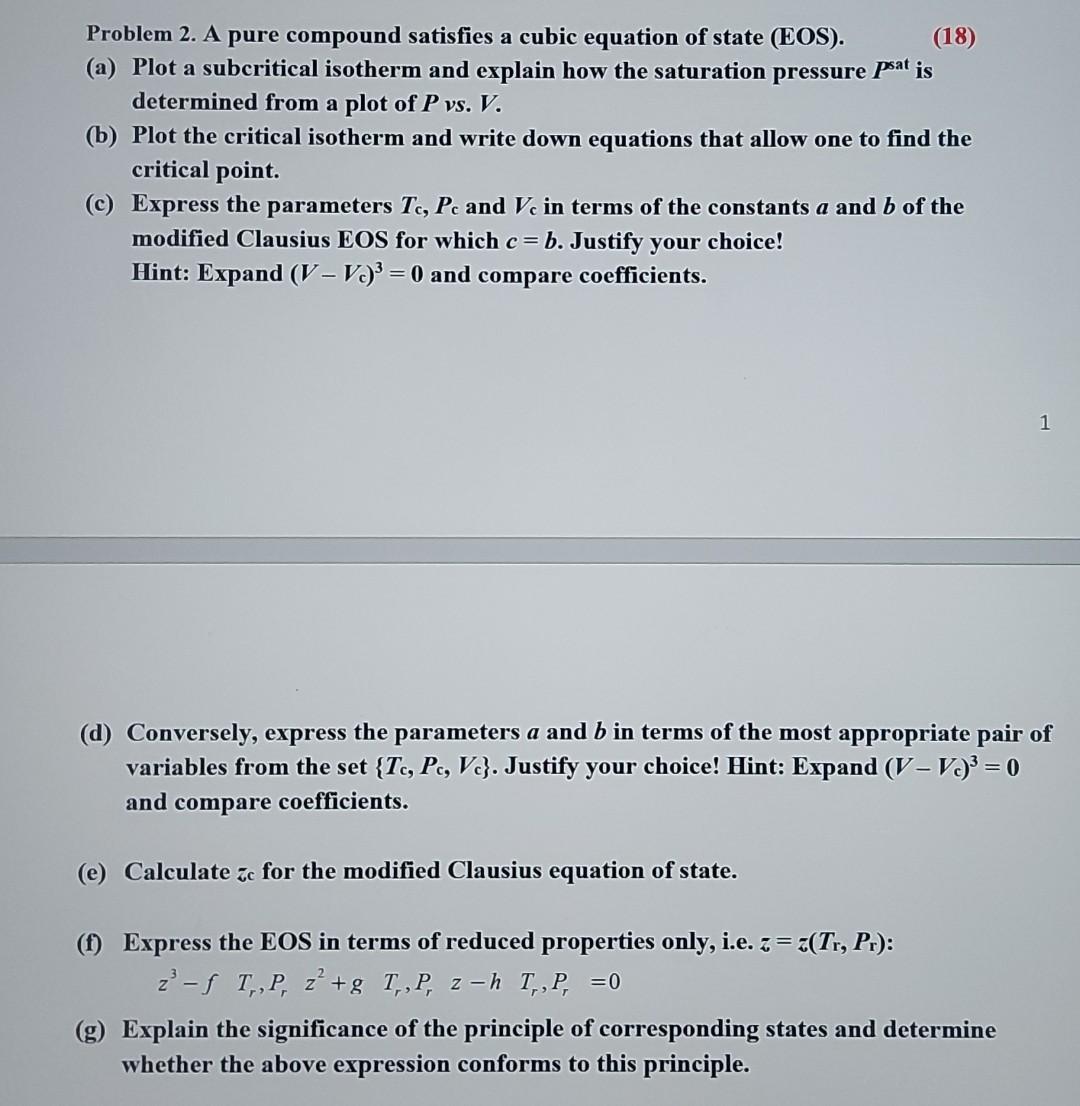
Problem 2. A pure compound satisfies a cubic equation of state (EOS). (18) (a) Plot a subcritical isotherm and explain how the saturation pressure Psat is determined from a plot of P vs. V. (b) Plot the critical isotherm and write down equations that allow one to find the critical point. (c) Express the parameters Tc, Pc and V. in terms of the constants a and b of the modified Clausius EOS for which c= b. Justify your choice! Hint: Expand (V-V) = 0 and compare coefficients. 1 (d) Conversely, express the parameters a and b in terms of the most appropriate pair of variables from the set {Tc, Pc, Ve}. Justify your choice! Hint: Expand (V-V) = 0 and compare coefficients. (e) Calculate ze for the modified Clausius equation of state. (1) Express the EOS in terms of reduced properties only, i.e. :=:(Tr, Pr): 2-S T,,P, 2+g T,,P, 2-h T,,P, =0 (g) Explain the significance of the principle of corresponding states and determine whether the above expression conforms to this principle. Problem 2. A pure compound satisfies a cubic equation of state (EOS). (18) (a) Plot a subcritical isotherm and explain how the saturation pressure Psat is determined from a plot of P vs. V. (b) Plot the critical isotherm and write down equations that allow one to find the critical point. (c) Express the parameters Tc, Pc and V. in terms of the constants a and b of the modified Clausius EOS for which c= b. Justify your choice! Hint: Expand (V-V) = 0 and compare coefficients. 1 (d) Conversely, express the parameters a and b in terms of the most appropriate pair of variables from the set {Tc, Pc, Ve}. Justify your choice! Hint: Expand (V-V) = 0 and compare coefficients. (e) Calculate ze for the modified Clausius equation of state. (1) Express the EOS in terms of reduced properties only, i.e. :=:(Tr, Pr): 2-S T,,P, 2+g T,,P, 2-h T,,P, =0 (g) Explain the significance of the principle of corresponding states and determine whether the above expression conforms to this principle
Step by Step Solution
There are 3 Steps involved in it

Get step-by-step solutions from verified subject matter experts
 Study Help