







Question: Please help with the following questions, 46) In the graph above, suppose the government mandates that the price of wheat rice can be no lower
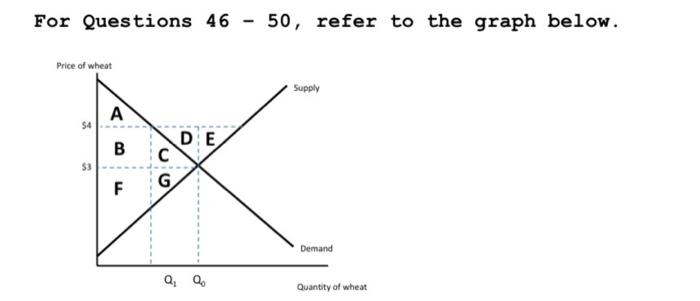
46)
In the graph above, suppose the government mandates that the price
of wheat rice can be no lower than $4 per bushel. Areas (C+G) in this
scenario would be referred to as
a net social welfare
- a deadweight loss.
- consumer surplus.
- a producer surplus
e) marginal benefits.
47) In the graph above, suppose the government mandates that the price
of wheat rice can be no lower than $4 per bushel. What area (s) represent the producer surplus after the implementation of this policy?
a) Areas (B+C)
b) Areas F+G)
c) Areas (A+B+F)
d) Areas (B+F)
e) Area F
48) In the graph above, suppose the government mandates that the price
of wheat rice can be no lower than $4 per bushel. What areas represent the deadweight loss as a result of this policy:
- Areas (D+E)
- Areas (B+C)
- Areas (C+G)
- Areas (F+G)
- Areas (A+B)
49) In the graph above, suppose the government mandates that the price of wheat rice can be no lower than $4 per bushel. What area (s) represent the consumer surplus after the implementation of this policy?
- Area A
- Areas (A+B)
- Areas (A+B+C)
- Areas (B+C)
- Areas (A+B+F)
50) In the graph above, suppose the government mandates that the price
of wheat rice can be no lower than $4 per bushel. What areas) represent a transfer of welfare from consumers to producers as a result of this policy?
- Area A
- Area B
- Areas (B+C)
- Area C
- Areas (A+B)
51)
Suppose that John is willing to pay a maximum of 5 dollars per cup of regular coffee at a coffee shop on campus. What is John's consume surplus from buying one cup of coffee if the actual price of coffee is 3 dollars per cup?
a) $5
b) $3
c) $2
d) $1
e) $0
52) Suppose Luis, Madeleine, and Emma are the only consumers in the entire coffee market, and that their maximum willingness to pay for a cup of coffee is $2, $4, and $6 respectively. Assume that the price of coffee is $2 per cup and that they each buy one cup of coffee. What is the market consumer surplus?
a. $7
b. $6
C. $5
d. $4
e. $2
53)
Suppose that the cost of producing the 600th cup of coffee to the local coffee shop is $2, and the price of coffee is $3.40 per cup. What is the producer surplus of selling the 600th cup of coffee?
a. $2.40
b. $1.40
c. $1
d. $0.40
e. $0
For Questions 46 - 50, refer to the graph below
Step by Step Solution
There are 3 Steps involved in it

Get step-by-step solutions from verified subject matter experts
 Study Help