







Question: Please help with the problem below. Thank you. 5) [10 points total] In a world with perfect intergenerational income mobility, a parent's income has no
Please help with the problem below. Thank you.
![Please help with the problem below. Thank you. 5) [10 points total]](https://dsd5zvtm8ll6.cloudfront.net/si.experts.images/questions/2024/09/66f6b00096eb5_94466f6b000537a0.jpg)
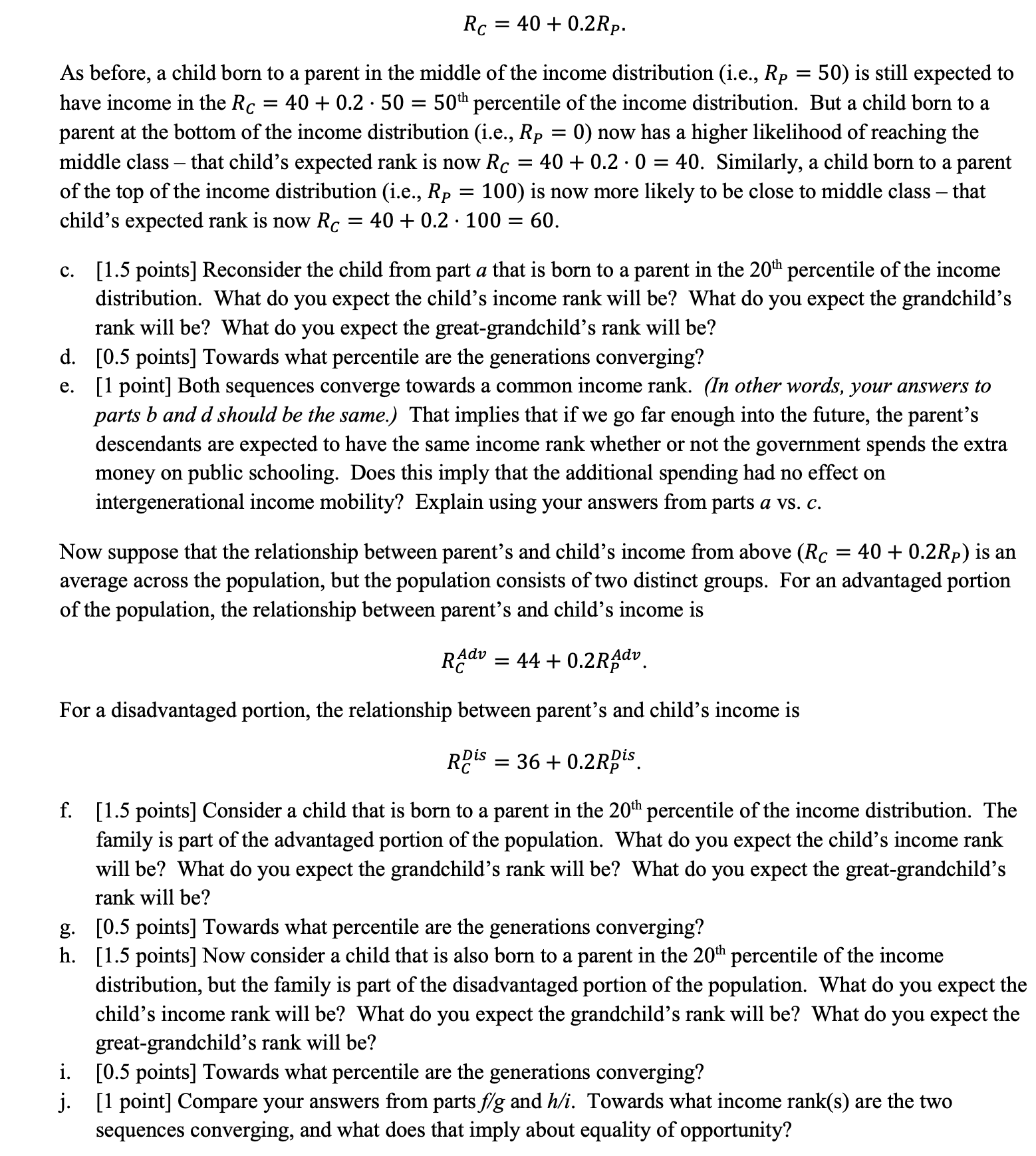
5) [10 points total] In a world with perfect intergenerational income mobility, a parent's income has no bearing whatsoever on a child's income. In a world without any intergenerational mobility, a child is destined to end up in the exact same point of the income distribution as the parent. In reality, a child's income depends in part of the parent's income, but there is not a perfect 1:1 relationship. In this problem, you will analyze how intergenerational mobility affects the income distribution over time. Dene a parent's percentile rank in the income distribution to be RP. The child's expected rank in the income distribution is RC. Suppose the two are related according to This implies that a child born to a parent in the middle of the income distribution (i.e., RP = 50) is also expected to have income in the RC = 25 + 0.5 - 50 = 50th percentile of the income distribution. But a child born to a parent at the bottom of the income distribution (i.e., RP = 0) is only expected to have income in the RC = 25 + 0.5 - 0 = 25tll percentile of the income distribution. A child born to a parent at the top of the income distribution (i.e., RP = 100) is expected to have income in the RC = 25 + 0.5 - 100 = 75th percentile of the income distribution. a. [1.5 points] Consider a child that is born to a parent in the 20tll percentile of the income distribution. What do you expect the child's income rank will be? What do you expect the grandchild's rank will be? What do you expect the great-grandchild's rank will be? (Hint: The child is the parent of the grandchild. The grandchild is the parent of the great-grandchild.) b. [0.5 points] Towards what percentile are the generations converging? Mint: The percentile of convergence is that at which a parent's and a child '5 percentile rank are equal. At what percentile rank does RC = RP ?) In an effort to promote more equal opportunity across the income distribution, the government invests additional funding in public schooling. This policy changes the relationship between parent's and child's income rank. It is now RC = 40 + 0.2.12... As before, a child born to a parent in the middle of the income distribution (i.e., RP = 50) is still expected to have income in the RC = 40 + 0.2 - 50 = 50th percentile of the income distribution. But a child born to a parent at the bottom of the income distribution (i.e., R p = 0) now has a higher likelihood of reaching the middle class that child's expected rank is now RC = 4-0 + 0.2 - 0 = 4-0. Similarly, a child born to a parent of the top of the income distribution (i.e., R p = 100) is now more likely to be close to middle class that child's expected rank is now RC = 40 + 0.2 - 100 = 60. c. [1.5 points] Reconsider the child from part a that is born to a parent in the 20th percentile of the income distribution. What do you expect the child's income rank will be? What do you expect the grandchild's rank will be? What do you expect the great-grandchild's rank will be? (1. [0.5 points] Towards what percentile are the generations converging? e. [1 point] Both sequences converge towards a common income rank. (In other words, your answers to parts b and d should be the same.) That implies that if we go far enough into the future, the parent's descendants are expected to have the same income rank whether or not the government spends the extra money on public schooling. Does this imply that the additional spending had no effect on intergenerational income mobility? Explain using your answers om parts a vs. c. Now suppose that the relationship between parent's and child's income om above (RC = 40 + 0.2Rp) is an average across the population, but the population consists of two distinct groups. For an advantaged portion of the population, the relationship between parent's and child's income is R5401\" = 44 + 0.2354\". For a disadvantaged portion, the relationship between parent's and child's income is R?\" = 36 + 0.2R3'3i'. f. [1.5 points] Consider a child that is born to a parent in the 20th percentile of the income distribution. The family is part of the advantaged portion of the population. What do you expect the child's income rank will be? What do you expect the grandchild's rank will be? What do you expect the great-grandchild's rank will be? g. [0.5 points] Towards what percentile are the generations converging? h. [1.5 points] Now consider a child that is also born to a parent in the 20tll percentile of the income distribution, but the family is part of the disadvantaged portion of the population. What do you expect the child's income rank will be? What do you expect the grandchild's rank will be? What do you expect the great-grandchild's rank will be? i. [0.5 points] Towards what percentile are the generations converging? j. [1 point] Compare your answers om parts g and h/i. Towards what income rank(s) are the two sequences converging, and what does that imply abOut equality of opportunity
Step by Step Solution
There are 3 Steps involved in it

Get step-by-step solutions from verified subject matter experts
 Study Help