







Question: Please help with the QM-related question below: Consider a twoparticle system subject to a force that only depends on the magnitude of sepa ration between
Please help with the QM-related question below:
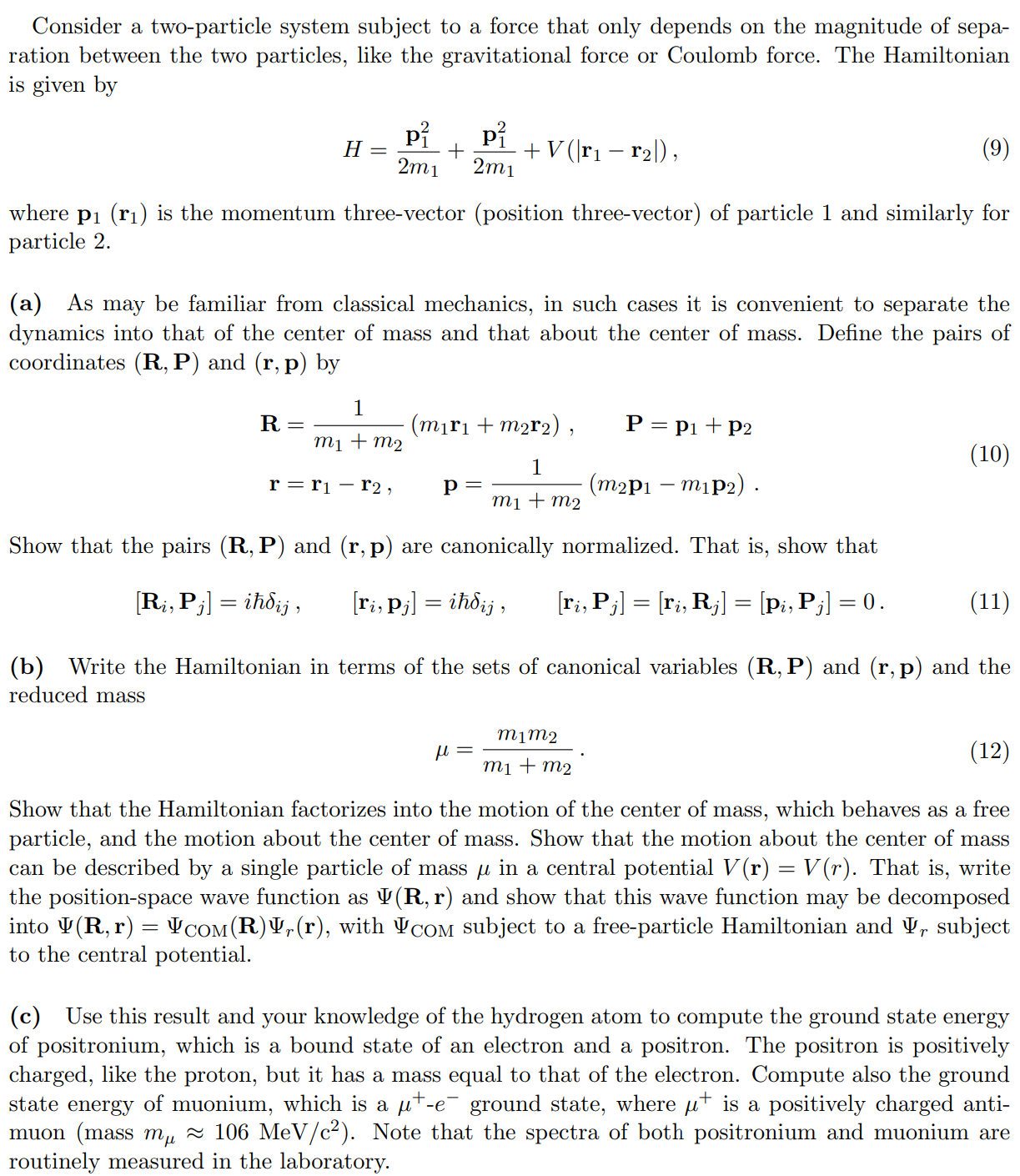
Consider a twoparticle system subject to a force that only depends on the magnitude of sepa ration between the two particles, like the gravitational force or Coulomb force. The Hamiltonian is given by 2 2 H i pl + pl n V _ . 9 271m 2ml+ (lrl r2|), () where p1 (r1) is the momentum threevector (position threevector) of particle 1 and similarly for particle 2. (a) As may be familiar from classical mechanics, in such cases it is convenient to separate the dynamics into that of the center of mass and that about the center of mass. Dene the pairs of coordinates (R, P) and (r, p) by 1 R = (m1r1+m2r2) , P 2 131+ p2 ml + m2 1 (10) I' 2 1'1 1'2, 1) = m (T112131 'mlpg) . Show that the pairs (R, P) and (r, p) are canonically normalized. That is, show that lanle : imaa [riipjl : mag, lrianl : [11:le : [13:3le : 0- (11) (b) Write the Hamiltonian in terms of the sets of canonical variables (R, P) and (r, p) and the reduced mass m 1 mg I! 2 m1 + m2 ' (12) Show that the Hamiltonian factorizes into the motion of the center of mass, which behaves as a free particle, and the motion about the center of mass. Show that the motion about the center of mass can be described by a single particle of mass u in a central potential V(r) 2 V0"). That is, write the position-space wave function as 111(R, r) and show that this wave function may be decomposed into @(R, r) = {ICON-[(R) 'I'Ar), with @001\" subject to a freeparticle Hamiltonian and WT subject to the central potential. (C) Use this result and your knowledge of the hydrogen atom to compute the ground state energy of positronium, which is a bound state of an electron and a positron. The positron is positively charged, like the proton, but it has a mass equal to that of the electron. Compute also the ground state energy of muonium, which is a {EL-(f ground state, where ,u+ is a positively charged anti- rnuon (mass m\" :5 106 :MeV/cg). Note that the spectra of both positronium and muonium are routinely measured in the laboratory
Step by Step Solution
There are 3 Steps involved in it

Get step-by-step solutions from verified subject matter experts
 Study Help