







Question: Please help with the question below on Behavioral Finance: QUESTION 2: TIME DISCOUNTING Viggo is thinking about retirement. He knows that he will live for
Please help with the question below on Behavioral Finance:
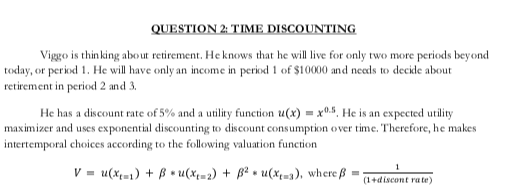
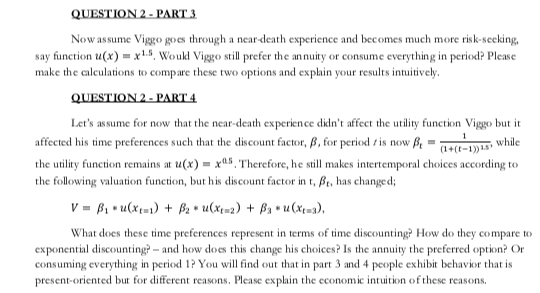
QUESTION 2: TIME DISCOUNTING Viggo is thinking about retirement. He knows that he will live for only two more periods beyond today, or period 1. He will have only an income in period 1 of $10000 and needs to decide about retirement in period 2 and 3. He has a discount rate of 5% and a utility function u(x) = x05. He is an expected utility maximizer and uses exponential discounting to discount consumption over time. Therefore, he makes intertemporal choices according to the following valuation function VE U(X=1) + Bu(x-2) + B2 * u(x-3), where (1+discontrate) QUESTION 2 - PART 3 Now assume Viggo goes through a near-death experience and becomes much more risk-secking, say function u(x) = x1.5. Would Viggo still prefer the annuity or consume everything in period? Please make the calculations to compare these two options and explain your results intuitively. QUESTION 2 - PART 4 Let's assume for now that the near-death experience didn't affect the utility function Viggo but it affected his time preferences such that the discount factor, B, for period ris now Be (1+t-1918 while the utility function remains at u(x) = x^5. Therefore, he still makes intertemporal choices according to the following valuation function, but his discount factor in t, B., has changed; V = B. * u(x=1) + B2 * u(x-2) + B; * u(x-3), What does these time preferences represent in terms of time discounting? How do they compare to exponential discounting? - and how does this change his choices? Is the annuity the preferred option? Or consuming everything in period 1? You will find out that in part 3 and 4 people exhibit behavior that is present-criented but for different reasons. Please explain the economic intuition of these reasons. QUESTION 2: TIME DISCOUNTING Viggo is thinking about retirement. He knows that he will live for only two more periods beyond today, or period 1. He will have only an income in period 1 of $10000 and needs to decide about retirement in period 2 and 3. He has a discount rate of 5% and a utility function u(x) = x05. He is an expected utility maximizer and uses exponential discounting to discount consumption over time. Therefore, he makes intertemporal choices according to the following valuation function VE U(X=1) + Bu(x-2) + B2 * u(x-3), where (1+discontrate) QUESTION 2 - PART 3 Now assume Viggo goes through a near-death experience and becomes much more risk-secking, say function u(x) = x1.5. Would Viggo still prefer the annuity or consume everything in period? Please make the calculations to compare these two options and explain your results intuitively. QUESTION 2 - PART 4 Let's assume for now that the near-death experience didn't affect the utility function Viggo but it affected his time preferences such that the discount factor, B, for period ris now Be (1+t-1918 while the utility function remains at u(x) = x^5. Therefore, he still makes intertemporal choices according to the following valuation function, but his discount factor in t, B., has changed; V = B. * u(x=1) + B2 * u(x-2) + B; * u(x-3), What does these time preferences represent in terms of time discounting? How do they compare to exponential discounting? - and how does this change his choices? Is the annuity the preferred option? Or consuming everything in period 1? You will find out that in part 3 and 4 people exhibit behavior that is present-criented but for different reasons. Please explain the economic intuition of these reasons
Step by Step Solution
There are 3 Steps involved in it

Get step-by-step solutions from verified subject matter experts
 Study Help