Question: Please help with these 3 3. If the main actor and director had demanded their original fees up front instead of taking a percentage of
Please help with these 3
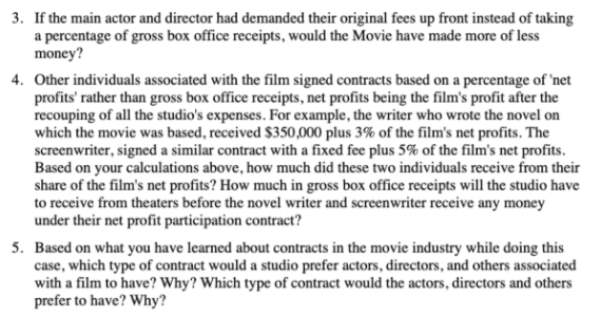
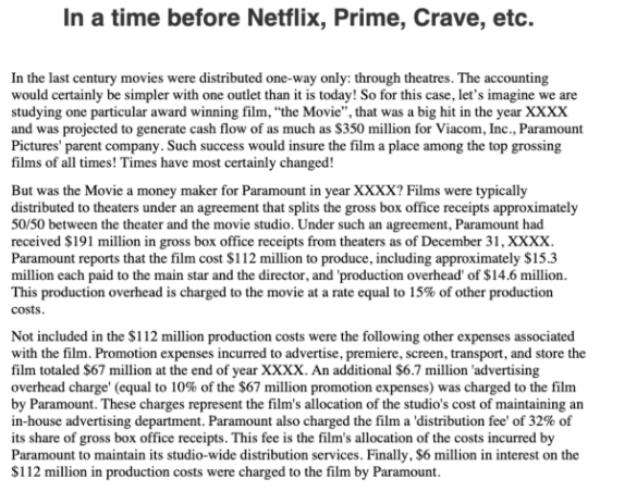
3. If the main actor and director had demanded their original fees up front instead of taking a percentage of gross box office receipts, would the Movie have made more of less money? 4. Other individuals associated with the film signed contracts based on a percentage of 'net profits' rather than gross box office receipts, net profits being the film's profit after the recouping of all the studio's expenses. For example, the writer who wrote the novel on which the movie was based, received $350,000 plus 3% of the film's net profits. The screenwriter, signed a similar contract with a fixed fee plus 5% of the film's net profits. Based on your calculations above, how much did these two individuals receive from their share of the film's net profits? How much in gross box office receipts will the studio have to receive from theaters before the novel writer and screenwriter receive any money under their net profit participation contract? 5. Based on what you have learned about contracts in the movie industry while doing this case, which type of contract would a studio prefer actors, directors, and others associated with a film to have? Why? Which type of contract would the actors, directors and others prefer to have? Why?In a time before Netflix, Prime, Crave, etc. In the last century movies were distributed one-way only: through theatres. The accounting would certainly be simpler with one outlet than it is today! So for this case, let's imagine we are studying one particular award winning film, "the Movie", that was a big hit in the year XXXX and was projected to generate cash flow of as much as $350 million for Viacom, Inc., Paramount Pictures' parent company. Such success would insure the film a place among the top grossing films of all times! Times have most certainly changed! But was the Movie a money maker for Paramount in year XXXX? Films were typically distributed to theaters under an agreement that splits the gross box office receipts approximately 50/50 between the theater and the movie studio. Under such an agreement, Paramount had received $191 million in gross box office receipts from theaters as of December 31, XXXX. Paramount reports that the film cost $112 million to produce, including approximately $15.3 million each paid to the main star and the director, and 'production overhead' of $14.6 million. This production overhead is charged to the movie at a rate equal to 15% of other production costs. Not included in the $112 million production costs were the following other expenses associated with the film. Promotion expenses incurred to advertise, premiere, screen, transport, and store the film totaled $67 million at the end of year XXXX. An additional $6.7 million 'advertising overhead charge' (equal to 10% of the $67 million promotion expenses) was charged to the film by Paramount. These charges represent the film's allocation of the studio's cost of maintaining an in-house advertising department. Paramount also charged the film a 'distribution fee' of 32% of its share of gross box office receipts. This fee is the film's allocation of the costs incurred by Paramount to maintain its studio-wide distribution services. Finally, $6 million in interest on the $112 million in production costs were charged to the film by Paramount









 Study Help