







Question: 1. Refraction results from differences in light's A. Frequency B. Incident angles C. Speed D. All of these 2. Refraction causes the bottom of
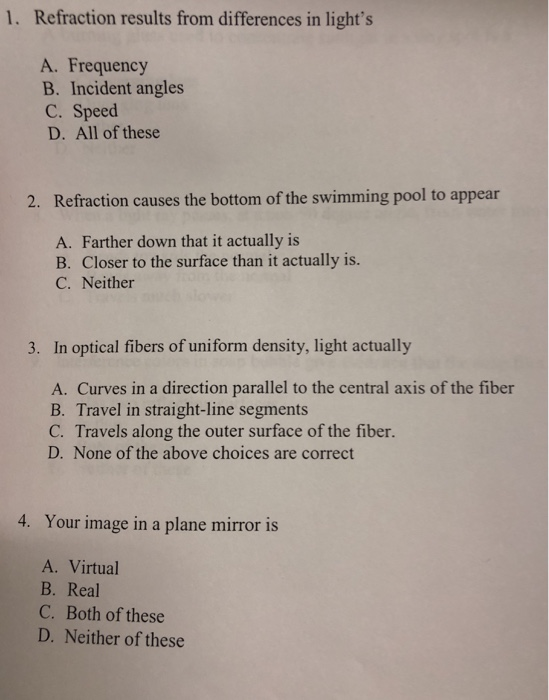
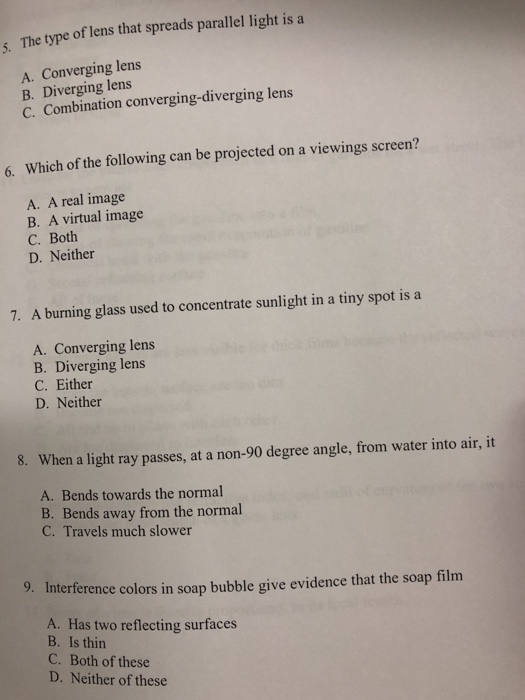
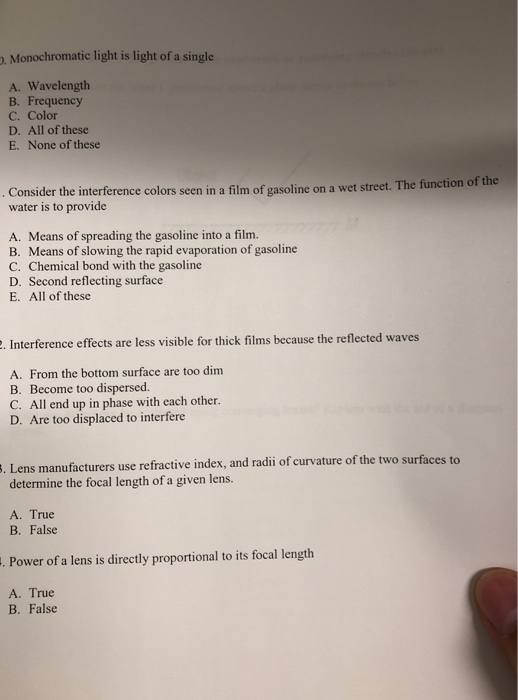
1. Refraction results from differences in light's A. Frequency B. Incident angles C. Speed D. All of these 2. Refraction causes the bottom of the swimming pool to appear A. Farther down that it actually is B. Closer to the surface than it actually is. C. Neither 3. In optical fibers of uniform density, light actually A. Curves in a direction parallel to the central axis of the fiber B. Travel in straight-line segments C. Travels along the outer surface of the fiber. D. None of the above choices are correct 4. Your image in a plane mirror is A. Virtual B. Real C. Both of these D. Neither of these 5. The type of lens that spreads parallel light is a A. Converging lens B. Diverging lens C. Combination converging-diverging lens 6. Which of the following can be projected on a viewings screen? A. A real image B. A virtual image C. Both D. Neither 7. A burning glass used to concentrate sunlight in a tiny spot is a A. Converging lens B. Diverging lens C. Either D. Neither 8. When a light ray passes, at a non-90 degree angle, from water into air, it A. Bends towards the normal B. Bends away from the normal C. Travels much slower 9. Interference colors in soap bubble give evidence that the soap film A. Has two reflecting surfaces B. Is thin C. Both of these D. Neither of these Monochromatic light is light of a single A. Wavelength B. Frequency C. Color D. All of these E. None of these Consider the interference colors seen in a film of gasoline on a wet street. The function of the water is to provide A. Means of spreading the gasoline into a film. B. Means of slowing the rapid evaporation of gasoline C. Chemical bond with the gasoline D. Second reflecting surface E. All of these 2. Interference effects are less visible for thick films because the reflected waves A. From the bottom surface are too dim B. Become too dispersed. C. All end up in phase with each other. D. Are too displaced to interfere 5. Lens manufacturers use refractive index, and radii of curvature of the two surfaces to determine the focal length of a given lens. A. True B. False . Power of a lens is directly proportional to its focal length A. True B. False
Step by Step Solution
3.46 Rating (159 Votes )
There are 3 Steps involved in it
The detailed answer for the above question is provided below 1D All of these Refraction results from ... View full answer

Get step-by-step solutions from verified subject matter experts
 Study Help