







Question: please help with these problems using R Studio or another statistics software. Here is a link to the data csv; (thanks so much!) https://drive.google.com/file/d/1WPI1yi873cfykQ02hp8O2TvLCUWew0AN/view?usp=sharing Download
please help with these problems using R Studio or another statistics software. Here is a link to the data csv; (thanks so much!)
https://drive.google.com/file/d/1WPI1yi873cfykQ02hp8O2TvLCUWew0AN/view?usp=sharing
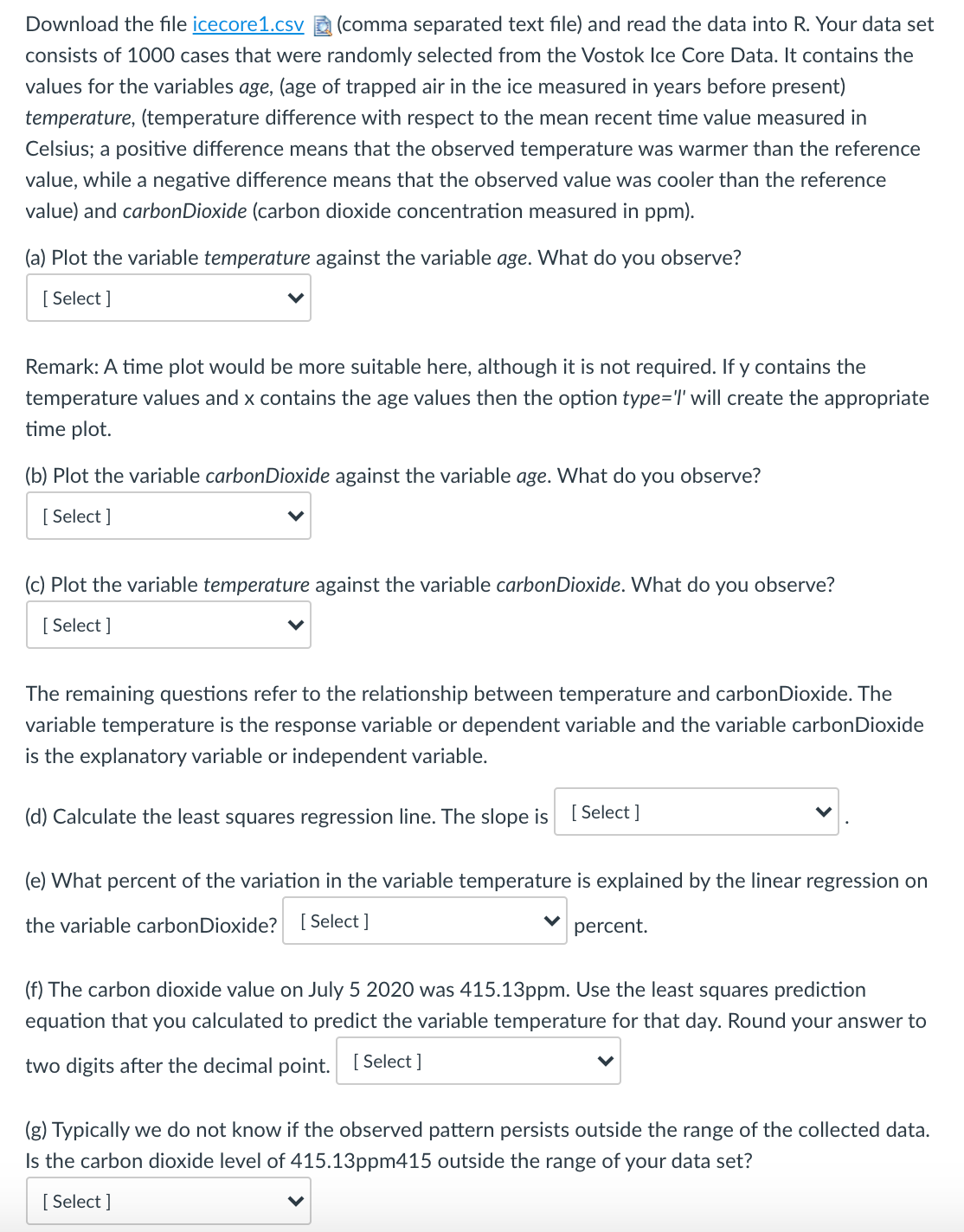
Download the le icecore1.csv (comma separated text le) and read the data into R. Your data set consists of 1000 cases that were randomly selected from the Vostok Ice Core Data. It contains the values for the variables age, (age of trapped air in the ice measured in years before present) temperature, (temperature difference with respect to the mean recent time value measured in Celsius; a positive difference means that the observed temperature was warmer than the reference value, while a negative difference means that the observed value was cooler than the reference value) and carbonDioxide (carbon dioxide concentration measured in ppm). (a) Plot the variable temperature against the variable age. What do you observe? [ Select] v Remark: A time plot would be more suitable here, although it is not required. If y contains the temperature values and x contains the age values then the option type='l' will create the appropriate time plot. (b) Plot the variable carbonDioxide against the variable age. What do you observe? [ Select] v (c) Plot the variable temperature against the variable carbonDioxide. What do you observe? [ Select] v The remaining questions refer to the relationship between temperature and carbonDioxide. The variable temperature is the response variable or dependent variable and the variable carbonDioxide is the explanatory variable or independent variable. (d) Calculate the least squares regression line. The slope is [59'9\"] V . (e) What percent of the variation in the variable temperature is explained by the linear regression on the variable carbonDioxide? [53'9\"] V percent. (f) The carbon dioxide value on July 5 2020 was 415.13ppm. Use the least squares prediction equation that you calculated to predict the variable temperature for that day. Round your answer to two digits after the decimal point. [59'9\"] V (g) Typically we do not know if the observed pattern persists outside the range of the collected data. Is the carbon dioxide level of 415.13ppm415 outside the range of your data set? I [ Select] v
Step by Step Solution
There are 3 Steps involved in it

Get step-by-step solutions from verified subject matter experts
 Study Help