





Question: Please help with these two multi step questions As a specific example we consider the non-homogeneous problem y 163/ = 9:35I (1) The general solution

Please help with these two multi step questions
Please help with these two multi step questionsPlease help with these two multi step questions
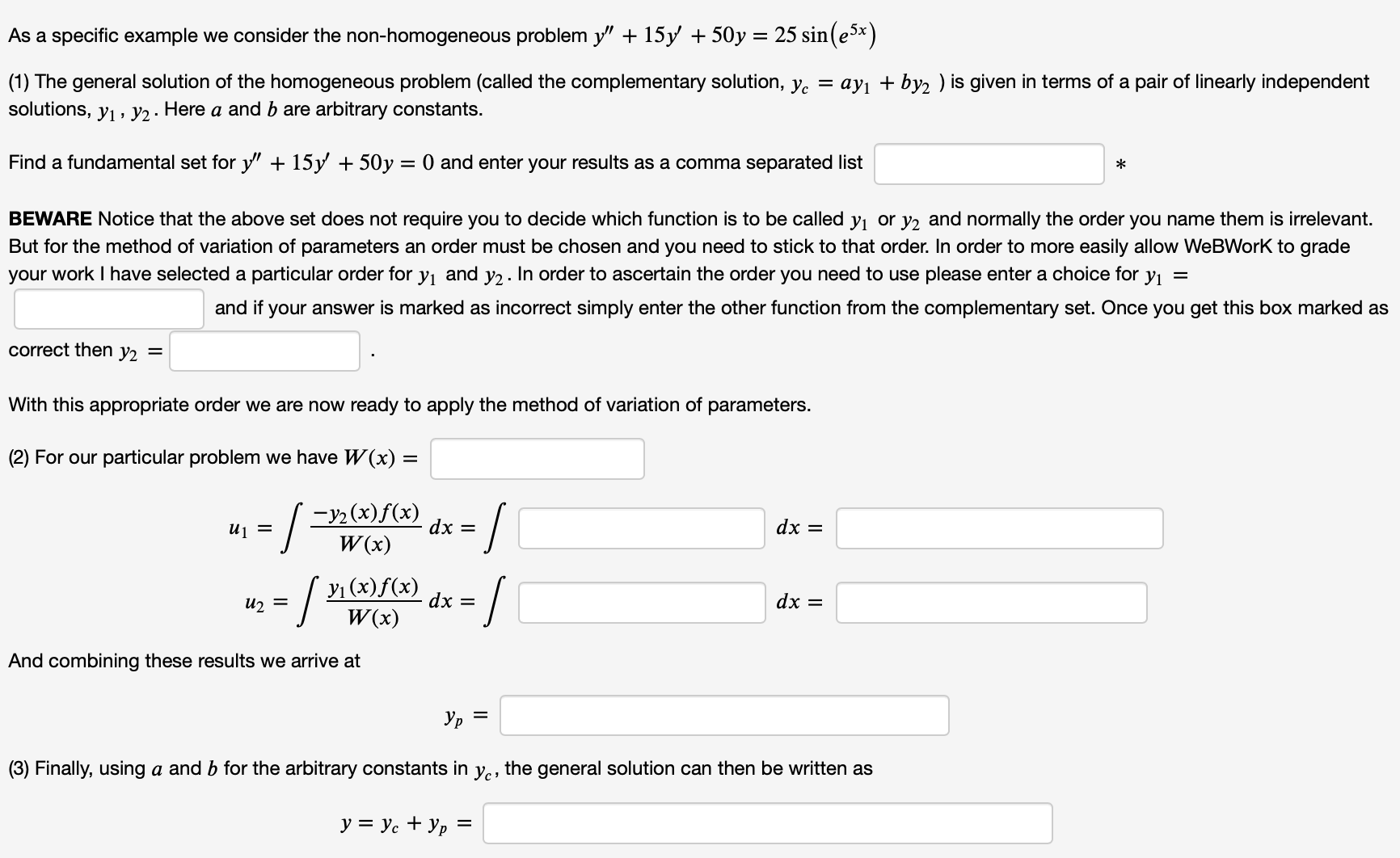
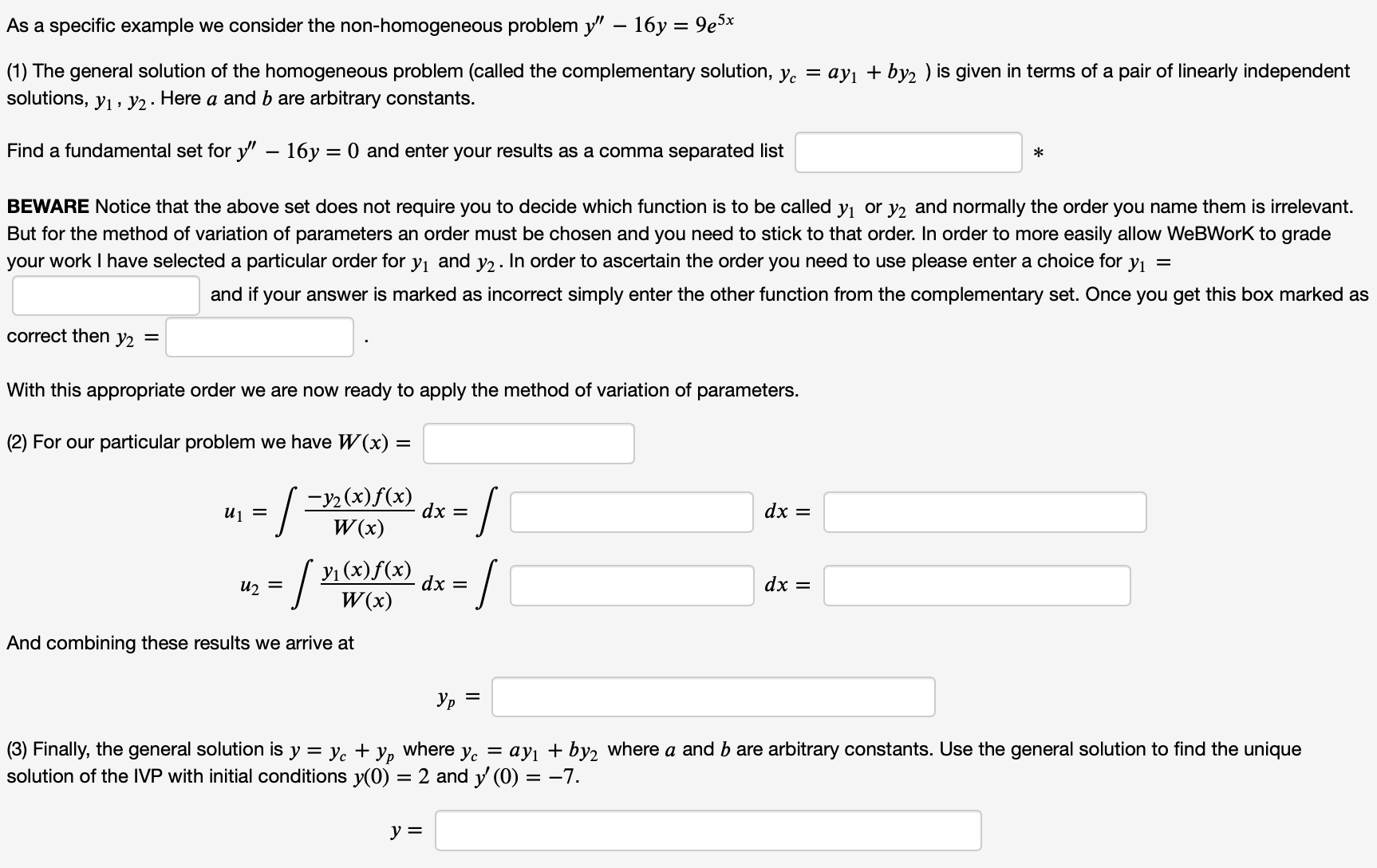
As a specific example we consider the non-homogeneous problem y\" 163/ = 9:35I (1) The general solution of the homogeneous problem (called the complementary solution, yo = ayl + by; ) is given in terms of a pair of linearly independent solutions, yl , y2 . Here a and b are arbitrary constants. Find a fundamental set for y" 16y = 0 and enter your results as a comma separated list are BEWARE Notice that the above set does not require you to decide which function is to be called .VI or y2 and normally the order you name them is irrelevant. But for the method of variation of parameters an order must be chosen and you need to stick to that order. In order to more easily allow WeBWorK to grade your work I have selected a particular order for yl and J'2- In order to ascertain the order you need to use please enter a choice for y1 = and if your answer is marked as incorrect simply enter the other function from the complementary set. Once you get this box marked as correct then y2 = With this appropriate order we are now ready to apply the method of variation of parameters. (2) For our particular problem we have W(x) = -y2(X)f(X) dx = / dx W(x) u =/de=/ dx= 2 W(x) And combining these results we arrive at ul yp= (3) Finally, the general solution is y = ye + yp where y.: = ayl + by; where a and b are arbitrary constants. Use the general solution to find the unique solution of the IVP with initial conditions y(0) = 2 and y' (0) = 7. y: As a specific example we consider the non-homogeneous problem y" + 15y' + 50y = 25 sin(e5x) (1) The general solution of the homogeneous problem (called the complementary solution, y. = ay + by2 ) is given in terms of a pair of linearly independent solutions, y1 , y2 . Here a and b are arbitrary constants. Find a fundamental set for y" + 15y + 50y = 0 and enter your results as a comma separated list BEWARE Notice that the above set does not require you to decide which function is to be called y, or y2 and normally the order you name them is irrelevant. But for the method of variation of parameters an order must be chosen and you need to stick to that order. In order to more easily allow WeBWork to grade your work I have selected a particular order for y, and y2 . In order to ascertain the order you need to use please enter a choice for y| = and if your answer is marked as incorrect simply enter the other function from the complementary set. Once you get this box marked as correct then y2 = With this appropriate order we are now ready to apply the method of variation of parameters. (2) For our particular problem we have W(x) = - 12 (x) f(x) U1 = dx = dx = W(x) VI (x) f(x ) U2 = dx = dx = W(x) And combining these results we arrive at Up = (3) Finally, using a and b for the arbitrary constants in y, the general solution can then be written as y = ye + yp =

Step by Step Solution

There are 3 Steps involved in it

1 Expert Approved Answer
Step: 1 Unlock blur-text-image

Question Has Been Solved by an Expert!

Get step-by-step solutions from verified subject matter experts

Step: 2 Unlock
Step: 3 Unlock

Students Have Also Explored These Related Mathematics Questions!