







Question: Please Help with this problem 2. A Bertrand Model with Product Differentiation Note: I have given you the final answers to these problems, but I
Please Help with this problem
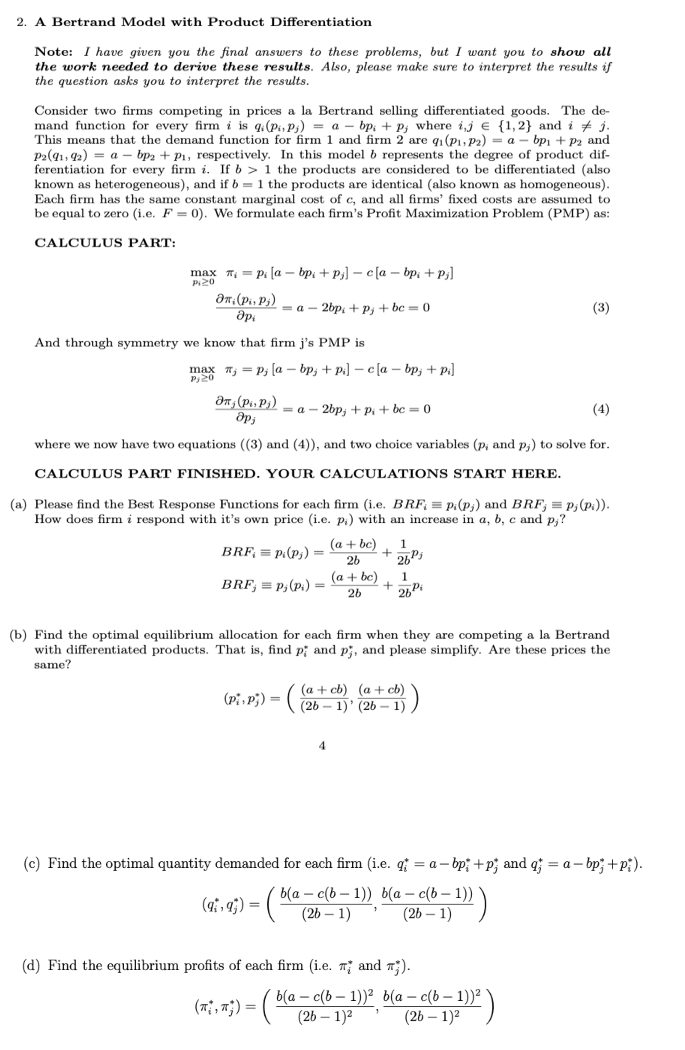
2. A Bertrand Model with Product Differentiation Note: I have given you the final answers to these problems, but I want you to show all the work needed to derive these results. Also, please make sure to interpret the results if the question asks you to interpret the results. Consider two firms competing in prices a la Bertrand selling differentiated goods. The de- mand function for every firm : is q:(pap, ) = a - bp; + p, where ,j E {1, 2} and i # j. This means that the demand function for firm 1 and firm 2 are qi(p1, p2) = a - bp, + p2 and P2(qi, 92) = a - 6p2 + Pi, respectively. In this model b represents the degree of product dif- ferentiation for every firm . If b > 1 the products are considered to be differentiated (also known as heterogeneous), and if 6 = 1 the products are identical (also known as homogeneous). Each firm has the same constant marginal cost of c, and all firms' fixed costs are assumed to be equal to zero (i.e. F = 0). We formulate each firm's Profit Maximization Problem (PMP) as: CALCULUS PART: max * = pila - bp, + p;] - c[a - bp; + p,] P: 20 an: (PiPi) = a - 2bp: + p, + be = 0 opi (3) And through symmetry we know that firm j's PMP is max *; = p, [a - bp; + pi] - cla - bp; + p.] On, (P..Pi) = a - 2bp; + pi + be = 0 op; (4) where we now have two equations ((3) and (4)), and two choice variables (p; and p;) to solve for. CALCULUS PART FINISHED. YOUR CALCULATIONS START HERE. (a) Please find the Best Response Functions for each firm (i.e. BRE. = p.(p,) and BRF, = p, (p.)). How does firm i respond with it's own price (i.e. p;) with an increase in a, b, c and p,? BRF. = P.(p;) = (a+ be) 1 26 26Pi BRE, = P,(p;) = (a+ bc) 2b 25 Pi (b) Find the optimal equilibrium allocation for each firm when they are competing a la Bertrand with differentiated products. That is, find p; and p;, and please simplify. Are these prices the same? (Pi,p;) = (a+ cb) (a + cb) (26 - 1)' (26 - 1) (c) Find the optimal quantity demanded for each firm (i.e. q; = a - bp; +p; and q; = a - bp; + p;). (qi,q;) = (b(a - c(b-1)) b(a - c(b -1)) (2b - 1) (2b - 1) (d) Find the equilibrium profits of each firm (i.e. n; and n;). (m), m;) = b(a - c(b -1))2 b(a - c(b- 1))2 (2b - 1)2 (2b - 1)2
Step by Step Solution
There are 3 Steps involved in it

Get step-by-step solutions from verified subject matter experts
 Study Help