







Question: Please help with this problem In case you can't see in the picture: Revenue: $280,000 Catering revenues: 86,670 366,670 Expenditures: Donut supplies: 141,880 Catering Expense:
Please help with this problem
In case you can't see in the picture: Revenue: $280,000 Catering revenues: 86,670 366,670 Expenditures: Donut supplies: 141,880 Catering Expense: 35,050 Salaries to shop employees: 59,500 Rent Expense: 46,070 Accident insurance premiums: 8,736 Other business expenditures: 8,530 -299,766 Net Income: $66,904 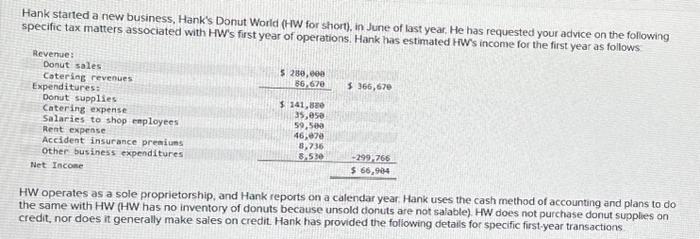
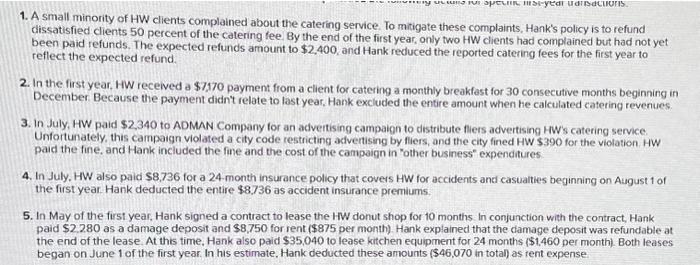
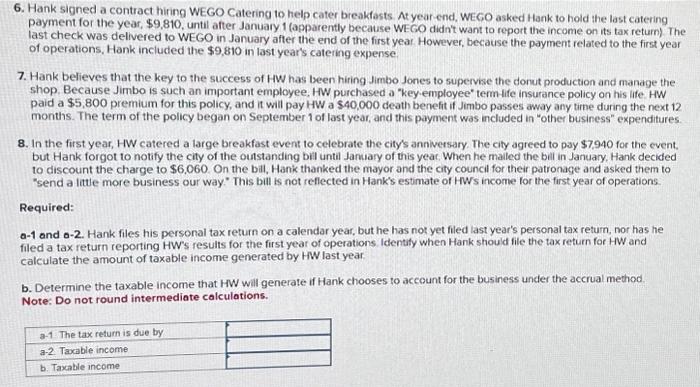
Hank started a new business, Hank's Donut World (HW for short), in June of last year. He has requested your advice on the following specific tax matters associated with HW's first year of operations. Hank has estimated HW's income for the first year as follows HW operates as a sole proprietorship, and Hank reports on a calendar year. Hank uses the cash method of accounting and plans to do the same with HW (HW has no imventory of donuts because unsold donuts are not salable). HW does not purchase donut supplies on credit, nor does it generally make sales on credit. Hank has provided the following details for specific first-year transactions 1. A small minority of HW clients complained about the catering service. To mitigate these complaints, Hank's policy is to refund dissatisfied clients 50 percent of the catering fee. By the end of the first year, only two HW clients had complained but had not yet been paid refunds. The expected refunds amount to $2,400, and Hank reduced the reported catering fees for the first year to reflect the expected refund. 2. In the first year. HW received a $7170 payment from a client for catering a monthly breakfest for 30 consecutive months beginning in December. Because the payment didn't relate to last year, Hank excluded the entire amount when he calculated catering revenues. 3. In July, HW paid $2,340 to ADMAN Company for an advertising campaign to distribute flers advertising HW's catering service. Unfortunately, this campaign violated a city code restricting advertising by fliers, and the city fined HW$390 for the violation. HW paid the fine, and Hank included the fine and the cost of the campaign in "other business" expenditures. 4. In July. HW also paid \$8,736 for a 24 month insurance policy that covers HW for accidents and casualtes beginning on August 1 of the first year. Hank deducted the entire $8.736 as accident insurance premiums, 5. In May of the first year, Hank signed a contract to lease the HW donut shop for 10 months. In conjunction with the contract, Hank paid $2.280 as a damage deposit and $8,750 for rent (\$875 per month). Hank explained that the damage deposit was refundable at the end of the lease. At this time, Hank also paid $35,040 to lease kitchen equipment for 24 months (\$1.460 per month). Both leases began on June 1 of the first year. In his estimate. Hank deducted these amounts ( $46,070 in total) as rent expense 6. Hank signed a contract hiring WEGO Catering to help cater breakfasts. At year-end, WEGO asked Hank to hold the last catering payment for the year, $9.810, until after January 1 (apparently because WEGO didn' want to report the income on its tax return). The last check was delivered to WEGO in January after the end of the first year. However, because the payment related to the first year of operations. Hank included the $9,810 in last year's catering expense. 7. Hank believes that the key to the success of HW has been hiring Jimbo Jones to supervise the donut production and manage the: shop. Because Jimbo is such an important employee, HW purchased a "key employee" tem-life insurance policy on his life. HW paid a $5,800 premium for this policy, and it will pay HW a $40,000 death benefit if Jimbo passes away any time during the next 12 months. The term of the policy began on September 1 of last year, and this payment was included in "other business" expenditures. 8. In the first year, HW catered a large breakfast event to celebrate the city's anniversary. The city agreed to pay $7,940 for the event. but Hank forgot to notify the city of the outstanding bil until Jaruary of this yeac. When he mailed the bill in January. Hank decided to discount the charge to $6,060. On the bill, Hank thanked the mayor and the city council for their patronage and asked them to "send a litte more business our way." This bill is not reflected in Hank's estimate of HWs income for the first year of operations. Required: a-1 and o-2. Hank files his personal tax return on a calendar year, but he has not yet filed last year's personal tax return, nor has he filed a tax return reporting HW's results for the first year of operations. Identify when Hank should file the tax return for HW and calculate the amount of taxable income generated by HW last year. b. Determine the taxable income that HW will generate if Hank chooses to account for the business under the accrual method. Note: Do not round intermediate calculations
Step by Step Solution
There are 3 Steps involved in it

Get step-by-step solutions from verified subject matter experts
 Study Help