







Question: Please help with this question. 1 e. Using her current income, calculate her debt limit ratio for the most expensive school loan and her auto
Please help with this question. 1
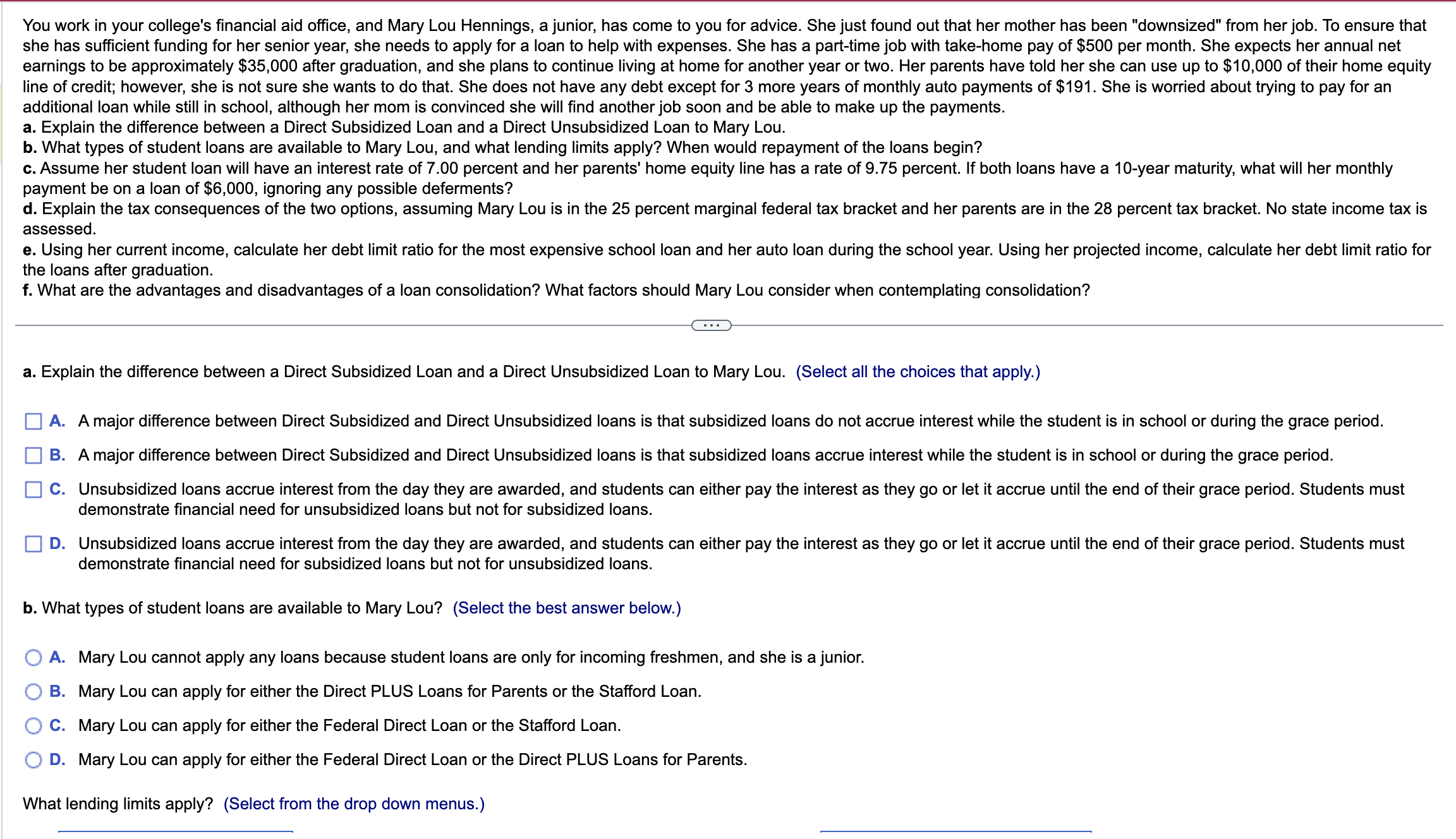
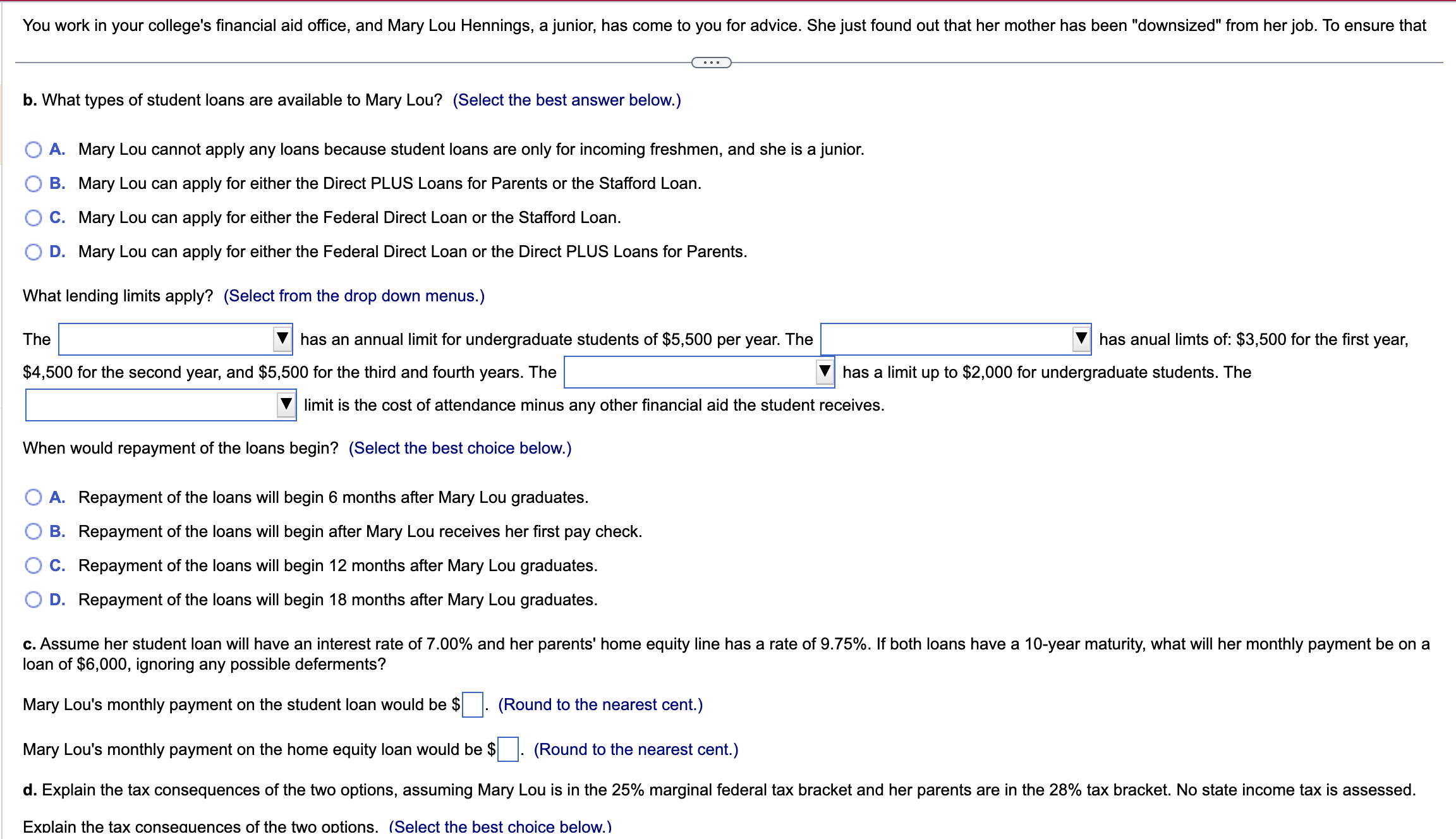
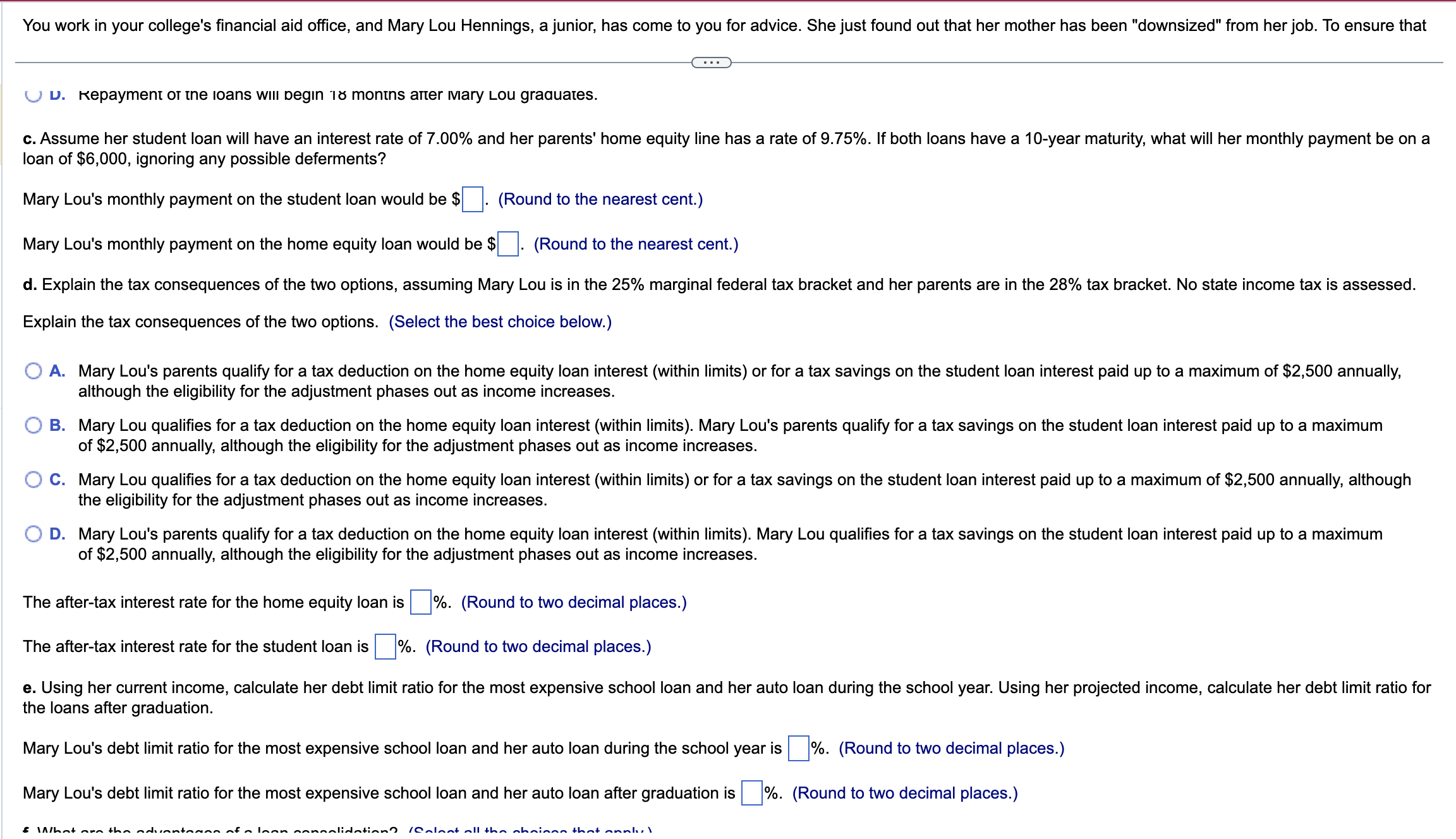
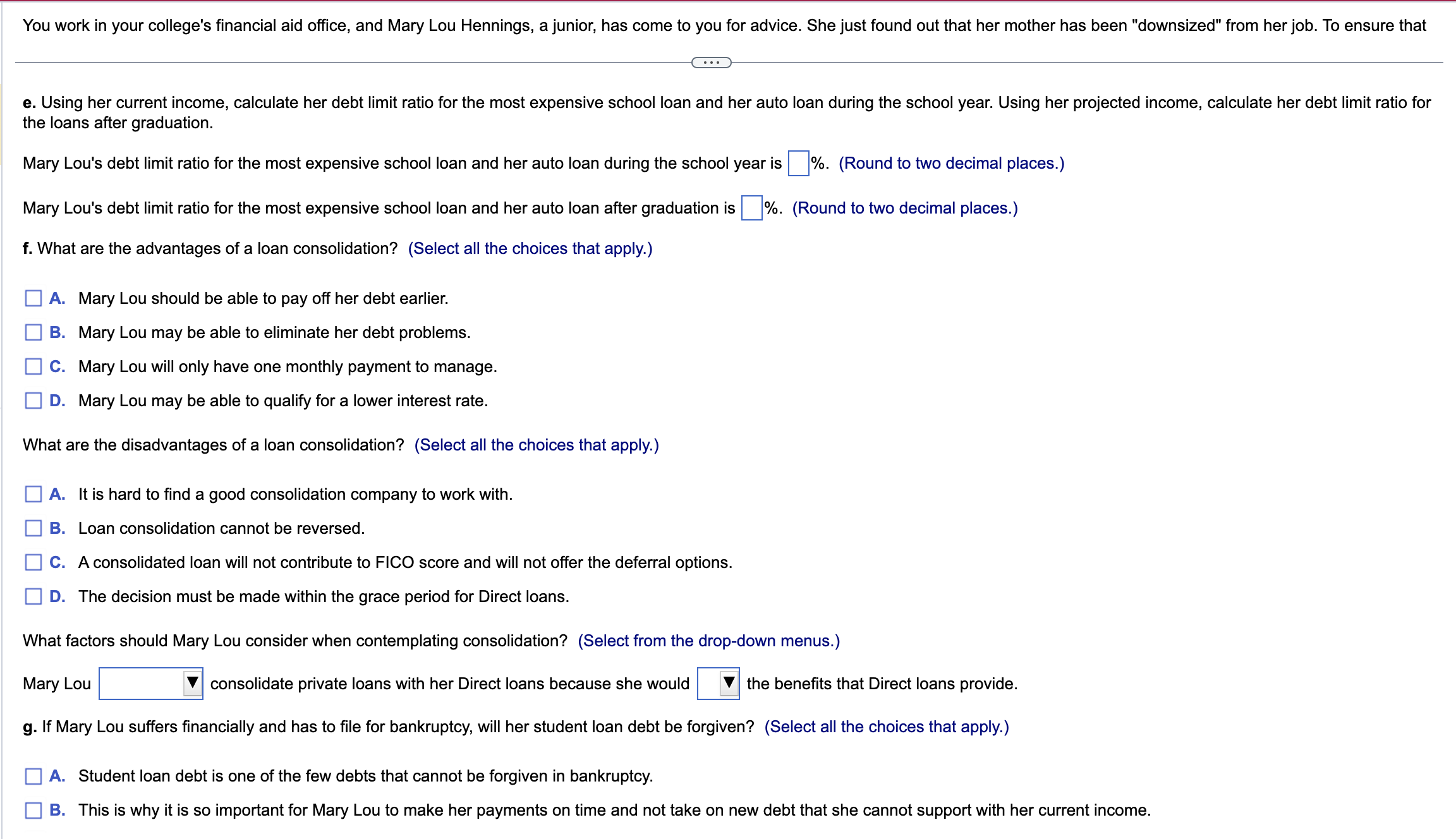
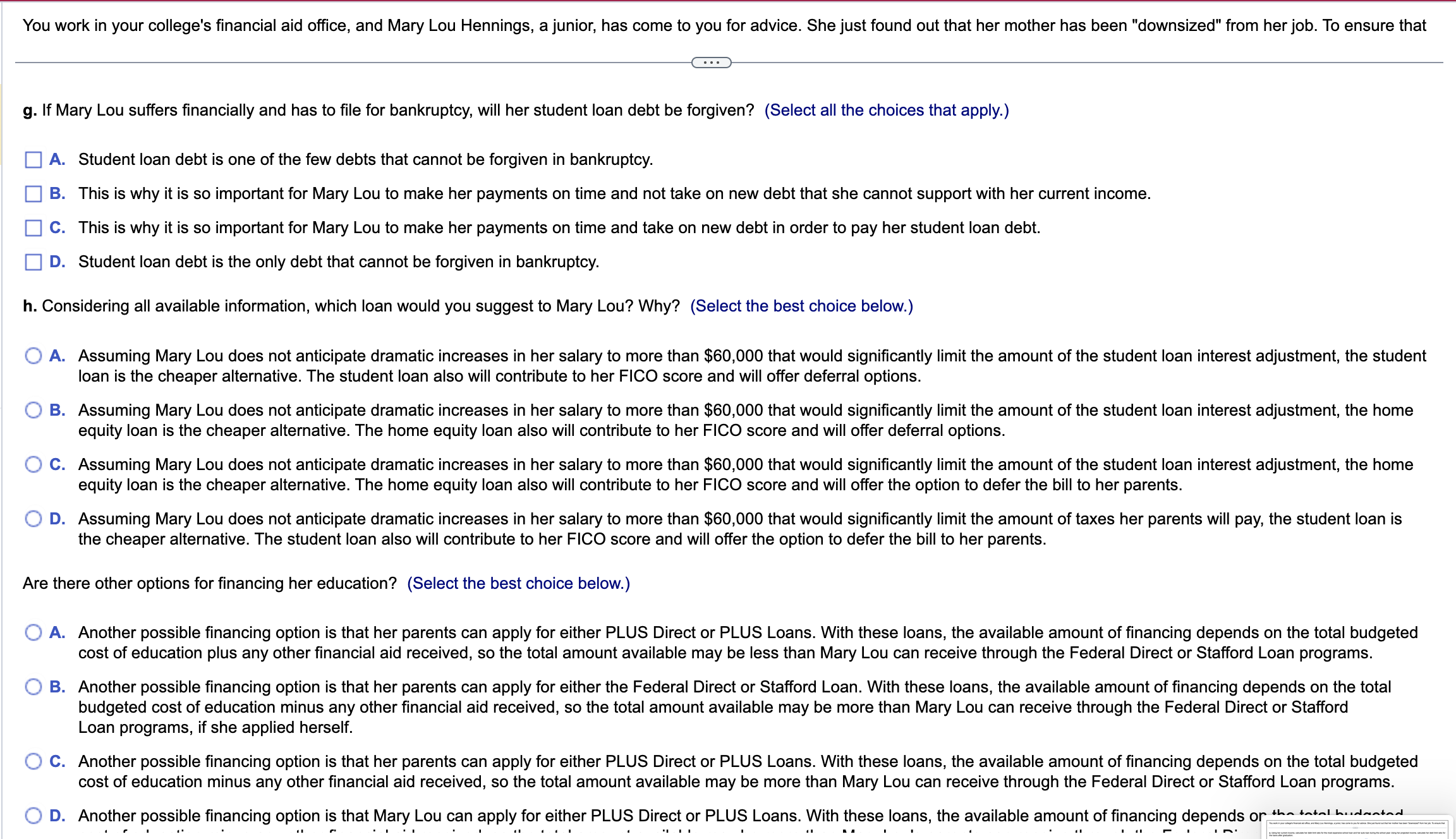
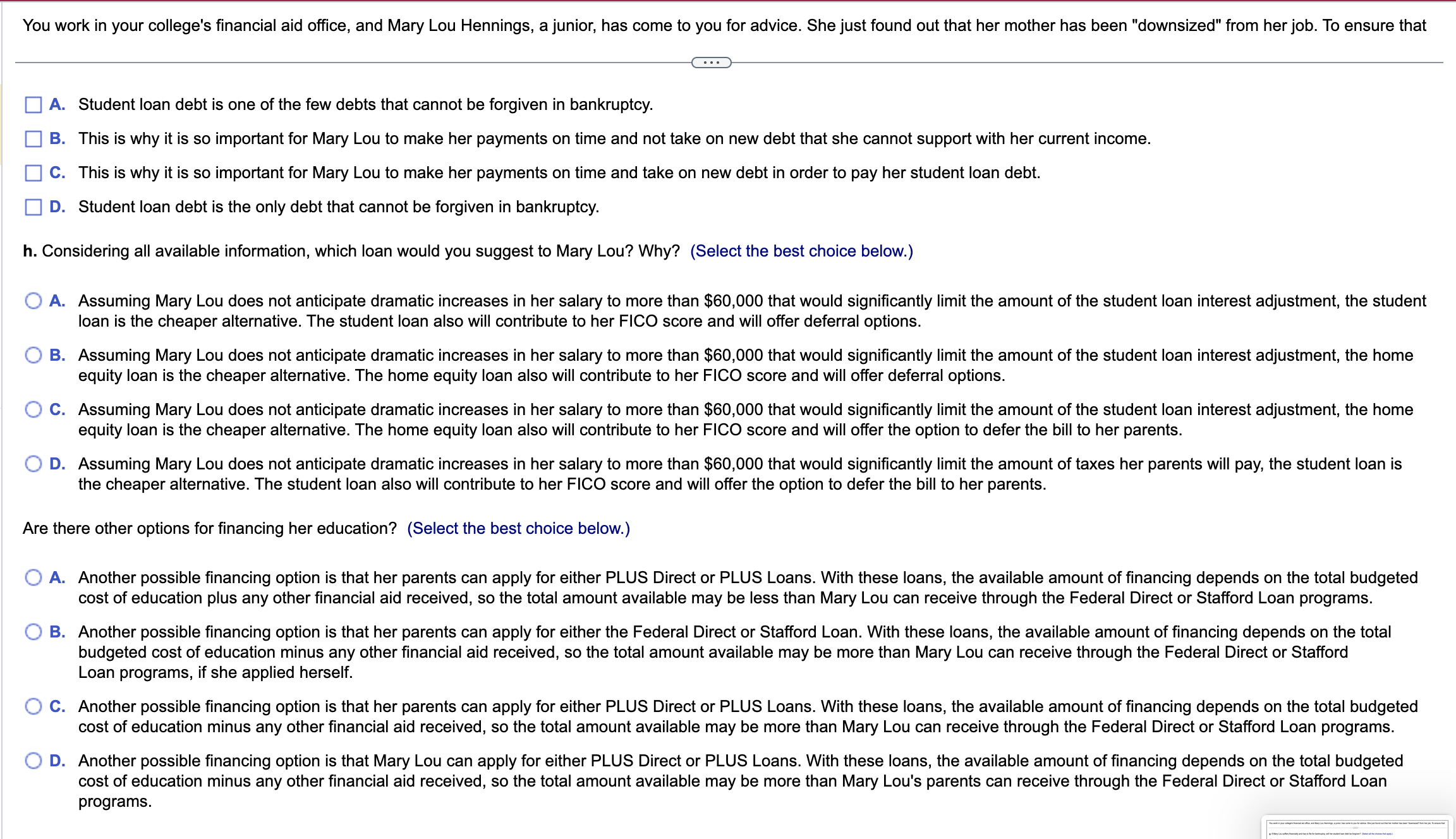
e. Using her current income, calculate her debt limit ratio for the most expensive school loan and her auto loan during the school year. Using her projected income, calculate her debt limit ratio for the loans after graduation. Mary Lou's debt limit ratio for the most expensive school loan and her auto loan during the school year is \%. (Round to two decimal places.) Mary Lou's debt limit ratio for the most expensive school loan and her auto loan after graduation is f. What are the advantages of a loan consolidation? (Select all the choices that apply.) A. Mary Lou should be able to pay off her debt earlier. B. Mary Lou may be able to eliminate her debt problems. C. Mary Lou will only have one monthly payment to manage. D. Mary Lou may be able to qualify for a lower interest rate. What are the disadvantages of a loan consolidation? (Select all the choices that apply.) A. It is hard to find a good consolidation company to work with. B. Loan consolidation cannot be reversed. C. A consolidated loan will not contribute to FICO score and will not offer the deferral options. D. The decision must be made within the grace period for Direct loans. What factors should Mary Lou consider when contemplating consolidation? (Select from the drop-down menus.) Mary Lou \%. (Round to two decimal places.) \%. (Round to two decimal places.) You work in your college's financial aid office, and Mary Lou Hennings, a junior, has come to you for advice. She just found out that her mother has been "downsized" from her job. To ensure that she has sufficient funding for her senior year, she needs to apply for a loan to help with expenses. She has a part-time job with take-home pay of $500 per month. She expects her annual net earnings to be approximately $35,000 after graduation, and she plans to continue living at home for another year or two. Her parents have told her she can use up to $10,000 of their home equity line of credit; however, she is not sure she wants to do that. She does not have any debt except for 3 more years of monthly auto payments of $191. She is worried about trying to pay for an additional loan while still in school, although her mom is convinced she will find another job soon and be able to make up the payments. a. Explain the difference between a Direct Subsidized Loan and a Direct Unsubsidized Loan to Mary Lou. b. What types of student loans are available to Mary Lou, and what lending limits apply? When would repayment of the loans begin? c. Assume her student loan will have an interest rate of 7.00 percent and her parents' home equity line has a rate of 9.75 percent. If both loans have a 10 -year maturity, what will her monthly payment be on a loan of $6,000, ignoring any possible deferments? d. Explain the tax consequences of the two options, assuming Mary Lou is in the 25 percent marginal federal tax bracket and her parents are in the 28 percent tax bracket. No state income tax is assessed. e. Using her current income, calculate her debt limit ratio for the most expensive school loan and her auto loan during the school year. Using her projected income, calculate her debt limit ratio for the loans after graduation. f. What are the advantages and disadvantages of a loan consolidation? What factors should Mary Lou consider when contemplating consolidation? a. Explain the difference between a Direct Subsidized Loan and a Direct Unsubsidized Loan to Mary Lou. (Select all the choices that apply.) A. A major difference between Direct Subsidized and Direct Unsubsidized loans is that subsidized loans do not accrue interest while the student is in school or during the grace period. B. A major difference between Direct Subsidized and Direct Unsubsidized loans is that subsidized loans accrue interest while the student is in school or during the grace period. C. Unsubsidized loans accrue interest from the day they are awarded, and students can either pay the interest as they go or let it accrue until the end of their grace period. Students must demonstrate financial need for unsubsidized loans but not for subsidized loans. D. Unsubsidized loans accrue interest from the day they are awarded, and students can either pay the interest as they go or let it accrue until the end of their grace period. Students must demonstrate financial need for subsidized loans but not for unsubsidized loans. b. What types of student loans are available to Mary Lou? (Select the best answer below.) A. Mary Lou cannot apply any loans because student loans are only for incoming freshmen, and she is a junior. B. Mary Lou can apply for either the Direct PLUS Loans for Parents or the Stafford Loan. C. Mary Lou can apply for either the Federal Direct Loan or the Stafford Loan. D. Mary Lou can apply for either the Federal Direct Loan or the Direct PLUS Loans for Parents. What lending limits apply? (Select from the drop down menus.) . Kepayment or tne ans will pegn to montns arter ivary Lou graquates. loan of $6,000, ignoring any possible deferments? Mary Lou's monthly payment on the student loan would be $ (Round to the nearest cent.) Mary Lou's monthly payment on the home equity loan would be $ (Round to the nearest cent.) Explain the tax consequences of the two options. (Select the best choice below.) although the eligibility for the adjustment phases out as income increases. of $2,500 annually, although the eligibility for the adjustment phases out as income increases. the eligibility for the adjustment phases out as income increases. of $2,500 annually, although the eligibility for the adjustment phases out as income increases. The after-tax interest rate for the home equity loan is %. (Round to two decimal places.) The after-tax interest rate for the student loan is %. (Round to two decimal places.) the loans after graduation. Mary Lou's debt limit ratio for the most expensive school loan and her auto loan during the school year is \%. (Round to two decimal places.) Mary Lou's debt limit ratio for the most expensive school loan and her auto loan after graduation is 'o. (Round to two decimal places.) b. What types of student loans are available to Mary Lou? (Select the best answer below.) A. Mary Lou cannot apply any loans because student loans are only for incoming freshmen, and she is a junior. B. Mary Lou can apply for either the Direct PLUS Loans for Parents or the Stafford Loan. C. Mary Lou can apply for either the Federal Direct Loan or the Stafford Loan. D. Mary Lou can apply for either the Federal Direct Loan or the Direct PLUS Loans for Parents. What lending limits apply? (Select from the drop down menus.) The has an annual limit for undergraduate students of $5,500 per year. The has anual limts of: $3,500 for the first year, $4,500 for the second year, and $5,500 for the third and fourth years. The has a limit up to $2,000 for undergraduate students. The limit is the cost of attendance minus any other financial aid the student receives. When would repayment of the loans begin? (Select the best choice below.) A. Repayment of the loans will begin 6 months after Mary Lou graduates. B. Repayment of the loans will begin after Mary Lou receives her first pay check. C. Repayment of the loans will begin 12 months after Mary Lou graduates. D. Repayment of the loans will begin 18 months after Mary Lou graduates. c. Assume her student loan will have an interest rate of 7.00% and her parents' home equity line has a rate of 9.75%. If both loans have a 10 -year maturity, what will her monthly payment be on a loan of $6,000, ignoring any possible deferments? Mary Lou's monthly payment on the student loan would be $ (Round to the nearest cent.) Mary Lou's monthly payment on the home equity loan would be $. (Round to the nearest cent.) d. Explain the tax consequences of the two options, assuming Mary Lou is in the 25% marginal federal tax bracket and her parents are in the 28% tax bracket. No state income tax is assessed. Explain the tax conseauences of the two options. (Select the best choice below.) g. If Mary Lou suffers financially and has to file for bankruptcy, will her student loan debt be forgiven? (Select all the choices that apply.) A. Student loan debt is one of the few debts that cannot be forgiven in bankruptcy. B. This is why it is so important for Mary Lou to make her payments on time and not take on new debt that she cannot support with her current income. C. This is why it is so important for Mary Lou to make her payments on time and take on new debt in order to pay her student loan debt. D. Student loan debt is the only debt that cannot be forgiven in bankruptcy. h. Considering all available information, which loan would you suggest to Mary Lou? Why? (Select the best choice below.) loan is the cheaper alternative. The student loan also will contribute to her FICO score and will offer deferral options. equity loan is the cheaper alternative. The home equity loan also will contribute to her FICO score and will offer deferral options. equity loan is the cheaper alternative. The home equity loan also will contribute to her FICO score and will offer the option to defer the bill to her parents. the cheaper alternative. The student loan also will contribute to her FICO score and will offer the option to defer the bill to her parents. Are there other options for financing her education? (Select the best choice below.) Loan programs, if she applied herself. A. Student loan debt is one of the few debts that cannot be forgiven in bankruptcy. B. This is why it is so important for Mary Lou to make her payments on time and not take on new debt that she cannot support with her current income. C. This is why it is so important for Mary Lou to make her payments on time and take on new debt in order to pay her student loan debt. D. Student loan debt is the only debt that cannot be forgiven in bankruptcy. h. Considering all available information, which loan would you suggest to Mary Lou? Why? (Select the best choice below.) A. Assuming Mary Lou does not anticipate dramatic increases in her salary to more than $60,000 that would significantly limit the amount of the student loan interest adjustment, the student loan is the cheaper alternative. The student loan also will contribute to her FICO score and will offer deferral options. B. Assuming Mary Lou does not anticipate dramatic increases in her salary to more than $60,000 that would significantly limit the amount of the student loan interest adjustment, the home equity loan is the cheaper alternative. The home equity loan also will contribute to her FICO score and will offer deferral options. C. Assuming Mary Lou does not anticipate dramatic increases in her salary to more than $60,000 that would significantly limit the amount of the student loan interest adjustment, the home equity loan is the cheaper alternative. The home equity loan also will contribute to her FICO score and will offer the option to defer the bill to her parents. D. Assuming Mary Lou does not anticipate dramatic increases in her salary to more than $60,000 that would significantly limit the amount of taxes her parents will pay, the student loan is the cheaper alternative. The student loan also will contribute to her FICO score and will offer the option to defer the bill to her parents. Are there other options for financing her education? (Select the best choice below.) A. Another possible financing option is that her parents can apply for either PLUS Direct or PLUS Loans. With these loans, the available amount of financing depends on the total budgeted cost of education plus any other financial aid received, so the total amount available may be less than Mary Lou can receive through the Federal Direct or Stafford Loan programs. B. Another possible financing option is that her parents can apply for either the Federal Direct or Stafford Loan. With these loans, the available amount of financing depends on the total budgeted cost of education minus any other financial aid received, so the total amount available may be more than Mary Lou can receive through the Federal Direct or Stafford Loan programs, if she applied herself. C. Another possible financing option is that her parents can apply for either PLUS Direct or PLUS Loans. With these loans, the available amount of financing depends on the total budgeted cost of education minus any other financial aid received, so the total amount available may be more than Mary Lou can receive through the Federal Direct or Stafford Loan programs. D. Another possible financing option is that Mary Lou can apply for either PLUS Direct or PLUS Loans. With these loans, the available amount of financing depends on the total budgeted cost of education minus any other financial aid received, so the total amount available may be more than Mary Lou's parents can receive through the Federal Direct or Stafford Loan programs
Step by Step Solution
There are 3 Steps involved in it

Get step-by-step solutions from verified subject matter experts
 Study Help