







Question: please I need answer for problem #2 only thank you. as medical lab technicians ( undergraduate) we need to answer these question I DLM DASED
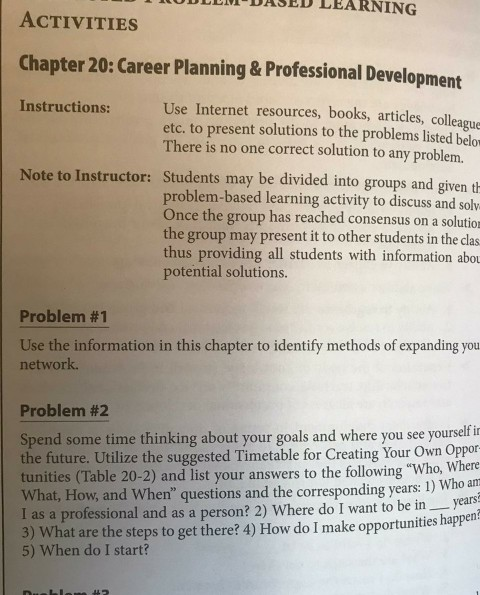
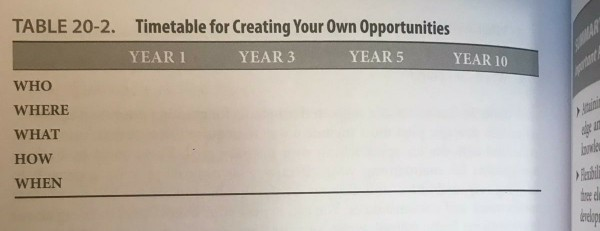
please I need answer for problem #2 only thank you.
as medical lab technicians ( undergraduate) we need to answer these question
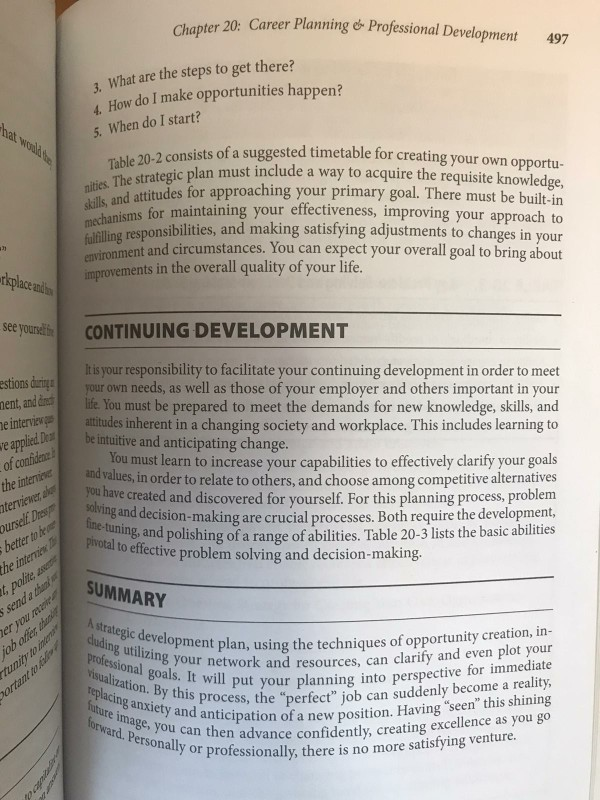
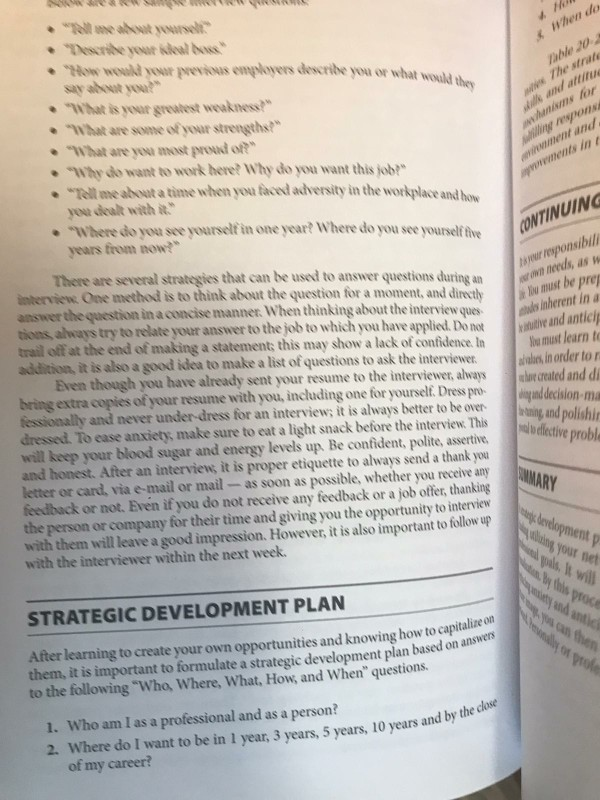
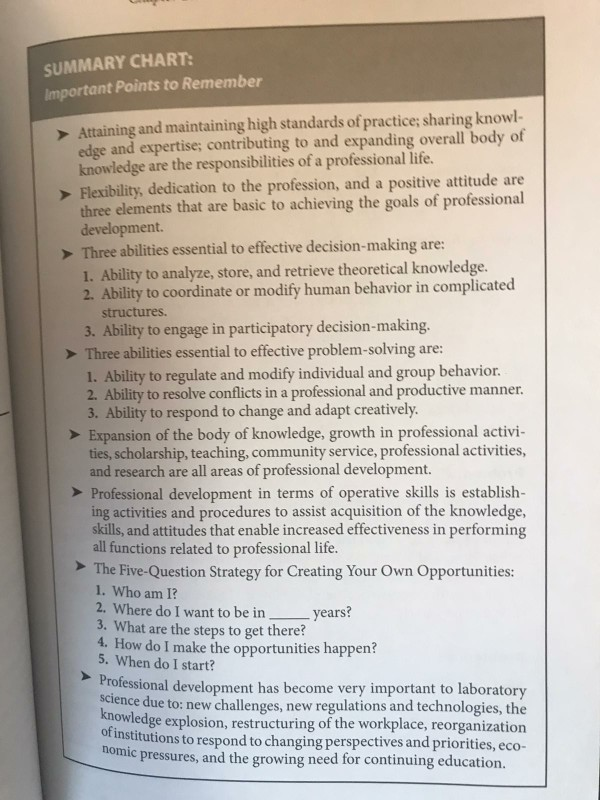
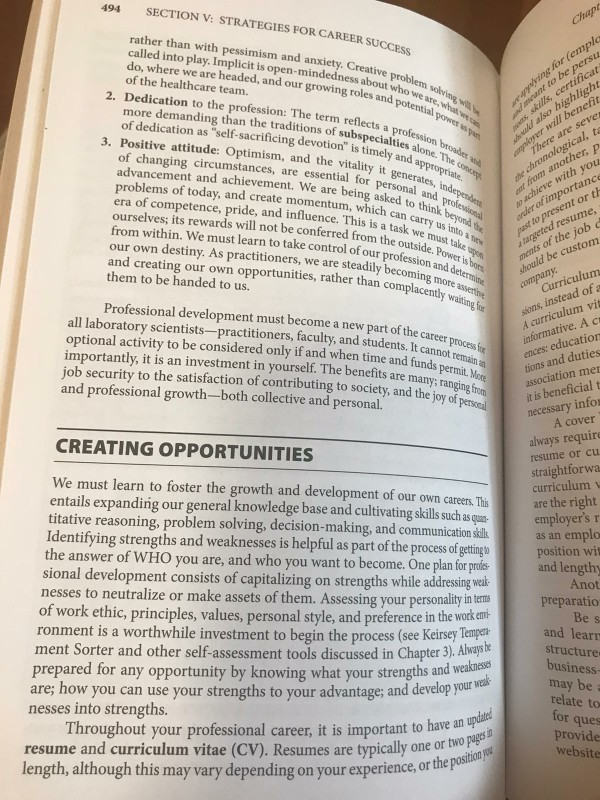
I DLM DASED LEARNING ACTIVITIES Chapter 20: Career Planning & Professional Development Instructions: Use Internet resources, books, articles, colleague etc. to present solutions to the problems listed below There is no one correct solution to any problem. Note to Instructor: Students may be divided into groups and given th problem-based learning activity to discuss and solv Once the group has reached consensus on a solution the group may present it to other students in the clas thus providing all students with information abou potential solutions. Problem #1 Use the information in this chapter to identify methods of expanding you network. Problem #2 Spend some time thinking about your goals and where you see yourself in the future. Utilize the suggested Timetable for Creating Your Own Oppor tunities (Table 20-2) and list your answers to the following "Who, Where What, How, and When" questions and the corresponding years: 1) Who ang I as a professional and as a person? 2) Where do I want to be in years 3) What are the steps to get there? 4) How do I make opportunities happen 5) When do I start? LP TABLE 20-2. Timetable for Creating Your Own Opportunities YEAR 1 YEAR 3 YEAR 5 YEAR 10 WHO WHERE WHAT HOW WHEN labi hoe die Chapter 20: Career Planning e Professional Development What are the steps to get there? How do I make opportunities happen? 5. When do I start? nities. The strategic plan must skills, and attitudes for mechanisms for main a suggested timetable for creating your own opportu- ble 20-2 consists of a suggested timetable for creating tegic plan must include a way to acquire the requisite knowledge, attitudes for approaching your primary goal. There must be built-in us for maintaining your effectiveness, improving your approach to esponsibilities, and making satisfying adjustments to changes in your nt and circumstances. You can expect your overall goal to bring about improvements in the overall quality of your life. rkplace andhan see yoursel's CONTINUING DEVELOPMENT estions durity ment, and died me interview que we applied Det of confidenzi the internet It is your responsibility to facilitate your continuing development in order to meet your own needs, as well as those of your employer and others important in your life. You must be prepared to meet the demands for new knowledge, skills, and attitudes inherent in a changing society and workplace. This includes learning to be intuitive and anticipating change. You must learn to increase your capabilities to effectively clarify your goals values, in order to relate to others, and choose among competitive alternatives nave created and discovered for yourself. For this planning process, problem nd decision-making are crucial processes. Both require the development, B and polishing of a range of abilities. Table 20-3 lists the basic abilities to effective problem solving and decision-making. terviews alor ourself. Des better to be fine-tuning, and polishing pivotal to effective proble the interna SUMMARY 1 polie Ssendahl Ter om 106 oferte A strategic development plan cluding utilizing your networ professional goals. It will Visualization. By this proce replacing anxiety and anticipo Tutare image, you can Torward. Personally or p ment plan, using the techniques of opportunity creation, in- network and resources, can clarify and even plot your ut your planning into perspective for immediate ss, the "perfect" job can suddenly become a reality, nticipation of a new position. Having "seen this shining can then advance confidently, creating excellence is you cellence as you go y of professionally, there is no more satisfying venture ward, Peu "Describe your heal bass "How would your previous emplovers describe you or what wou M When do Table 10 ilk and attitud wat lor I and ents in CONTINUING a new reponsibil Beds, as Xw must be prey "What is your greatest weakness." "What are some of your strengths "What are you most proud of?" "Why do want to work here? Why do you want this job?" Tell me about a time when you faced adversity in the workplace and how your dealt with it Where do you see yourself in one year? Where do you see yourself five years from now?" There are several strategies that can be used to answer questions during an interview One method is to think about the question for a moment, and directly answer the question in a concise manner. When thinking about the interview ques tions always try to relate your answer to the job to which you have applied. Do not trail off at the end of making a statement this may show a lack of confidence. In addition, it is also a good idea to make a list of questions to ask the interviewer Even though you have already sent your resume to the interviewer, always bring extra copies of your resume with you, including one for yourself. Dress pro fessionally and never under-dress for an interviews it is always better to be over dressed. To ease anxiety, make sure to eat a light snack before the interview. This will keep your blood sugar and energy levels up Be confident, polite, assertive and honest. After an interview, it is proper etiquette to always send a thank you letter or card. via e-mail or mail - as soon as possible, whether you receive any feedback or not. Even if you do not receive any feedback or a job offer, thanking the person or company for their time and giving you the opportunity to interview with them will leave a good impression. However, it is also important to follow up with the interviewer within the next week. is inherent in a www and antich Hou must learn to alues in order to ochore created and di bing and decision-me woning and polishi hodiective proble MMARY your ne s poc STRATEGIC DEVELOPMENT PLAN on the After learning to create your own opportunities and knowing how to capitu them, it is important to formulate a strategic development plan based on to the following "Who, Where, What, How, and When" questions 10 years and by the close 1. Who am I as a professional and as a person? 2. Where do I want to be in 1 year, 3 years, 5 years, 10 years an of my career? SUMMARY CHART: Important Points to Remember Attaining and maintaining high standards of practice; sharing knowl edge and expertise; contributing to and expanding overall body of knowledge are the responsibilities of a professional life. Flexibility, dedication to the profession, and a positive attitude are three elements that are basic to achieving the goals of professional development. Three abilities essential to effective decision-making are: 1. Ability to analyze, store, and retrieve theoretical knowledge. 2. Ability to coordinate or modify human behavior in complicated structures. 3. Ability to engage in participatory decision-making. Three abilities essential to effective problem-solving are: 1. Ability to regulate and modify individual and group behavior. 2. Ability to resolve conflicts in a professional and productive manner. 3. Ability to respond to change and adapt creatively. Expansion of the body of knowledge, growth in professional activi- ties, scholarship, teaching, community service, professional activities, and research are all areas of professional development. Professional development in terms of operative skills is establish- ing activities and procedures to assist acquisition of the knowledge, skills, and attitudes that enable increased effectiveness in performing all functions related to professional life. The Five-Question Strategy for Creating Your Own Opportunities: 1. Who am I? 2. Where do I want to be in years? 3. What are the steps to get there? 4. How do I make the opportunities happen? 5. When do I start? Professional development has become very important to laboratory science due to: new challenges, new regulations and technologies, the knowledge explosion, restructuring of the workplace, reorganization institutions to respond to changing perspectives and priorities, eco- omic pressures, and the growing need for continuing education. 494 SECTION V: STRATEGIES FOR CAREER SUCCES Chape we problem solving who we are, wat potential power profession de les alone. Ive ving for(emple to be pers skills, certificat ld also highlight er will benefit rather than with pessimism and anxiety. Creative called into play. Implicit is open-mindedness about wh do, where we are headed, and our growing roles and pote of the healthcare team. 2. Dedication to the profession: The term reflects a p more demanding than the traditions of subspecialties of dedication as "self-sacrificing devotion" is timely a 3. Positive attitude: Optimism, and the vitality it gener of changing circumstances, are essential for person advancement and achievement. We are being asked to problems of today, and create momentum, which can era of competence, pride, and influence. This is a task ourselves; its rewards will not be conferred from the outsid from within. We must learn to take control of our professi our own destiny. As practitioners, we are steadily becomir and creating our own opportunities, rather than complacer them to be handed to us. timely and appropriate venerates, widegen cypal and person ked to think beyond the ich can carry W ave ask we must alleen side. Power is bons profession and dete becoming more avete ymplacently waiting There are sever e chronological ta al from another, p achieve with you ser of importance pust to present orth targeted resume, ments of the job d should be custom company Professional development must become a new part of the care all laboratory scientists--practitioners, faculty, and students. It can optional activity to be considered only if and when time and fund importantly, it is an investment in yourself. The benefits are man job security to the satisfaction of contributing to society, and the joy of and professional growth-both collective and personal. art of the career processo dents. It cannot remain on time and funds permit. More benefits are many ranging from Curriculum sions, instead of A curriculum vit informative. A CH ences: education tions and duties association met it is beneficial t CREATING OPPORTUNITIES necessary info: A cover always require resume or cu straightforwa curriculum are the right employer's r as an emplo position wit and length Anot preparatio Be s We must learn to foster the growth and development of our own careers. This entails expanding our general knowledge base and cultivating skills such as quan titative reasoning, problem solving, decision-making, and communication skill Identifying strengths and weaknesses is helpful as part of the process of getting the answer of WHO you are, and who you want to become. One plan for profes sional development consists of capitalizing on strengths while addressing weak nesses to neutralize or make assets of them. Assessing your personality in terms of work ethic, principles, values, personal style, and preference in the work em ronment is a worthwhile investment to begin the process (see Keirseylempa ment Sorter and other self-assessment tools discussed in Chapter 3). A prepared for any opportunity by knowing what your strengths and weak are; how you can use your strengths to your advantage; and develop your nesses into strengths. Throughout your professional career, it is important to have resume and curriculum vitae (CV). Resumes are typically one of length, although this may vary depending on your experience, or and learn structure business may be relate to for ques provide website tant to have an updated cally one or two pages Perlence, or the position po I DLM DASED LEARNING ACTIVITIES Chapter 20: Career Planning & Professional Development Instructions: Use Internet resources, books, articles, colleague etc. to present solutions to the problems listed below There is no one correct solution to any problem. Note to Instructor: Students may be divided into groups and given th problem-based learning activity to discuss and solv Once the group has reached consensus on a solution the group may present it to other students in the clas thus providing all students with information abou potential solutions. Problem #1 Use the information in this chapter to identify methods of expanding you network. Problem #2 Spend some time thinking about your goals and where you see yourself in the future. Utilize the suggested Timetable for Creating Your Own Oppor tunities (Table 20-2) and list your answers to the following "Who, Where What, How, and When" questions and the corresponding years: 1) Who ang I as a professional and as a person? 2) Where do I want to be in years 3) What are the steps to get there? 4) How do I make opportunities happen 5) When do I start? LP TABLE 20-2. Timetable for Creating Your Own Opportunities YEAR 1 YEAR 3 YEAR 5 YEAR 10 WHO WHERE WHAT HOW WHEN labi hoe die Chapter 20: Career Planning e Professional Development What are the steps to get there? How do I make opportunities happen? 5. When do I start? nities. The strategic plan must skills, and attitudes for mechanisms for main a suggested timetable for creating your own opportu- ble 20-2 consists of a suggested timetable for creating tegic plan must include a way to acquire the requisite knowledge, attitudes for approaching your primary goal. There must be built-in us for maintaining your effectiveness, improving your approach to esponsibilities, and making satisfying adjustments to changes in your nt and circumstances. You can expect your overall goal to bring about improvements in the overall quality of your life. rkplace andhan see yoursel's CONTINUING DEVELOPMENT estions durity ment, and died me interview que we applied Det of confidenzi the internet It is your responsibility to facilitate your continuing development in order to meet your own needs, as well as those of your employer and others important in your life. You must be prepared to meet the demands for new knowledge, skills, and attitudes inherent in a changing society and workplace. This includes learning to be intuitive and anticipating change. You must learn to increase your capabilities to effectively clarify your goals values, in order to relate to others, and choose among competitive alternatives nave created and discovered for yourself. For this planning process, problem nd decision-making are crucial processes. Both require the development, B and polishing of a range of abilities. Table 20-3 lists the basic abilities to effective problem solving and decision-making. terviews alor ourself. Des better to be fine-tuning, and polishing pivotal to effective proble the interna SUMMARY 1 polie Ssendahl Ter om 106 oferte A strategic development plan cluding utilizing your networ professional goals. It will Visualization. By this proce replacing anxiety and anticipo Tutare image, you can Torward. Personally or p ment plan, using the techniques of opportunity creation, in- network and resources, can clarify and even plot your ut your planning into perspective for immediate ss, the "perfect" job can suddenly become a reality, nticipation of a new position. Having "seen this shining can then advance confidently, creating excellence is you cellence as you go y of professionally, there is no more satisfying venture ward, Peu "Describe your heal bass "How would your previous emplovers describe you or what wou M When do Table 10 ilk and attitud wat lor I and ents in CONTINUING a new reponsibil Beds, as Xw must be prey "What is your greatest weakness." "What are some of your strengths "What are you most proud of?" "Why do want to work here? Why do you want this job?" Tell me about a time when you faced adversity in the workplace and how your dealt with it Where do you see yourself in one year? Where do you see yourself five years from now?" There are several strategies that can be used to answer questions during an interview One method is to think about the question for a moment, and directly answer the question in a concise manner. When thinking about the interview ques tions always try to relate your answer to the job to which you have applied. Do not trail off at the end of making a statement this may show a lack of confidence. In addition, it is also a good idea to make a list of questions to ask the interviewer Even though you have already sent your resume to the interviewer, always bring extra copies of your resume with you, including one for yourself. Dress pro fessionally and never under-dress for an interviews it is always better to be over dressed. To ease anxiety, make sure to eat a light snack before the interview. This will keep your blood sugar and energy levels up Be confident, polite, assertive and honest. After an interview, it is proper etiquette to always send a thank you letter or card. via e-mail or mail - as soon as possible, whether you receive any feedback or not. Even if you do not receive any feedback or a job offer, thanking the person or company for their time and giving you the opportunity to interview with them will leave a good impression. However, it is also important to follow up with the interviewer within the next week. is inherent in a www and antich Hou must learn to alues in order to ochore created and di bing and decision-me woning and polishi hodiective proble MMARY your ne s poc STRATEGIC DEVELOPMENT PLAN on the After learning to create your own opportunities and knowing how to capitu them, it is important to formulate a strategic development plan based on to the following "Who, Where, What, How, and When" questions 10 years and by the close 1. Who am I as a professional and as a person? 2. Where do I want to be in 1 year, 3 years, 5 years, 10 years an of my career? SUMMARY CHART: Important Points to Remember Attaining and maintaining high standards of practice; sharing knowl edge and expertise; contributing to and expanding overall body of knowledge are the responsibilities of a professional life. Flexibility, dedication to the profession, and a positive attitude are three elements that are basic to achieving the goals of professional development. Three abilities essential to effective decision-making are: 1. Ability to analyze, store, and retrieve theoretical knowledge. 2. Ability to coordinate or modify human behavior in complicated structures. 3. Ability to engage in participatory decision-making. Three abilities essential to effective problem-solving are: 1. Ability to regulate and modify individual and group behavior. 2. Ability to resolve conflicts in a professional and productive manner. 3. Ability to respond to change and adapt creatively. Expansion of the body of knowledge, growth in professional activi- ties, scholarship, teaching, community service, professional activities, and research are all areas of professional development. Professional development in terms of operative skills is establish- ing activities and procedures to assist acquisition of the knowledge, skills, and attitudes that enable increased effectiveness in performing all functions related to professional life. The Five-Question Strategy for Creating Your Own Opportunities: 1. Who am I? 2. Where do I want to be in years? 3. What are the steps to get there? 4. How do I make the opportunities happen? 5. When do I start? Professional development has become very important to laboratory science due to: new challenges, new regulations and technologies, the knowledge explosion, restructuring of the workplace, reorganization institutions to respond to changing perspectives and priorities, eco- omic pressures, and the growing need for continuing education. 494 SECTION V: STRATEGIES FOR CAREER SUCCES Chape we problem solving who we are, wat potential power profession de les alone. Ive ving for(emple to be pers skills, certificat ld also highlight er will benefit rather than with pessimism and anxiety. Creative called into play. Implicit is open-mindedness about wh do, where we are headed, and our growing roles and pote of the healthcare team. 2. Dedication to the profession: The term reflects a p more demanding than the traditions of subspecialties of dedication as "self-sacrificing devotion" is timely a 3. Positive attitude: Optimism, and the vitality it gener of changing circumstances, are essential for person advancement and achievement. We are being asked to problems of today, and create momentum, which can era of competence, pride, and influence. This is a task ourselves; its rewards will not be conferred from the outsid from within. We must learn to take control of our professi our own destiny. As practitioners, we are steadily becomir and creating our own opportunities, rather than complacer them to be handed to us. timely and appropriate venerates, widegen cypal and person ked to think beyond the ich can carry W ave ask we must alleen side. Power is bons profession and dete becoming more avete ymplacently waiting There are sever e chronological ta al from another, p achieve with you ser of importance pust to present orth targeted resume, ments of the job d should be custom company Professional development must become a new part of the care all laboratory scientists--practitioners, faculty, and students. It can optional activity to be considered only if and when time and fund importantly, it is an investment in yourself. The benefits are man job security to the satisfaction of contributing to society, and the joy of and professional growth-both collective and personal. art of the career processo dents. It cannot remain on time and funds permit. More benefits are many ranging from Curriculum sions, instead of A curriculum vit informative. A CH ences: education tions and duties association met it is beneficial t CREATING OPPORTUNITIES necessary info: A cover always require resume or cu straightforwa curriculum are the right employer's r as an emplo position wit and length Anot preparatio Be s We must learn to foster the growth and development of our own careers. This entails expanding our general knowledge base and cultivating skills such as quan titative reasoning, problem solving, decision-making, and communication skill Identifying strengths and weaknesses is helpful as part of the process of getting the answer of WHO you are, and who you want to become. One plan for profes sional development consists of capitalizing on strengths while addressing weak nesses to neutralize or make assets of them. Assessing your personality in terms of work ethic, principles, values, personal style, and preference in the work em ronment is a worthwhile investment to begin the process (see Keirseylempa ment Sorter and other self-assessment tools discussed in Chapter 3). A prepared for any opportunity by knowing what your strengths and weak are; how you can use your strengths to your advantage; and develop your nesses into strengths. Throughout your professional career, it is important to have resume and curriculum vitae (CV). Resumes are typically one of length, although this may vary depending on your experience, or and learn structure business may be relate to for ques provide website tant to have an updated cally one or two pages Perlence, or the position po
Step by Step Solution
There are 3 Steps involved in it
1 Expert Approved Answer
Step: 1 Unlock

Question Has Been Solved by an Expert!
Get step-by-step solutions from verified subject matter experts
Step: 2 Unlock
Step: 3 Unlock
 Study Help