







Question: please I need help to do this this is the questions here and this data down This is what they need and out but should
 this is the questions here and this data down
  This is what they need
  and out but should be like this down
 This is the output it's means we need to create class and we have to do a best to write all the words then we have to read it and complain each state which is have more to vote please I relly need help to do this
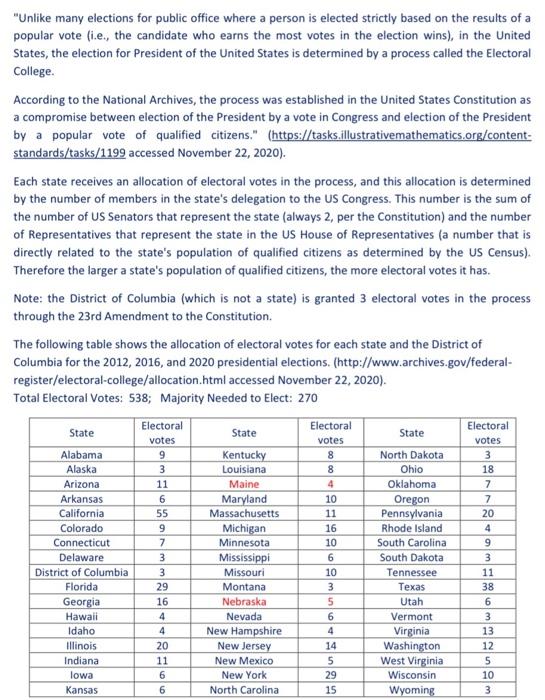
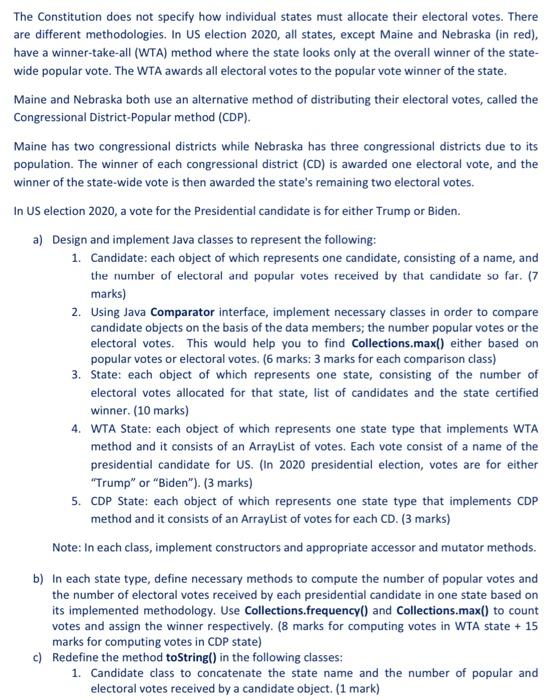
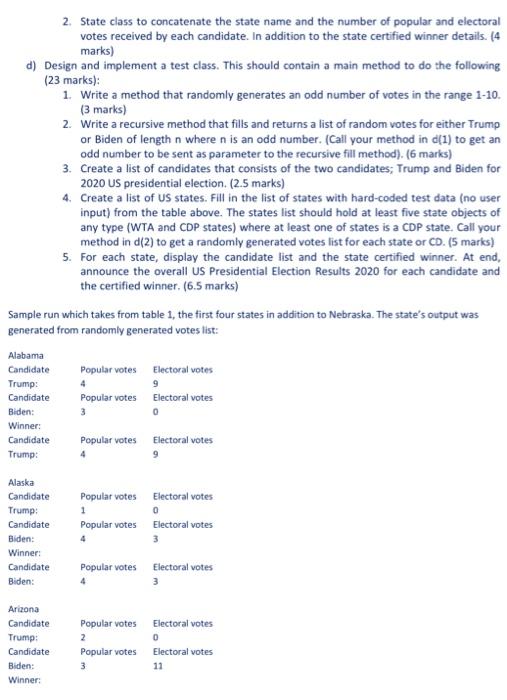
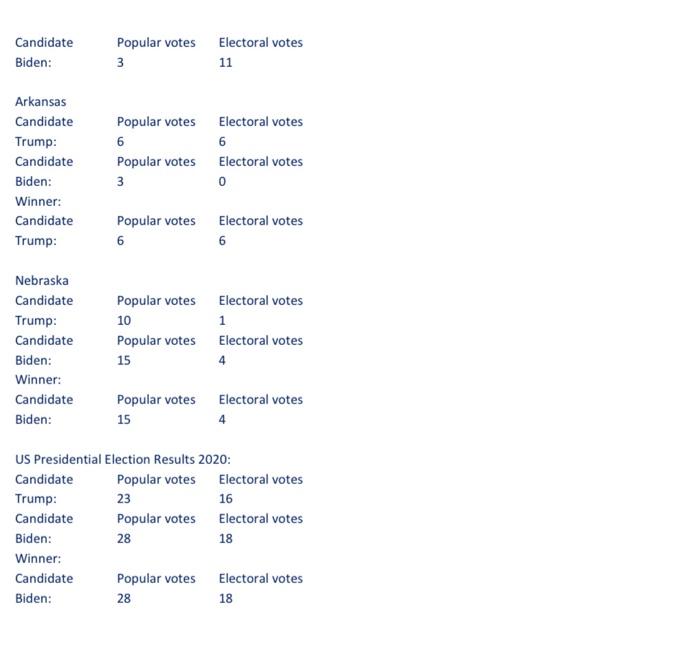
 "Unlike many elections for public office where a person is elected strictly based on the results of a popular vote (i.e., the candidate who earns the most votes in the election wins), in the United States, the election for President of the United States is determined by a process called the Electoral College. According to the National Archives, the process was established in the United States Constitution as a compromise between election of the President by a vote in Congress and election of the President by a popular vote of qualified citizens." (https://tasks.illustrativemathematics.org/content- standards/tasks/1199 accessed November 22, 2020). Each state receives an allocation of electoral votes in the process, and this allocation is determined by the number of members in the state's delegation to the US Congress. This number is the sum of the number of US Senators that represent the state (always 2, per the Constitution) and the number of Representatives that represent the state in the US House of Representatives (a number that is directly related to the state's population of qualified citizens as determined by the US Census). Therefore the larger a state's population of qualified citizens, the more electoral votes it has. Note: the District of Columbia (which is not a state) is granted 3 electoral votes in the process through the 23rd Amendment to the Constitution. The following table shows the allocation of electoral votes for each state and the District of Columbia for the 2012, 2016, and 2020 presidential elections. (http://www.archives.gov/federal- register/electoral-college/allocation.html accessed November 22, 2020). Total Electoral Votes: 538; Majority Needed to Elect: 270 Electoral Electoral Electoral State State State votes Alabama Kentucky North Dakota Louisiana Arizona Maine Oklahoma 7 Arkansas Maryland Oregon 7 California Massachusetts Pennsylvania Colorado Michigan Rhode Island Connecticut South Carolina Delaware Mississippi South Dakota 3 District of Columbia Missouri Tennessee 11 Florida Montana Texas Georgia Nebraska Utah Hawaii Nevada Vermont Idaho New Hampshire Virginia Illinois New Jersey Washington Indiana 5 West Virginia 5 New York Wisconsin Kansas North Carolina Wyoming 3 18 Alaska Ohio votes 9 3 11 6 55 9 20 4 9 Minnesota votes 8 8 4 10 11 16 10 6 10 3 5 6 4 14 7 3 3 29 16 4 4 20 11 6 6 38 6 3 13 12 New Mexico lowa 29 15 10 3 The Constitution does not specify how individual states must allocate their electoral votes. There are different methodologies. In US election 2020, all states, except Maine and Nebraska (in red), have a winner-take-all (WTA) method where the state looks only at the overall winner of the state- wide popular vote. The WTA awards all electoral votes to the popular vote winner of the state. Maine and Nebraska both use an alternative method of distributing their electoral votes, called the Congressional District Popular method (CDP). Maine has two congressional districts while Nebraska has three congressional districts due to its population. The winner of each congressional district (CD) is awarded one electoral vote, and the winner of the state-wide vote is then awarded the state's remaining two electoral votes. In US election 2020, a vote for the Presidential candidate is for either Trump or Biden. a) Design and implement Java classes to represent the following: 1. Candidate: each object of which represents one candidate, consisting of a name, and the number of electoral and popular votes received by that candidate so far. (7 marks) 2. Using Java Comparator interface, implement necessary classes in order to compare candidate objects on the basis of the data members; the number popular votes or the electoral votes. This would help you to find Collections.max() either based on popular votes or electoral votes. (6 marks: 3 marks for each comparison class) 3. State: each object of which represents one state, consisting of the number of electoral votes allocated for that state, list of candidates and the state certified winner. (10 marks) 4. WTA State: each object of which represents one state type that implements WTA method and it consists of an ArrayList of votes. Each vote consist of a name of the presidential candidate for US. (In 2020 presidential election, votes are for either "Trump" or "Biden"). (3 marks) 5. CDP State: each object of which represents one state type that implements CDP method and it consists of an ArrayList of votes for each CD. (3 marks) Note: In each class, implement constructors and appropriate accessor and mutator methods. b) In each state type, define necessary methods to compute the number of popular votes and the number of electoral votes received by each presidential candidate in one state based on its implemented methodology. Use Collections.frequency) and Collections.max() to count votes and assign the winner respectively. (8 marks for computing votes in WTA state + 15 marks for computing votes in CDP state) c) Redefine the method toString() in the following classes: 1. Candidate class to concatenate the state name and the number of popular and electoral votes received by a candidate object. (1 mark) 2. State class to concatenate the state name and the number of popular and electoral votes received by each candidate. In addition to the state certified winner details. (4 marks) d) Design and implement a test class. This should contain a main method to do the following (23 marks): 1. Write a method that randomly generates an odd number of votes in the range 1-10. (3 marks) 2. Write a recursive method that fills and returns a list of random votes for either Trump or Biden of length n where n is an odd number. (Call your method in d(1) to get an odd number to be sent as parameter to the recursive fill method). (6 marks) 3. Create a list of candidates that consists of the two candidates; Trump and Biden for 2020 US presidential election. (2.5 marks) 4. Create a list of US states. Fill in the list of states with hard-coded test data (no user input) from the table above. The states list should hold at least five state objects of any type (WTA and CDP states) where at least one of states is a CDP state. Call your method in d(2) to get a randomly generated votes list for each state or CD. (5 marks) 5. For each state, display the candidate list and the state certified winner. At end, announce the overall US Presidential Election Results 2020 for each candidate and the certified winner. (6.5 marks) Sample run which takes from table 1, the first four states in addition to Nebraska. The state's output was generated from randomly generated votes list: 4 Alabama Candidate Trump: Candidate Biden: Winner: Candidate Trump: Popular votes Electoral votes Popular votes Electoral votes 9 3 0 Popular votes Electoral votes 4 Alaska Candidate Trump: Candidate Biden: Winner: Candidate Biden: Popular votes Electoral votes 1 0 Popular votes Electoral votes 4 Popular votes Electoral votes 4 Arizona Candidate Trump: Candidate Biden: Winner: Popular votes 2 Popular votes 3 Electoral votes 0 Electoral votes 11 Candidate Biden: Popular votes Electoral votes 3 11 Arkansas Candidate Trump: Candidate Biden: Winner: Candidate Trump: Popular votes Electoral votes 6 6 Popular votes Electoral votes 3 0 Popular votes Electoral votes 6 6 Nebraska Candidate Trump: Candidate Biden: Winner: Candidate Biden: Popular votes Electoral votes 10 1 Popular votes Electoral votes 15 4 Popular votes Electoral votes 15 4 US Presidential Election Results 2020: Candidate Popular votes Electoral votes Trump: 23 16 Candidate Popular votes Electoral votes Biden: 28 18 Winner: Candidate Popular votes Electoral votes Biden: 28 18
Step by Step Solution
There are 3 Steps involved in it

Get step-by-step solutions from verified subject matter experts
 Study Help