







Question: please i need help with this, and make the code as simple as possible for easy comprehension.....we are using unix for this....thanks! A positive integer
 please i need help with this, and make the code as simple as possible for easy comprehension.....we are using unix for this....thanks!
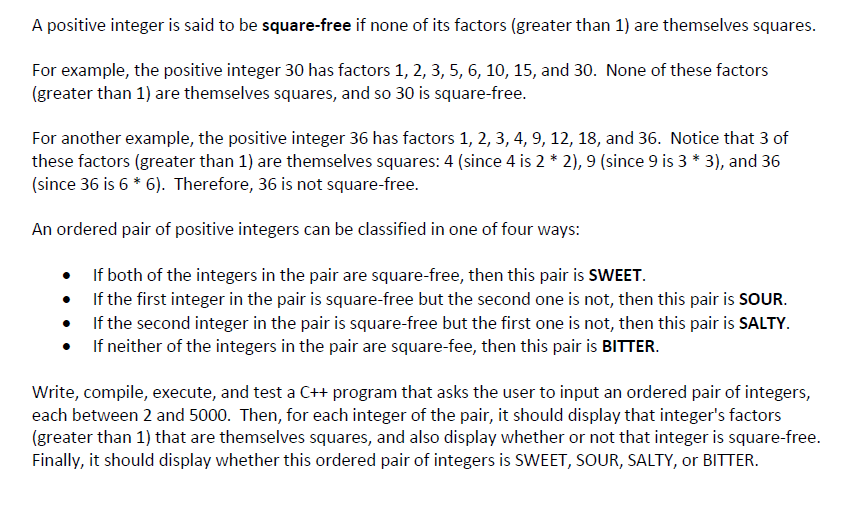
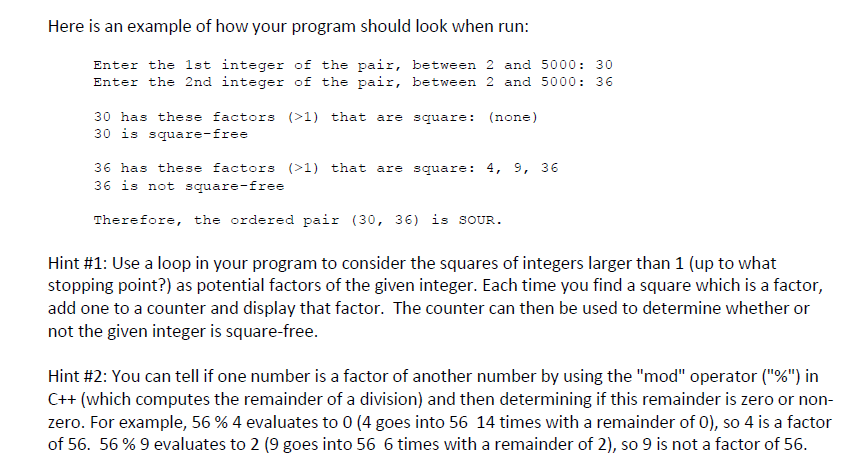
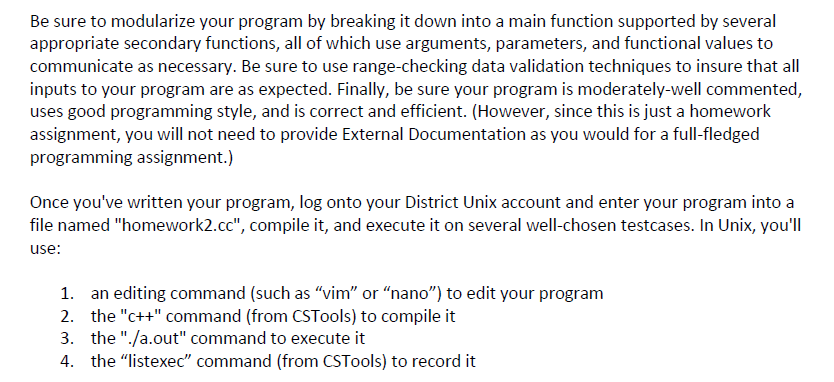
A positive integer is said to be square-free if none of its factors (greater than 1) are themselves squares For example, the positive integer 30 has factors 1, 2, 3, 5, 6, 10, 15, and 30. None of these factors (greater than 1) are themselves squares, and so 30 is square-free. For another example, the positive integer 36 has factors 1, 2, 3, 4, 9, 12, 18, and 36. Notice that 3 of these factors (greater than 1) are themselves squares: 4 (since 4 is 2 2), 9 (since 9 is 3 3), and 36 (since 36 is 6 6). Therefore, 36 is not square-free. An ordered pair of positive integers can be classified in one of four ways: If both of the integers in the pair are square-free, then this pair is SWEET If the first integer in the pair is square-free but the second one is not, then this pair is SOUR. If the second integer in the pair is square-free but the first one is not, then this pair is SALTY If neither off the integers in the pair are square-fee, then this pair is BITTER Write, compile, execute, and test a C++ program that asks the user to input an ordered pair of integers, each between 2 and 5000. Then, for each integer of the pair, it should display that integer's factors (greater than 1) that are themselves squares, and also display whether or not that integer is square-free. Finally, it should display whether this ordered pair of integers is SWEET, SOUR, SALTY, or BITTER
Step by Step Solution
There are 3 Steps involved in it

Get step-by-step solutions from verified subject matter experts
 Study Help