







Question: Please I need help with this discuss the passive loss rules and the material participation rules as they apply to Donald Trump. Then, discuss the
Please I need help with this
discuss the passive loss rules and the material participation rules as they apply to Donald Trump. Then, discuss the possible scenario where Donald Trump does not participate in the real estate business, but still owns the same assets. What would be the result?
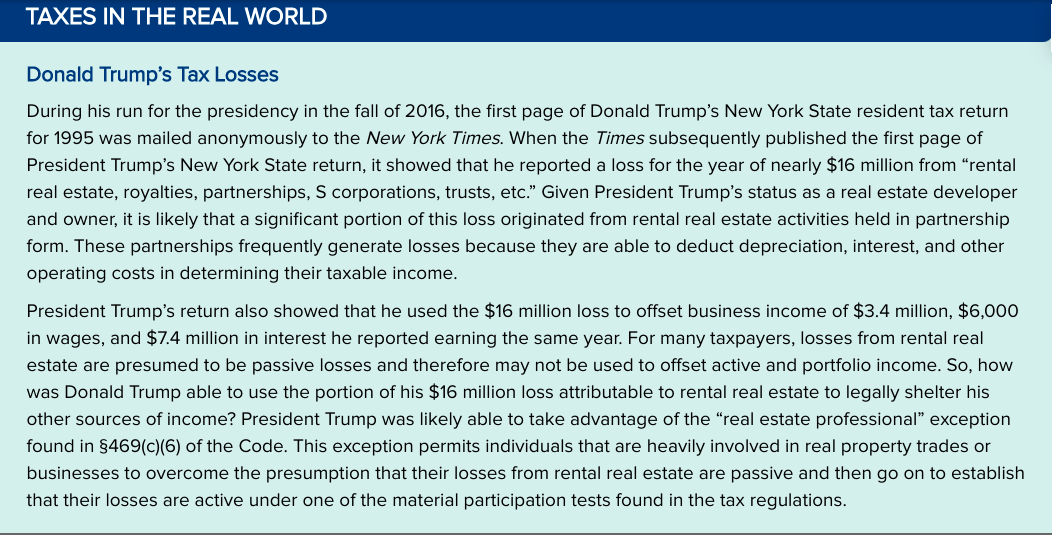
TAXES IN THE REAL WORLD Donald Trump's Tax Losses During his run for the presidency in the fall of 2016, the first page of Donald Trump's New York State resident tax return for 1995 was mailed anonymously to the New York Times. When the Times subsequently published the first page of President Trump's New York State return, it showed that he reported a loss for the year of nearly $16 million from rental real estate, royalties, partnerships, S corporations, trusts, etc." Given President Trump's status as a real estate developer and owner, it is likely that a significant portion of this loss originated from rental real estate activities held in partnership form. These partnerships frequently generate losses because they are able to deduct depreciation, interest, and other operating costs in determining their taxable income. President Trump's return also showed that he used the $16 million loss to offset business income of $3.4 million, $6,000 in wages, and $7.4 million in interest he reported earning the same year. For many taxpayers, losses from rental real estate are presumed to be passive losses and therefore may not be used to offset active and portfolio income. So, how was Donald Trump able to use the portion of his $16 million loss attributable to rental real estate to legally shelter his other sources of income? President Trump was likely able to take advantage of the real estate professional exception found in 469(c)(6) of the Code. This exception permits individuals that are heavily involved in real property trades or businesses to overcome the presumption that their losses from rental real estate are passive and then go on to establish that their losses are active under one of the material participation tests found in the tax regulations. TAXES IN THE REAL WORLD Donald Trump's Tax Losses During his run for the presidency in the fall of 2016, the first page of Donald Trump's New York State resident tax return for 1995 was mailed anonymously to the New York Times. When the Times subsequently published the first page of President Trump's New York State return, it showed that he reported a loss for the year of nearly $16 million from rental real estate, royalties, partnerships, S corporations, trusts, etc." Given President Trump's status as a real estate developer and owner, it is likely that a significant portion of this loss originated from rental real estate activities held in partnership form. These partnerships frequently generate losses because they are able to deduct depreciation, interest, and other operating costs in determining their taxable income. President Trump's return also showed that he used the $16 million loss to offset business income of $3.4 million, $6,000 in wages, and $7.4 million in interest he reported earning the same year. For many taxpayers, losses from rental real estate are presumed to be passive losses and therefore may not be used to offset active and portfolio income. So, how was Donald Trump able to use the portion of his $16 million loss attributable to rental real estate to legally shelter his other sources of income? President Trump was likely able to take advantage of the real estate professional exception found in 469(c)(6) of the Code. This exception permits individuals that are heavily involved in real property trades or businesses to overcome the presumption that their losses from rental real estate are passive and then go on to establish that their losses are active under one of the material participation tests found in the tax regulations
Step by Step Solution
There are 3 Steps involved in it

Get step-by-step solutions from verified subject matter experts
 Study Help