







Question: Please, I need help with this work problem for my MATH 3 4 5 The Clohessey - Wiltshire equations model what happens when two orbiting
Please, I need help with this work problem for my MATH
The ClohesseyWiltshire equations model what happens when two orbiting bodies are close to each other. Typically, one spacecraft is fixed as the primary
craft, which is called the target, and the secondary spacecraft is called the chaser. The ClohesseyWiltshire equations model the movement of the chaser
relative to the target. In other words, in this frame of reference, the target's position is always considered to be
The functions and give the coordinates of the chaser's position at time Likewise, their derivatives and second derivatives give the
velocity and acceleration of the chaser relative to the velocity and acceleration of the target.
This is useful because the movement of the chaser may be significant relative to the position of the target, even if the movement is small and insignificant
relative to the body which it is orbiting.
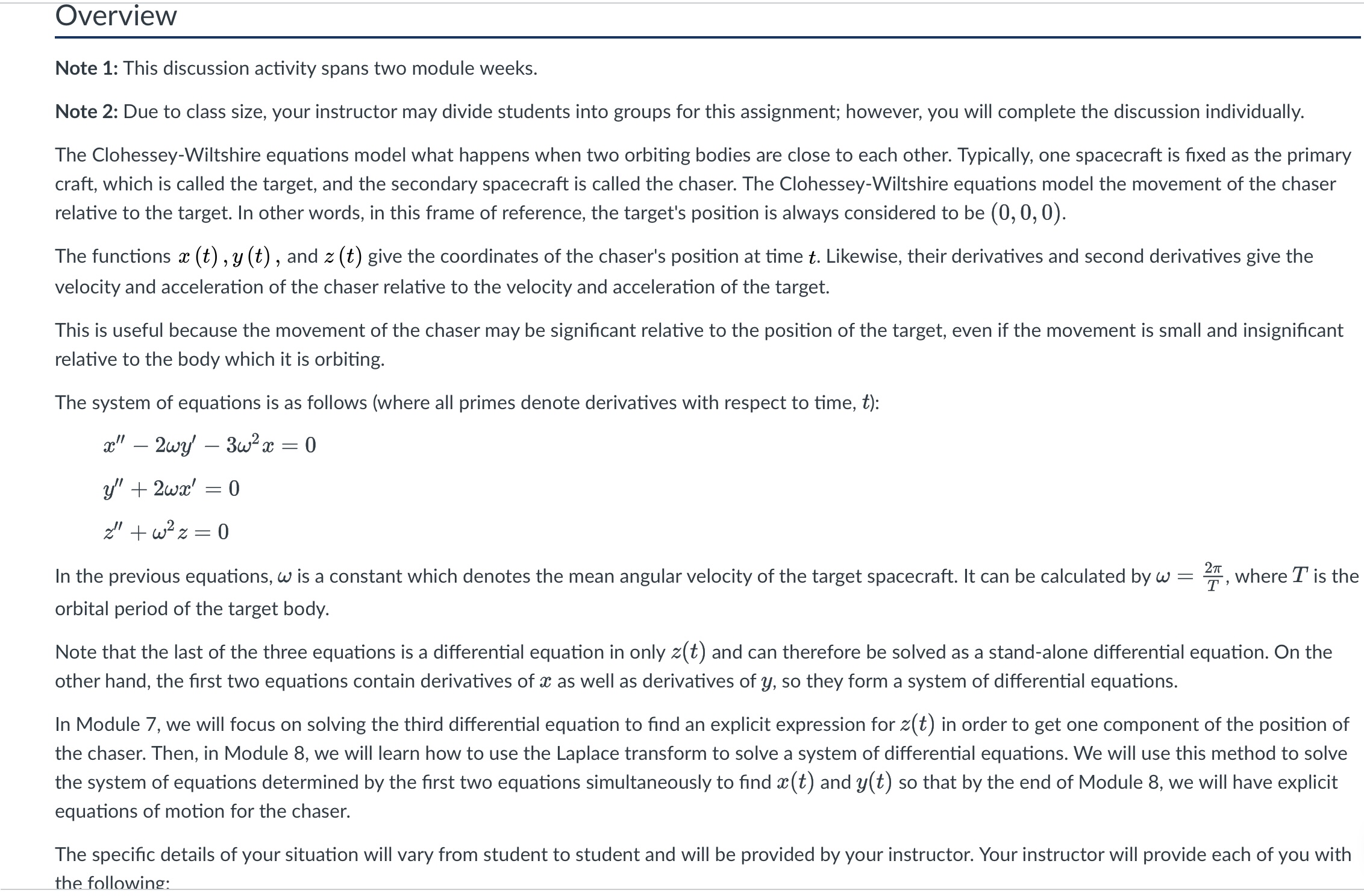
The system of equations is as follows where all primes denote derivatives with respect to time, :
In the previous equations, is a constant which denotes the mean angular velocity of the target spacecraft. It can be calculated by where is the
orbital period of the target body.
Note that the last of the three equations is a differential equation in only and can therefore be solved as a standalone differential equation. On the
other hand, the first two equations contain derivatives of as well as derivatives of so they form a system of differential equations.
In Module we will focus on solving the third differential equation to find an explicit expression for in order to get one component of the position of
the chaser. Then, in Module we will learn how to use the Laplace transform to solve a system of differential equations. We will use this method to solve
the system of equations determined by the first two equations simultaneously to find and so that by the end of Module we will have explicit
equations of motion for the chaser.
The specific details of your situation will vary from student to student and will be provided by your instructor. Your instructor will provide each of you with
the following:
The orbital period of the spacecraft
A vector representing the initial position of the chaser relative to the target
A vector representing the initial velocity of the chaser relative to the target
This information will create an initial value problem that you can solve to find the relative position of the spacecraft.
You will be using the Laplace transform to solve these equations. In your work, you may refer to the Laplace transform of as the transform of
as and the transform of as Make sure to be careful with your work so that you use capital letters in the correct places.
As you calculate, you may choose to use exact values or round to significant figures.
Also, note that the work in Module can get a little messy, so just make sure to go slowly and be careful with your work.
Instructions
Please read through all sections before proceeding to the next page and refer back whenever necessary.
Use the values that your instructor has provided you to solve the initial value problem defined by the third equation to find a function
that gives the component of the position of the chaser relative to the target. Make sure to state the values that you were given.
While this IVP can be solved using other methods, for the sake of this discussion, you must use the Laplace transform method to solve the differential
equation.
NOTE: Initial Values
The first value is the orbital period in minutes. You will need to convert it to angular velocity. The second and third items are vectors representing the initial position in meters and the initial velocity in meterssecond respectively. A word of advice: wait until the final step in each post to substitute in your personal values. This will help all of you compare steps and work along the way:
; ;
Step by Step Solution
There are 3 Steps involved in it
1 Expert Approved Answer
Step: 1 Unlock

Question Has Been Solved by an Expert!
Get step-by-step solutions from verified subject matter experts
Step: 2 Unlock
Step: 3 Unlock
 Study Help