







Question: please i need the answer for this question for the same numbers for my exam due tonight before the proposed discount) and the new pollcy
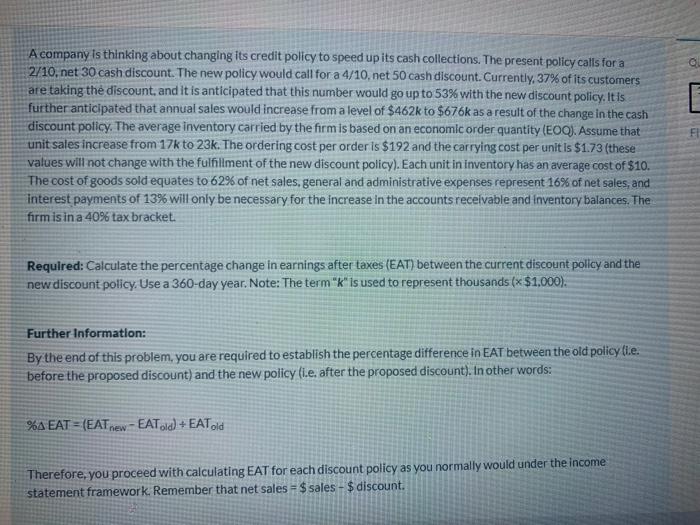
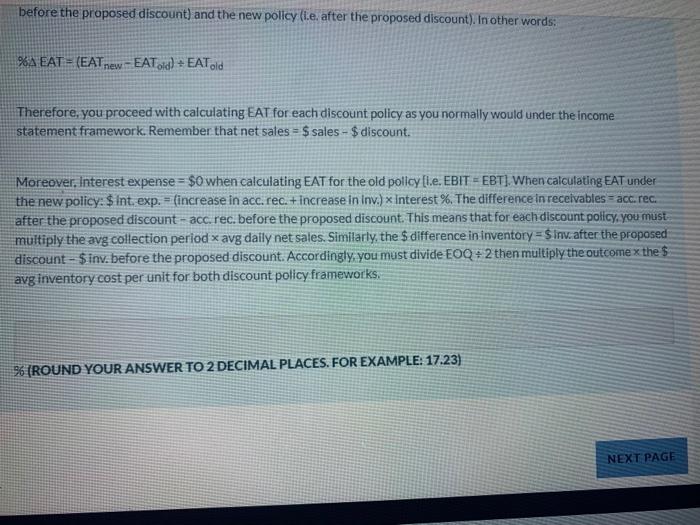
before the proposed discount) and the new pollcy (ie, after the proposed discount) in other words: %A EAT = (EATnew.- EAT id) + EAT old Therefore, you proceed with calculating EAT for each discount policy as you normally would under the income statement framework. Remember that net sales = $ sales - $ discount Moreover. Interest expense = $0 when calculating EAT for the old policy lie.EBIT = EBT]. When calculating EAT under the new policy: $ int. exp. = (increase in acc. rec. + Increase in inv.) x interest %. The difference in receivables = acc. rec. after the proposed discount - acc. rec. before the proposed discount. This means that for each discount policy, you must multiply the avg collection period x avg daily net sales. Similarly, the $ difference in inventory = $ir. after the proposed discount - $ inv. before the proposed discount. Accordingly, you must divide EOQ + 2 then multiply the outcome x the $ avg inventory cost per unit for both discount policy frameworks. 96 (ROUND YOUR ANSWER TO 2 DECIMAL PLACES. FOR EXAMPLE: 17.23) NEXT PAGE before the proposed discount) and the new pollcy (ie, after the proposed discount) in other words: %A EAT = (EATnew.- EAT id) + EAT old Therefore, you proceed with calculating EAT for each discount policy as you normally would under the income statement framework. Remember that net sales = $ sales - $ discount Moreover. Interest expense = $0 when calculating EAT for the old policy lie.EBIT = EBT]. When calculating EAT under the new policy: $ int. exp. = (increase in acc. rec. + Increase in inv.) x interest %. The difference in receivables = acc. rec. after the proposed discount - acc. rec. before the proposed discount. This means that for each discount policy, you must multiply the avg collection period x avg daily net sales. Similarly, the $ difference in inventory = $ir. after the proposed discount - $ inv. before the proposed discount. Accordingly, you must divide EOQ + 2 then multiply the outcome x the $ avg inventory cost per unit for both discount policy frameworks. 96 (ROUND YOUR ANSWER TO 2 DECIMAL PLACES. FOR EXAMPLE: 17.23) NEXT PAGE
Step by Step Solution
There are 3 Steps involved in it

Get step-by-step solutions from verified subject matter experts
 Study Help